Scouting a Move to Hokkaido by Campervan: Consultation Desks, Short Stays, and Winter [2026]
Scout a move to Hokkaido by campervan: consultation desks, Chotto Kurashi short stays, what to check in each town, and why to see winter, using JMA data.
If you are thinking of moving to Hokkaido, scouting candidate towns is easier to plan by combining three things: consult a desk, live for a few days in short-stay housing, and tour several towns by campervan. The prefectural migration portal lists consultation desks in Tokyo and Sapporo, and the migration portal “Hokkaido de Kurasou! (Let’s Live in Hokkaido!)” explains how to apply for municipal “Chotto Kurashi” short-term trial stays (Hokkaido Prefectural Government page and Let’s Live in Hokkaido!, checked 2026-10-23). The division of labor is simple: Chotto Kurashi lets you try living inside one town, and the campervan is your way of moving between towns to compare them.
This article is for couples, families, and retirees on the mainland who are considering moving to Hokkaido or splitting their time between two places. It covers the official desks you can use, what to look at on scouting days, why it is worth seeing winter at least once, and how many towns to cover in one trip, in that order. It uses only what could be confirmed from Japan Meteorological Agency normals and the official pages of the Hokkaido Prefectural Government and the Ministry of Health, Labour and Welfare.
Compare Hokkaido Campervan Rentals
Base yourself at New Chitose Airport and compare rates, vehicle types, and pickup locations all in one place.
Compare rental companies and vehicles →Where should I go first for advice when scouting Hokkaido for a move?
You can use the desks even if you have not chosen a town yet. The Hokkaido Prefectural Government’s migration portal lists “Dosanko Exchange Terrace (Dosanko Koryu Terrace)” in Tokyo (8th floor of the Tokyo Kotsu Kaikan, Tuesday to Sunday, 10:00–18:00) and a desk in Sapporo (inside the prefectural government building, Monday to Friday, 8:45–17:30). Individual consultations at both require an advance reservation, and the Sapporo desk also offers online migration consultations (same page, checked 2026-10-23).
Once you start narrowing down towns, you can use the list of municipal consultation desks on the migration portal “Let’s Live in Hokkaido!”. For each of six regions (Central Hokkaido, Southern Hokkaido, Northern Hokkaido, Okhotsk, Tokachi, and Kushiro-Nemuro), it lists the municipal contact department and contact details. If you cannot decide on a municipality, the same site’s guidance lists a general information desk run by the Hokkaido Migration and Exchange Promotion Council (checked 2026-10-23).
The advantage of contacting a desk first is that you can tell the town your scouting dates in advance. Before the trip, you can confirm which days you can meet the town office staff, which homes you can see, and who can tell you about winter life. You can wait for these replies before booking the campervan, and still be in time.
What is “Chotto Kurashi”? How far can you use it before scouting?
“Chotto Kurashi” (short-term trial living) is a program in which people considering a move stay in a candidate area for a short period. According to the explanation on “Let’s Live in Hokkaido!”, municipalities provide furnished housing or long-stay facilities, and combine them with experience programs and chances to meet residents so that you can get to know the area. The application flow has five steps: consider where to stay, contact the municipality’s one-stop desk and book, confirm the conditions of use, arrange your own travel to Hokkaido, and be received at the desk (the Chotto Kurashi guide page, checked 2026-10-23).
Rates and the number of days are set by each municipality. The prefectural government page carries an Excel file, “List of Chotto Kurashi housing (as of April 1, 2026),” which gives each municipality’s housing name, type, rate, available days, and usage restrictions. For example, Iwamizawa offers a support payment, depending on the length of stay, for staying three or more consecutive nights at municipality-designated accommodation, and the condition is that you are considering moving or living in two places. Kushiro introduces more than 100 long-stay facilities (list on the prefectural government’s migration portal, checked 2026-10-23).
In other words, Chotto Kurashi is a program for settling into one town and experiencing daily life there. If you would rather start by comparing towns, the order that fits is this: tour several towns by campervan, narrow your candidates to two or three, and then apply for Chotto Kurashi in one of them.
Why use a campervan to scout a move?
There are three reasons. First, you do not have to book a place to sleep in every town. Scouting is a trip on which you want to change plans if you do not like a place, and if your lodging is already booked, it is harder to cut a town short by a day. Second, you can see a town in the morning and at night. For sightseeing the daytime face of a town is enough, but if you are looking at it as a place to live, the morning commute traffic, the street lighting and quiet at night, and the supermarket in the early morning are what you judge by. Third, you can keep moving with your luggage loaded. While you tour several towns, there is no packing and unpacking.
On the other hand, a campervan can only tell you so much. The “living” side of things, such as how garbage is collected, relations with neighbors, and winter preparation for plumbing, cannot be seen by driving through. That is the part to fill in with Chotto Kurashi from the previous section and the town office desks. The longer you use the vehicle, the more you also need heating and power. If you want to work remotely while touring, leave the setup of connectivity and power to our article on remote work with a campervan in Hokkaido. How to plan driving and health for senior travelers is covered in our article on campervan trips in Hokkaido for seniors.
Is it worth seeing winter at least once? Snow amounts differ many times over between towns
Yes, I recommend it. Hokkaido’s snow cannot be summed up as simply “heavy” or “cold,” and it varies greatly from town to town. The table below uses Japan Meteorological Agency normals (1991–2020). Maximum snow depth in February is 95 cm in Sapporo, against 22 cm in Muroran and 26 cm in Kushiro, a three- to four-fold difference. Conversely, Obihiro and Chitose get less snow than Sapporo, yet their average January daily minimum temperatures are −13.0°C in Obihiro and −12.9°C in Chitose, nearly double Sapporo’s (−6.4°C). A town where shoveling snow is the hard part and a town where the cold changes daily life are different towns.
| Location | Average daily minimum temperature in January | Snowfall depth in January (monthly total) | Maximum snow depth in February |
|---|---|---|---|
| Sapporo | −6.4℃ | 137cm | 95cm |
| Hakodate | −6.0℃ | 91cm | 41cm |
| Muroran | −4.0℃ | 49cm | 22cm |
| Chitose (near New Chitose Airport) * | −12.9℃ | 63cm | 46cm |
| Asahikawa | −11.7℃ | 125cm | 84cm |
| Furano | −14.4℃ | 145cm | 73cm |
| Obihiro | −13.0℃ | 52cm | 63cm |
| Kushiro | −9.8℃ | 32cm | 26cm |
| Abashiri | −8.9℃ | 90cm | 58cm |
| Wakkanai | −6.4℃ | 129cm | 64cm |
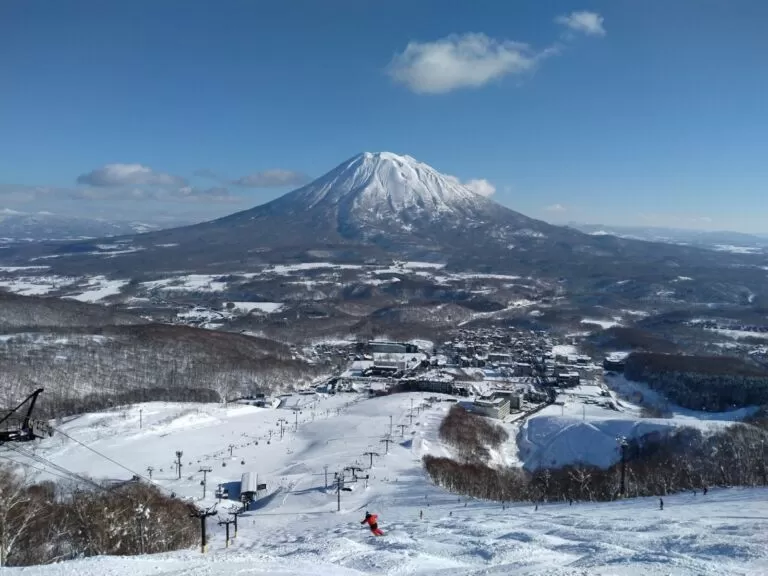
This table shows normals, not the actual snow or temperature of any given winter. What the numbers show is the difference in each town’s “winter character.” When you scout a move, it is worth seeing for yourself at least once how a town you saw in summer or autumn changes in winter. Snow removal, how roads freeze, and how hard it is to find time to go shopping are all invisible in snow-free seasons. For how to drive and keep warm in a campervan in winter, see the complete guide to winter campervan drives in Hokkaido, and for sorting out your worries, see our article collecting worries about winter campervan trips in Hokkaido.
If you rent in winter, note that some companies stop operating in winter. Which companies rent in winter, and what to check before booking, is summarized in our article on campervan rentals in Hokkaido that are available in winter.
What should I look at on scouting days? Hospitals, supermarkets, snow removal, winter roads, and commuting
When you arrive in a town, deciding on five things to look at makes towns easier to compare even after you visit several. Look up what you can through official searches beforehand, and spend your time on site on “what you can only confirm on foot.”
| What to look at | How to check beforehand | What to confirm on site |
|---|---|---|
| Hospitals | On the Ministry of Health, Labour and Welfare’s Medical Information Net (Navii), narrow down the town’s hospitals and clinics by department and reception hours | Whether the departments you would want as your regular doctors are in town. The route to the nearest night and holiday facility |
| Supermarkets and shopping | Check store locations on a map | The route from the planned home to the store. Whether you can make a round trip on a winter evening |
| Snow removal | Check whether prefectural roads get overnight snow removal on the Hokkaido Prefectural Government page. For town and city roads, ask the municipal desk | How the neighborhood roads and main roads look around 6 a.m. |
| Winter roads | Look up sections closed in winter | Whether your everyday destinations involve mountain passes or coastal sections |
| Commuting | Check the route to your workplace or school on a map | Actually drive the same route during the morning commute |
For hospitals, you can use the Hokkaido edition of the Medical Information Net (Navii). It is a search run by the Ministry of Health, Labour and Welfare, and you can narrow results by medical department, location and range, and reception hours, as well as by attributes such as holiday and night-time availability, foreign-language support, and care for seniors or children (checked 2026-10-23). If you enter the town’s name and check beforehand whether a clinic for your chronic condition is nearby, all that is left to confirm on site is how many minutes it takes to get there.
Snow removal is divided among road managers. According to the Hokkaido Prefectural Government page, on prefectural roads managed by the prefecture, Class 2 and Class 3 routes with fewer than 1,000 vehicles a day do not get overnight snow removal (22:00–5:00) (Hokkaido Prefectural Government page on snow removal routes, displayed as posted 2025-12-04, checked 2026-10-23). What condition is that road in on the morning after snow falls overnight? If you are staying in the town in your campervan, you can see the morning roads. For your commuting route, try driving it, if possible, on the morning after snowfall.
When you look into winter road closures, our article on Hokkaido roads that become impassable in winter is the place to start. Check sunset times too, and you will know how many hours you can be out and about in each town. Winter sunset times are in our article on winter sunset times in Hokkaido.
How many towns, and how? A touring plan capped at 200 km and 9 hours a day
This site caps driving on a campervan trip at 200 km and 9 hours a day. On a scouting trip this cap matters more than on a sightseeing trip, because you get out and walk around in each town and also stop by the town office and the hospital. If you look at a town while still tired from driving, your judgment dulls as well. If you cannot find a place to sleep within the cap, split the trip over more days.
Three rules of thumb are enough for planning your route.
- One town a day at most: the day you arrive is the day to see the town in the morning and at night. Move on to the next town the following day
- Do not see towns on travel days: if you pack sightseeing and visits into a travel day, you easily exceed the driving cap
- Work backward from the day you return to the airport for the last town: on the night before you return the vehicle, stay in a town you can reach the airport from with time to spare
If you rent and return at New Chitose Airport, list your candidate towns in order of closeness to the airport and tour them from the farthest back toward the nearest, and your last day’s drive will be shorter. Measure the distance between towns on a map before you leave and check that each stays within 200 km. Decide first on places where you can park the campervan to sleep. RV parks that are open in winter are in our article on RV parks open in winter. For etiquette when overnight parking at Michi-no-Eki (roadside rest stops), see 8 manners for overnight parking at a Michi-no-Eki.
Chotto Kurashi fits naturally at the end of this plan. After touring several towns, contact the desk of the town that made you think “this one,” and on your second trip stay a few days in that town’s housing. On the second trip, you can simply return the campervan.
What should I confirm with the rental company when renting to scout a move?
A scouting trip is longer than a sightseeing trip and is likely to include winter. Before you rent, confirm three points: the rental period, whether the company rents out vehicles in winter, and how winter tires are handled. For how to think about long rentals, start with the Hokkaido campervan one-month rental guide, and for costs, with the one-month cost simulation. For studless tires, you can compare companies in our article on tire-change timing and each rental company’s winter tire support. Rates change with season and number of days, so this article does not list them.
New Chitose Airport / Tokachi-Obihiro Airport
Rent the Cabcon “Cresson Journey”
Base yourself at New Chitose Airport and compare rates, vehicle types, and pickup locations all in one place.
See details at Moving Inn →Frequently Asked Questions (FAQ)
Where should I go first for advice when scouting Hokkaido for a move?
Either “Dosanko Exchange Terrace (Dosanko Koryu Terrace)” in Tokyo or the Sapporo desk, both listed on the Hokkaido Prefectural Government’s migration portal. Individual consultations require an advance reservation, and the Sapporo desk also offers online consultations. If you have already decided on a town, you can contact that municipality’s one-stop desk directly (Hokkaido Prefectural Government page and Let’s Live in Hokkaido!, checked 2026-10-23).
Can anyone use “Chotto Kurashi”? How long can I stay?
Conditions differ by municipality. The prefectural housing list gives the rate, available days, and usage restrictions for each municipality. For example, Iwamizawa gives a support payment for three or more consecutive nights, and says it can be used by people considering a move or living in two places (list on the Hokkaido Prefectural Government page, checked 2026-10-23). Confirm the conditions with the desk of the town you apply to.
Is a campervan suited to scouting a move?
It suits the stage of comparing several towns. You can tour without booking lodging every night, and you can also see the towns in the morning and evening. At the stage of settling into one town to look at daily life, Chotto Kurashi housing is the better fit.
Is a winter visit necessary? Which towns get the most snow?
Seeing it once gives you more to base your decision on. In Japan Meteorological Agency normals, maximum snow depth in February is 95 cm in Sapporo, 84 cm in Asahikawa, 22 cm in Muroran, and 26 cm in Kushiro. Even though Obihiro and Chitose get relatively little snow, the average January daily minimum temperature drops to around −13°C (Japan Meteorological Agency website, checked 2026-09-24).
How many towns can I cover in one trip?
One town a day is the guideline. Keep driving to 200 km and 9 hours a day, and make the day you arrive in a town the day you see it in the morning and at night. If you cannot find a place to sleep, split the trip over more days.
Next pages to read
- Hokkaido Campervan One-Month Rental Guide | Costs, Model Plans, and Points to Note [2026]
- Campervan Rentals in Hokkaido Available in Winter
- Before a Winter Campervan Trip in Hokkaido | Resolving Every Worry About Snowy Roads, Ice, Heating, and Overnight Parking [2026]
- Remote Work with a Campervan in Hokkaido | A Practical Workation Guide to Connectivity, Power, and Work Setup [2026]
- Campervan Trips in Hokkaido for Seniors | Sensible Itineraries, Driving, and Health Management
Book a Campervan in Hokkaido
Moving Inn New Chitose Airport supports English booking and offers airport transfers.