Furano & Biei Campervan Guide | Lavender, Autumn Colors, Blue Pond & Winter Snowfields [2026]
Lavender, autumn colors, Blue Pond lights and snowfields in Furano and Biei: peak dates, winter driving, campervan stays and routes, from official sources.
Pick a campervan by what matters to you.
Rent at New Chitose Airport
See only the rental bases in Chitose, where the airport is.
Rent in winter (Dec–Mar)
Companies that rent through winter, listed apart from those that close.
Guide price
Moving Inn New Chitose Airport: HIACE van conversion from ¥22,000 per night. 20–30% off when booked 60–90 days ahead (official rate table, checked 15 Oct 2026).
New Chitose Airport map for campervan travellers →
Before you book: with an International Driving Permit if your country is in the Geneva Convention (for example the US, Australia, Singapore); Taiwan, Switzerland, Germany, France, Belgium and Monaco need your licence plus a Japanese translation (Tokyo Metropolitan Police). Questions in English: Moving Inn on WhatsApp. Every roadside station (michi-no-eki) must have free 24-hour toilets, and Hokkaido has 128 of them (MLIT).
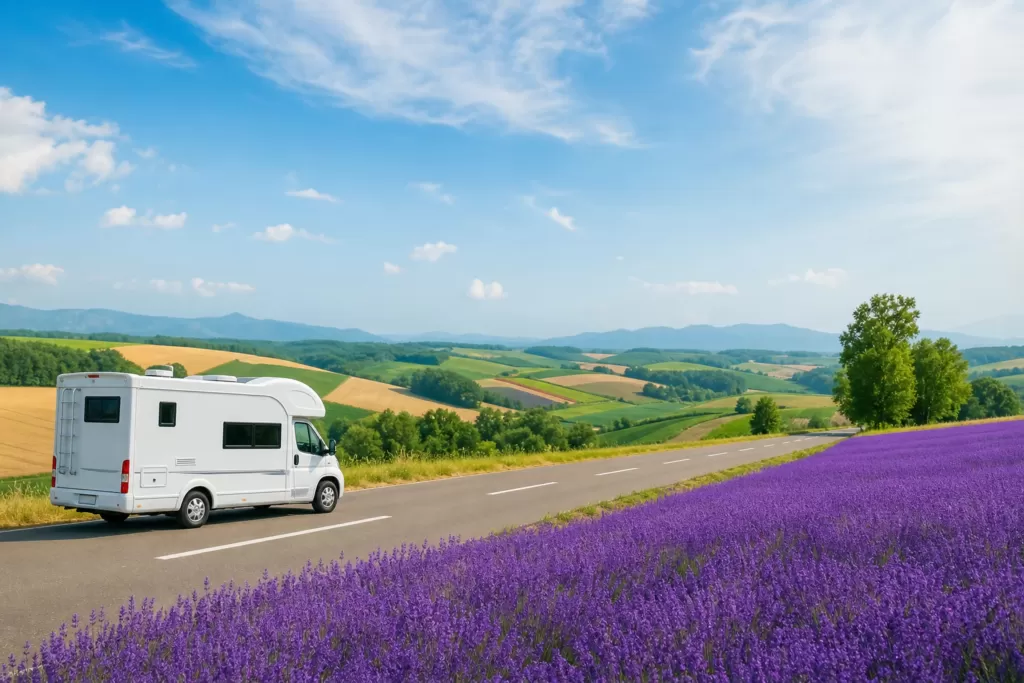
Furano and Biei draw visitors because the whole landscape changes with the seasons. Summer brings lavender and flower-covered hills from late June to early August. Autumn brings foliage and the Tokachi Mountain Range from late September through October. Winter brings snowfield hills plus the Blue Pond and Shirahige Falls illuminations.
This guide checks what you can see and when against official information from the Biei Town Tourism Association and the Furano Tourism Association, then sets out where to stay by campervan and model routes.
Biei’s Blue Pond is lit up every year for winter, when snow hides the water surface. The 2026-27 schedule had not been announced as far as we could confirm, so the dates here are from the previous season (2025-26). If you have never driven on snowy roads, first read Hokkaido winter worries: snowy roads, ice and heating.
Compare Hokkaido Campervan Rentals
Base yourself at New Chitose Airport and compare rates, vehicle types, and pickup locations all in one place.
Compare rental companies and rates →Tokachi-dake volcano update (checked October 8, 2026) Mt. Tokachi has been at Volcanic Alert Level 3 (do not approach the volcano) since September 12, 2026. Stay out of the area within about 3 km of the crater. Route 966 is closed between the Bogakudai gate and Tokachidake Onsen; you can still drive to Bogakudai. The Shirogane Onsen area is open as usual. Before you go, check the Japan Meteorological Agency’s Tokachi-dake volcano page (updated Mondays and Fridays at 16:00) and Biei Town’s notice.
What makes Furano and Biei special? Summer lavender, autumn foliage and winter snowfields make it a different place each season
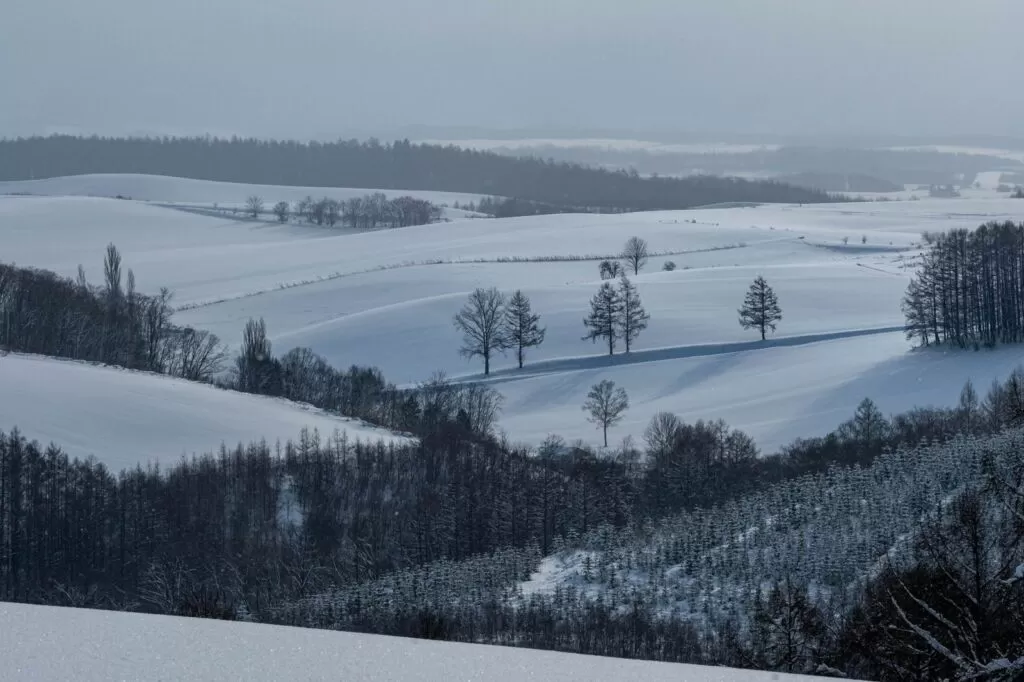
Summer lavender is centered on Furano, and the hill scenery on Biei. You can link the two towns in one trip (35.0 km, 33 minutes of driving from Furano Station to the Blue Pond; calculated with OSRM, snow-free conditions, no breaks, calculated 2026-10-07).
| Season | Highlights | Timing guide (official) |
|---|---|---|
| Summer | Lavender fields, flower hills, Blue Pond | Lavender from late June to early August, peak in mid-July |
| Autumn | Broadleaf foliage, Bogakudai on Mt. Tokachi, golden larch | Broadleaf trees from late September to October, peak at Bogakudai in early October, larch from late October to early November |
| Winter | Snowfield hills, Blue Pond and Shirahige Falls illuminations, Furano Ski Resort, Shirogane Onsen | Last illumination season ran October 24, 2025 to April 22, 2026; Furano Ski Resort opens November 28, 2026 |
| Spring | Hills after the thaw, before Lavender East opens | The Blue Pond can look less blue during snowmelt or heavy rain |
When is the lavender at its best? Blooming starts in late June, peaks in mid-July, and late varieties last into early August
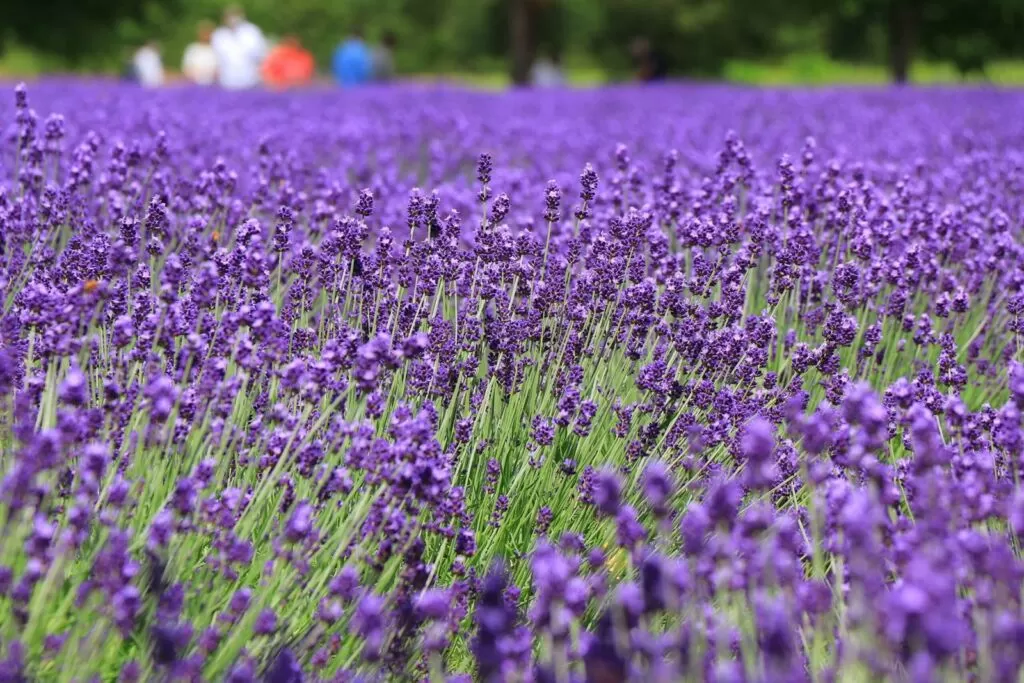
According to the Furano Tourism Association, early varieties begin blooming in late June. “Okamurasaki,” the variety with the largest planted area in the city, peaks around mid-July, and late varieties can be enjoyed until early August. It takes about 10 days from first bloom to peak, and this shifts with each year’s weather (Lavender bloom information, checked 2026-10-07).
At Farm Tomita’s Lavender East, 2026 ran from June 20 to July 20, 9:30 to 16:30, with the best viewing in early to mid-July. The official site says the season and hours change with the weather (Lavender East, checked 2026-10-07). Check the official site for next year’s dates before you leave.
Summer in Furano also has the Hokkai Heso Festival. Check that article for the dates. If you drive through the southern mountains, you can add the Minami-Furano and Karikachi Pass guide.
How should you drive the Biei hills? The fields are private land, so take photos from the paved road
The Biei hills are a sightseeing spot, but they are also farmers’ fields. The Biei Town Tourism Association urges visitors: “Never step into the fields. The fields are private land, and entering without permission is not allowed.”
Because germs on shoe soles can lead to crop disease, the association asks visitors to take photos from the paved asphalt (Touring the hills, checked 2026-10-07).
This applies equally to summer sunflower fields and winter snowfields. In winter, when snow hides the boundary between field and road, people are more likely to park on the shoulder and walk into the snow. Choose a viewpoint park or a spot with a car park.
The hill viewpoints the association lists include Shikisai-no-Oka, with 15 hectares of flower fields; Shinei-no-Oka Viewpoint Park, for the Tokachi Mountain Range and sunsets; and Sanai-no-Oka Viewpoint Park, popular with cyclists (same page, checked 2026-10-07). On narrow farm roads, a Vancon-class vehicle with some margin in height and width is easier to drive.
When should you see the Blue Pond? Blue in summer and autumn, lit up in winter when snow hides the water, and sometimes less blue in spring
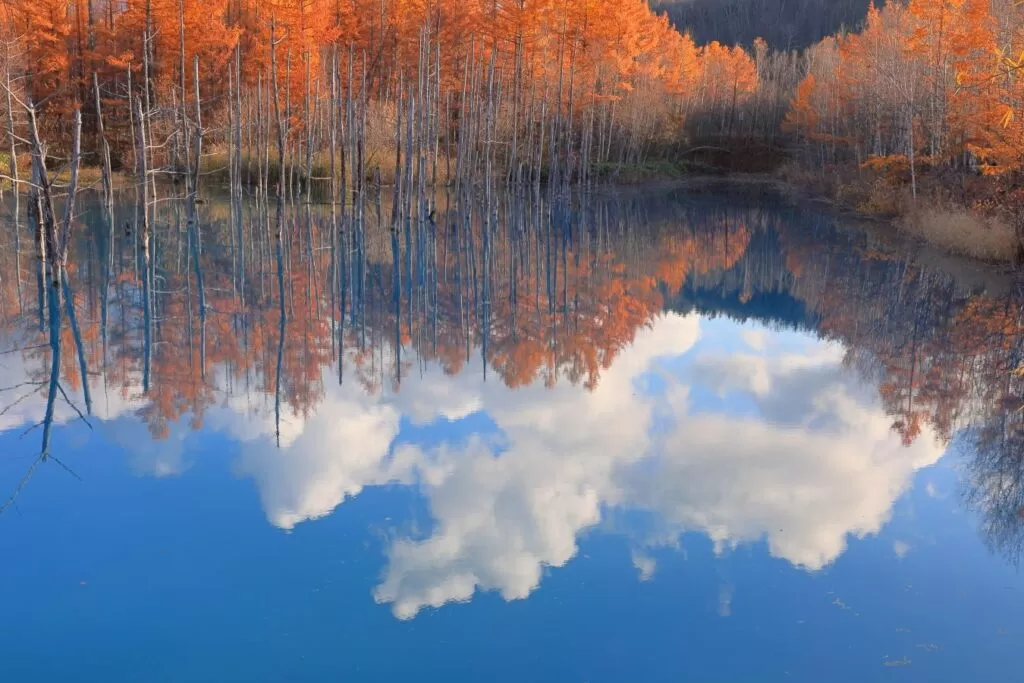
In summer and autumn, the surface of Shirogane Blue Pond looks cobalt blue. The tourism association gives early October as the autumn peak (Autumn scenes coloring the hills, checked 2026-10-07). In winter, snow cover hides the blue water, so the pond is lit up at night.
In spring, snowmelt or heavy rain can dilute the mineral concentration, so the water may turn cloudy or lose its blue color (Shirogane Blue Pond, checked 2026-10-07).
From July 1, 2026, parking costs ¥1,000 for standard cars and ¥6,000 for large vehicles of 6 m or more. Vehicles of 6 m or more must use a different entrance from standard cars (same page, checked 2026-10-07). Check your campervan’s total length before you rent it, because whether it exceeds 6 m changes your budget.
What is autumn like in Furano and Biei? Broadleaf trees in late September, Bogakudai in early October, larch in late October
The Biei Town Tourism Association gives late September through October for broadleaf foliage, and late October to early November for golden larch, a short window of about 7 to 10 days. It says there are days when you can see the larches lining the hill ridges, the green of autumn-sown wheat, and the freshly snow-capped Tokachi Mountain Range all at once (Autumn scenes coloring the hills, checked 2026-10-07).
At Bogakudai on Mt. Tokachi, at 930 m elevation, colors begin to appear in late September and peak in early October. The page says that right after the first snowfall, foliage and snow patches overlap. There is a free car park, but it is closed for some periods in winter (Mt. Tokachi Bogakudai, checked 2026-10-07). Since September 12, 2026, Mt. Tokachi has been at Volcanic Alert Level 3, and Route 966 beyond Bogakudai is closed (Bogakudai itself is open to traffic; Biei Town, checked October 8, 2026).
We could not confirm on the official page whether you can stay overnight at Bogakudai, so choose where to sleep from the accommodation section below.
Mornings and evenings are cold in this season. For temperature guidelines from November onward, see Hokkaido winter temperatures.
What can you see in Biei and Furano in winter? Snowfield hills, the Blue Pond and Shirahige Falls illuminations, skiing and hot springs
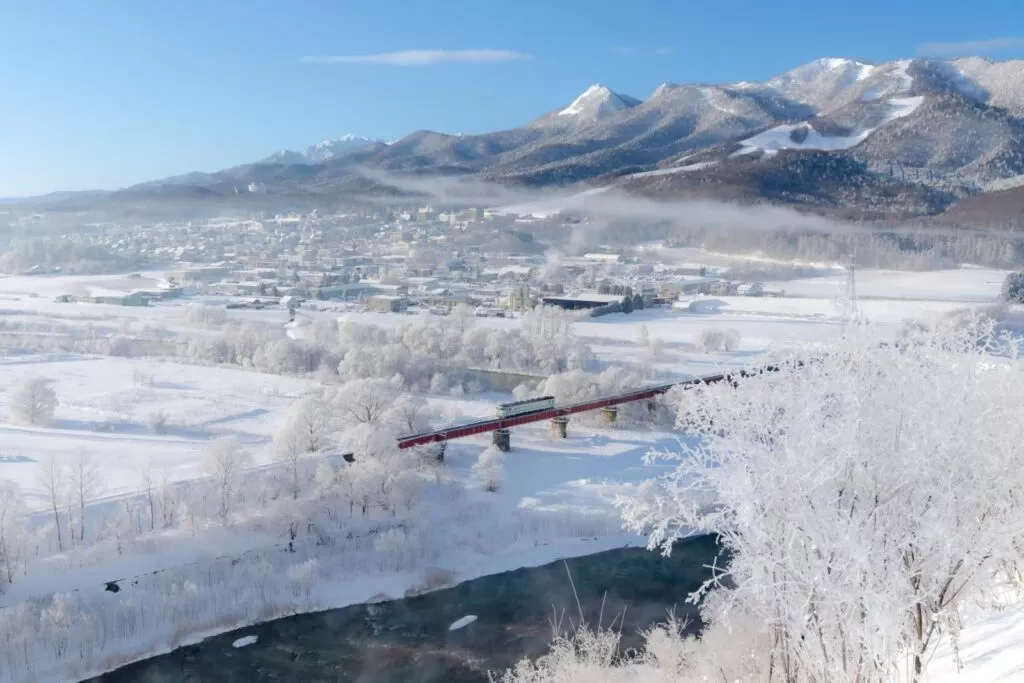
Blue Pond and Shirahige Falls illuminations
According to the Biei Town Tourism Association, the lights were on every day from sunset until 21:00 between October 24, 2025 (Fri) and April 22, 2026 (Wed). Start times are 17:00 in October, November and January, 16:30 in December, 17:30 in February, 18:00 in March, and 18:30 in April (Biei Illumination, checked 2026-10-07).
We could not find an announcement of the 2026-27 season’s period and hours when we checked. The figures above are from the previous season, and this season may differ. Shirahige Falls is illuminated all year: during the period above it follows the same times as the Blue Pond, and outside that period it is lit from 18:00 to 21:00.
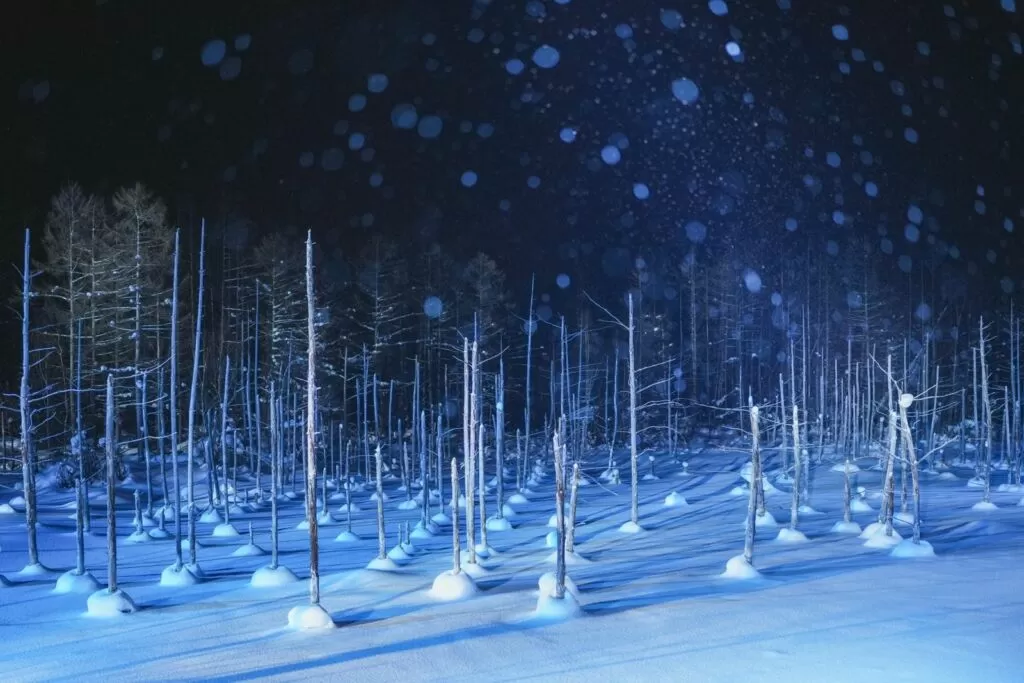
The official site says entering the pond area outside designated places is extremely dangerous. Do not go into the pond. The illumination may be canceled in bad weather.
Snowfield hills and winter activities
The tourism association lists snowshoeing in the Biei hills from late December to early March, snow rafting and sledding at the “Snowland” in Shikisai-no-Oka, and ice balls and snow candles lit up on the hills from late January to mid-February.
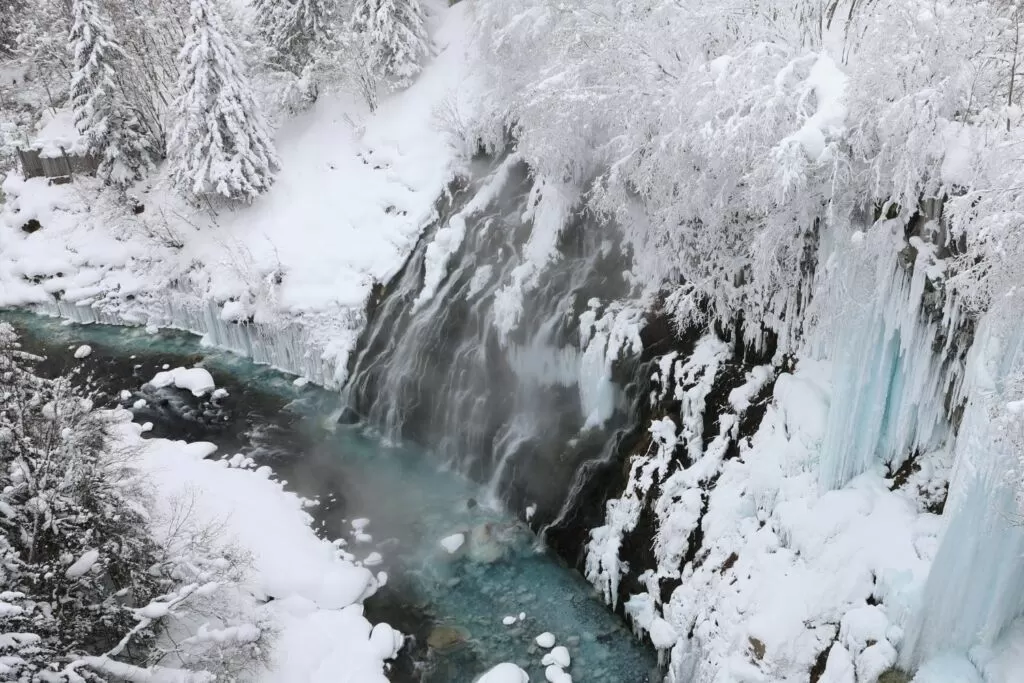
The page is dated 2024, so check dates and prices with the tourism association (0166-92-4378) before you leave (Winter fun, checked 2026-10-07).
Furano Ski Resort and Shirogane Onsen
Furano Ski Resort‘s 2026-27 season runs from November 28, 2026 to May 5, 2027. It has a vertical drop of 839 m and a longest run of 4,000 m, and the official site promotes the powder snow typical of a basin (Furano Ski Resort official site, checked 2026-10-07).
Opening dates for other ski resorts are listed in Hokkaido ski resort opening dates.
Day-use bathing at Shirogane Onsen: Aonobi Yuyu is 11:00 to 20:00 and ¥1,200 for adults; Mori no Shizuku RIN is 11:00 to 21:00 and ¥1,200 for adults; Hotel Park Hills is 11:00 to 21:00 and ¥1,530 for adults.
Yudokoro Tsuewasure no Yu is ¥800 for adults and closed on Tuesdays and Wednesdays in winter (Biei Town Tourism Association: hot springs, checked 2026-10-07).
The Kokumin Hoyo Center was listed as temporarily closed for equipment inspection, so call ahead if you want to use it in winter. For hot springs in general, see the hot spring guide for campervan trips.
Is winter driving okay? Know about closed roads, temperatures and early darkness first
Several mountain passes in Hokkaido close in winter. The closure periods are collected in Hokkaido roads closed in winter. Many sections have no announced 2026-27 dates, so check before you leave, including whether your route in this area is affected. Some viewpoints, such as Bogakudai, also close in winter.
Winter days are short, and the Blue Pond illumination starts in the 17:00 hour. You will drive back on dark snowy roads afterward, so stay nearby, for example at a Shirogane Onsen inn, and ask about parking when you book.
For guideline January sunset times, the 10-day winter Hokkaido model route has figures for Sapporo. For winter tires, heating and ice, check the article linked at the top first.
Winter attractions on the Asahikawa side include Asahiyama Zoo’s winter opening and penguin walk, the Asahikawa Winter Festival and the Sounkyo Ice Falls Festival. From Biei to Asahikawa Station is 25.7 km, 35 minutes of driving (calculated with OSRM, snow-free conditions, no breaks, calculated 2026-10-07).
Where can you park a campervan overnight? Whether a facility is open in winter varies
There are few places to stay in the center of Furano and Biei. We list only facilities confirmed on official pages. For winter operation, where nothing is stated we have written “Confirm when booking.”
| Facility | Location | Confirmed details | Winter |
|---|---|---|---|
| Michi-no-Eki Biei “Shirogane Birke” campervan site | Shirogane, Biei | From ¥3,500 per site (FY2026), AC power, water, wastewater disposal, vehicles up to 12 m | Not stated. Confirm when booking |
| RV Park Aizomeyui no Mori | Biei | Listed at ¥4,000 in our RV park list | Shown as open in winter in the list. Confirm when booking |
| Spa & Hotel Resort Furano Latelle (Yu-You Park) | Furano | 19 km from Furano Ski Resort | Year-round operation confirmed in Overnight parking at ski resorts in winter (checked 2026-09-14) |
During the lavender season (mid-July to early August), sites can fill up quickly. This table includes only facilities confirmed on official sources. For other options and winter operation, search the RV park list above.
How many nights from New Chitose? 2 to 3 nights in summer, and 2 nights and 3 days is realistic in winter
These are example trips with a campervan rented at New Chitose Airport. Distances and driving times are calculated from OpenStreetMap road data (OSRM) in snow-free conditions with no breaks (calculated 2026-10-07).
This site’s guideline is 200 km and 9 hours of driving per day, which is not an official standard. We do not plan routes that stretch beyond this limit. On snowy roads, trips take longer than shown.
Departing from New Chitose Airport
Head to Furano and Biei in a Moving Inn Campervan
Check vehicle types, rates, and availability on the official site.
See vehicles at Moving Inn →Summer: 2 nights, 3 days (lavender and hills)
| Day | Leg | Distance | Driving time | Overnight |
|---|---|---|---|---|
| Day 1 | New Chitose Airport → Farm Tomita (Nakafurano) | 139.7 km | 112 min | Around Furano |
| Day 2 | Farm Tomita → around Biei Station → Blue Pond | 25.4 km + 16.8 km | 20 min + 19 min | Biei / Shirogane |
| Day 3 | Blue Pond → around Asahikawa Station → New Chitose Airport | 41.4 km + 149.3 km | 52 min + 137 min | (Return) |
Winter: 2 nights, 3 days (Blue Pond illumination and skiing)
| Day | Leg | Distance | Driving time | Overnight |
|---|---|---|---|---|
| Day 1 | New Chitose Airport → Furano Station | 129.8 km | 104 min | Furano |
| Day 2 | Ski in Furano, then the Blue Pond in the evening (Furano Station → Blue Pond) | 35.0 km | 33 min | A Shirogane Onsen inn, etc. |
| Day 3 | Blue Pond → around Asahikawa Station → New Chitose Airport | 41.4 km + 149.3 km | 52 min + 137 min | (Return) |
If you use Asahikawa Airport, the drive to Biei shrinks to 14.3 km and 23 minutes (OSRM calculation, calculated 2026-10-07). Rental bases are covered in How to rent a campervan at Asahikawa Airport. If you want to extend your trip toward the Daisetsuzan side, see the Daisetsuzan and Sounkyo guide.
How much does it cost? About ¥100,000 to ¥190,000 for 2 people over 3 nights and 4 days
This table is a rough sense of market prices as of June 2026, not official rates. Rental fees vary widely by vehicle, company and season.
| Item | Estimate (2 people, 3 nights and 4 days) | Notes |
|---|---|---|
| Campervan rental | ¥80,000–¥140,000 | Varies widely from Vancon to Cabcon |
| Gasoline | ¥8,000–¥15,000 | Assumes 400 to 600 km in total. The main legs from the airport through Furano, Biei and Asahikawa and back to the airport add up to about 340 km, and this allows for detours |
| Accommodation (campsite / RV park) | ¥6,000–¥12,000 | Calculated at ¥2,000–¥4,000/night for 3 nights. Shirogane Birke is from ¥3,500 per site |
| Food | ¥12,000–¥20,000 | A mix of supermarkets, Michi-no-Eki and eating out |
| Sightseeing, baths, parking | ¥2,000–¥5,000 | Blue Pond parking, hot spring baths, etc. Blue Pond parking for large vehicles of 6 m or more is ¥6,000 |
| Estimated total | ¥108,000–¥192,000 | Total for 2 people. Varies with season and activities |
Both the lavender peak (mid-July) and the winter ski season tend to push up rental fees and accommodation. Check actual prices in the rental company comparison above.
What about vehicle type, trash and trouble? Use a smaller vehicle on farm roads, and plan to take your trash with you
Some farm roads in the hills are narrow, and passing oncoming traffic may require backing up and turning. For 2 to 3 people a Vancon suits best, and for 4 to 5 people or long stays a Cabcon, but with a Cabcon check the car park’s height limit at the entrance.
Many facilities expect you to take your trash with you, so keep trash bags in the vehicle. For vehicle trouble (a flat tire or a dead battery), first call the rental company’s emergency number that you noted at pickup. Check tourist information office hours on the official pages of the Biei Town Tourism Association and the Furano Tourism Association before you leave.
FAQ
Are Furano and Biei worth visiting outside summer?
Yes. In autumn, broadleaf foliage runs from late September to October. In winter there are the Blue Pond and Shirahige Falls illuminations and Furano Ski Resort (scheduled to open November 28, 2026). Check the official sources for the winter details before you leave.
When is the best time for lavender?
According to the Furano Tourism Association, early varieties bloom from late June, the peak is around mid-July, and late varieties last until early August. Farm Tomita’s Lavender East ran from June 20 to July 20 in 2026. Check the official site for next year’s dates.
Can I walk into the fields in Biei to take photos?
No. The Biei Town Tourism Association says the fields are private land and entering without permission is not allowed, and asks visitors to take photos from the paved asphalt. The same applies to winter snowfields.
Can I see the Blue Pond in winter?
Snow hides the blue of the water, but there is an illumination. Last season (2025-26) it ran from October 24, 2025 to April 22, 2026, from sunset to 21:00. We have not been able to confirm an announcement of the 2026-27 dates, so check the official source.
When should I go in autumn?
Broadleaf trees peak from late September to October, Bogakudai on Mt. Tokachi in early October, and larch for a short window from late October to early November. Timing shifts from year to year, so check the tourism association’s information just before you go.
What can I do in Biei and Furano in winter?
There is the Blue Pond illumination, Furano Ski Resort, day-use baths at Shirogane Onsen and snowshoeing. Snowshoeing is listed as late December to early March, but the page is dated 2024, so confirm dates and prices with the tourism association.
Is it okay to drive a campervan in winter?
You need to prepare for snowy roads, ice and darkness. Some roads are closed in winter. For winter driving worries and road closure periods, check the linked articles in the winter section of this article first.
Where can I stay?
Examples confirmed from official sources are the Michi-no-Eki Biei “Shirogane Birke” campervan site (from ¥3,500 per site, FY2026), RV Park Aizomeyui no Mori, and Furano Latelle. Winter operation varies by facility, so ask when you book.
How long does it take from New Chitose Airport?
It is 129.8 km and 104 minutes to Furano Station, and 139.7 km and 112 minutes to Farm Tomita (OSRM calculation, snow-free conditions, no breaks). On snowy roads it takes longer.
How much does it cost?
As a guideline, the total for 2 people over 3 nights and 4 days is ¥108,000–¥192,000. These are not official rates. Blue Pond parking is ¥6,000 for large vehicles of 6 m or more.
What type of vehicle suits best?
The farm roads in the hills are narrow, so for 2 to 3 people a Vancon is easier to drive. With a Cabcon, check the car park’s height limit at the entrance.
Compare Hokkaido Campervan Rentals
Base yourself at New Chitose Airport and compare rates, vehicle types, and pickup locations all in one place.
Compare rental companies and rates →Pages to read next
- Hokkaido roads closed in winter: winter closure sections and reopening dates
- A 10-day winter Hokkaido model route: two routes, for January and February
- How to rent a campervan at Asahikawa Airport: a starting point for Furano and Biei
- Asahiyama Zoo’s winter opening: 35 minutes from Biei
- Sounkyo Ice Falls Festival: another winter destination on the Asahikawa side
Book a Campervan in Hokkaido
Moving Inn New Chitose Airport supports English booking and offers airport transfers.
Pick a campervan by what matters to you.
Rent at New Chitose Airport
See only the rental bases in Chitose, where the airport is.

![When and Where Can You See Harbor Seals at Cape Erimo? Kaze no Yakata Official Information, Viewing Season, and Windy-Day Notes [2026-27]](https://hokkaido-campingcar.jp/wp-content/uploads/2026/10/erimo-cape-lighthouse-768x511.jpg.webp)
![Where and Under What Conditions Can You See Diamond Dust in Hokkaido? How Cold a Morning It Takes, and Where It Appears [2026-27]](https://hokkaido-campingcar.jp/wp-content/uploads/2026/10/hokkaido-diamond-dust-nayoro-768x512.jpg.webp)
![Can You Drive to Hokkaido Jingu for Hatsumode? Parking, Crowds, and Where to Park and Walk [2027]](https://hokkaido-campingcar.jp/wp-content/uploads/2026/10/hokkaido-jingu-winter-torii-768x504.jpg.webp)
![Hokkaido Roads Over New Year [2026-27] | Expressway Sections Prone to Blizzard Closures, Forecast Congestion Days, No Holiday Discount, and New Chitose Airport Parking](https://hokkaido-campingcar.jp/wp-content/uploads/2026/10/hokkaido-winter-rural-road-edge-markers-768x432.jpg.webp)
![Where to See Sea Smoke (Kearashi) in Hokkaido: Rumoi’s Ogon-misaki and the Morning Conditions [2026-27]](https://hokkaido-campingcar.jp/wp-content/uploads/2026/10/rumoi-kearashi-sea-smoke-768x511.jpg.webp)
![Geminid Meteor Shower 2026 in Hokkaido: Peak Around 23:00 on December 14, Sapporo Moonset 20:40, and Staying Warm in a Winter Campervan [2026]](https://hokkaido-campingcar.jp/wp-content/uploads/2026/10/geminids-2026-hokkaido-768x575.jpg.webp)