Hokkaido Domestic Ferry Guide for Campervans: Hakodate–Aomori, Oma & Esashi–Okushiri Vehicle Fares Compared (2026)
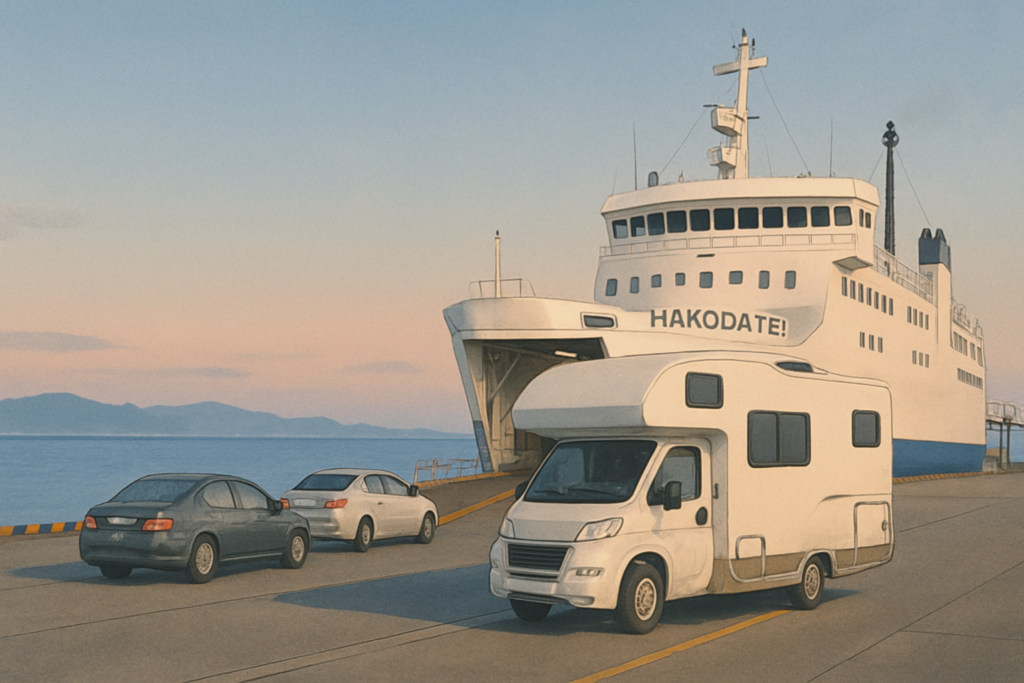
Hakodate Port handles 14 ferry departures a day. Tsugaru Kaikyo Ferry runs six round trips between Hakodate and Aomori and two round trips between Hakodate and Oma, while Seikan Ferry runs eight sailings a day between Hakodate and Aomori (confirmed on each company’s official site, August 1, 2026). From Esashi Port, Heartland Ferry also runs a route to Okushiri Island, letting you cross from southern Hokkaido to the island with your campervan still loaded.
Even so, vehicle transport fares change sharply with vehicle length. On the Hakodate–Aomori route, a vehicle under 6m and a 6–7m cabcon can differ by more than ¥15,000 one way (Tsugaru Kaikyo Ferry’s fare table for July 18–September 30, 2026). This guide focuses only on the short intra-Hokkaido routes and covers each company’s fares and how boarding day actually works. Ferries between Honshu and Hokkaido are covered separately in our Honshu round-trip ferry guide, so check that one instead if that’s what you need.
Which ferry from Hakodate or Esashi should you use?
Vehicle-carrying ferries within Hokkaido fall into three main groups: Hakodate–Aomori, Hakodate–Oma, and Esashi–Okushiri Island. Routes from Wakkanai to Rebun/Rishiri and from Haboro to Teuri/Yagishiri also exist, and those are covered in detail in our Rebun and Rishiri Islands guide and Teuri and Yagishiri Islands guide. Here’s how the whole picture compares.
| Route | Operator | Crossing time | Sailings (approx.) | Vehicle fare, under 6m, peak season |
|---|---|---|---|---|
| Hakodate⇔Aomori | Tsugaru Kaikyo Ferry | 3h 40m | 6 round trips/day | ¥28,600 (Period C) |
| Hakodate⇔Aomori | Seikan Ferry | approx. 3h 50m | 8 sailings/day | ¥25,300 (peak season) |
| Hakodate⇔Oma | Tsugaru Kaikyo Ferry | 90 min | 2 round trips/day | ¥22,870 (Period C) |
| Esashi⇔Okushiri Island | Heartland Ferry | approx. 2h 20m | 1–2 round trips (seasonal) | ¥35,440 (Jul–Sep 2026) |
*Vehicle fares are one-way estimates for the under-6m bracket; passenger fares may apply separately. Each company defines its own seasonal periods, so always confirm the current fare on the official site before booking (each operator’s official site, confirmed August 1, 2026).
Choosing by destination
If you’re heading straight for Aomori city or the Shinkansen station, Hakodate–Aomori is the obvious pick. If you want to work Shimokita Peninsula or Mount Osore into your route, Hakodate–Oma is worth a look. Okushiri Island is a destination in itself, so the Esashi–Okushiri route is the only option there. Routes from Wakkanai and Haboro are covered in a later section. Since two companies compete on Hakodate–Aomori, it’s fine to pick whichever sailing fits your schedule first and choose the operator around it.
Hakodate–Aomori: Tsugaru Kaikyo Ferry or Seikan Ferry?
Two companies compete on the same Hakodate–Aomori crossing. Tsugaru Kaikyo Ferry runs six round trips a day and offers plans such as a round-trip discount (10% off the return fare) and an online booking discount. Seikan Ferry runs eight sailings a day and supports unaccompanied vehicle transport, where the vehicle travels without the driver on board. Its round-trip discount is also 10% off the return fare (Seikan Ferry official site, confirmed August 1, 2026).
One-way vehicle fares for a vehicle under 6m: Tsugaru Kaikyo Ferry charges ¥21,260 in Period A (Oct 1–Dec 26), ¥25,450 in Period B (Jun 1–Jul 23, Aug 18–Sep 30, and Dec 27–31), and ¥28,600 in Period C (Jul 24–Aug 17). Seikan Ferry charges ¥20,700 in the off-peak season (Oct–May) and ¥25,300 in peak season (Jun–Sep) (both companies’ official fare pages, confirmed August 1, 2026). Tsugaru Kaikyo Ferry’s published calendar for January–May is thin, so if you’re sailing then, check the current calendar on the official site.
Compare Hokkaido Campervan Rentals
Base yourself at New Chitose Airport and compare rates, vehicle types, and pickup locations all in one place.
Compare rental companies and prices →How much does vehicle length actually change the fare?
Ferry vehicle fares step up in brackets tied to overall length. On Seikan Ferry’s Hakodate–Aomori route, the under-4m, under-5m, and under-6m brackets look like this.
| Vehicle length | Peak season (Jun–Sep) | Off-peak (Oct–May) |
|---|---|---|
| Under 4m | ¥21,100 | ¥17,200 |
| Under 5m | ¥23,100 | ¥19,100 |
| Under 6m | ¥25,300 | ¥20,700 |
(Seikan Ferry official fare page, confirmed August 1, 2026. Vehicles 6m and over use a separate table; for Jul–Sep 2026 the 6–7m bracket totals ¥43,130.)
Every extra meter pushes the fare up by several thousand yen, so it’s worth knowing which bracket your cabcon falls into. The same thing happens on Tsugaru Kaikyo Ferry’s Hakodate–Aomori route. In Period C (Jul 24–Aug 17), a vehicle under 6m costs ¥28,600, but a 6–7m vehicle costs a base fare of ¥33,550 plus a ¥10,740 fuel-price adjustment, for a total of ¥44,290 — a ¥15,690 difference for one extra meter (same operator’s official fare page, confirmed August 1, 2026). Popular cabcon models such as the “Cresson Journey” and “Cordbanks” typically run 5.8–6.5m overall, so whether they land in the under-6m or over-6m bracket makes a real difference to the fare.
Note that Tsugaru Kaikyo Ferry’s Hakodate–Oma vehicle fare includes one driver’s standard-class passenger fare. Whether the driver’s fare is bundled into the vehicle fare varies by route and company for Hakodate–Aomori and other operators, so it’s worth confirming when you book.
- Check the “length” field on your vehicle registration first
- Also measure the actual overall length including the spare tire, rear ladder, or bike rack
- Vehicles near the 6m line are sometimes measured on-site and reclassified, so build in some margin
- The fuel-price adjustment changes with the season, so check the current figure again just before booking
Is the 90-minute Hakodate–Oma crossing worth using?
Oma is the northernmost port on Honshu. Tsugaru Kaikyo Ferry runs two round trips a day, taking 90 minutes each way (operator’s official site, confirmed August 1, 2026). The under-6m vehicle fare is ¥17,000 in Period A, ¥20,350 in Period B, and ¥22,870 in Period C — several thousand yen cheaper than the same company’s Hakodate–Aomori route. With only a third as many sailings as the Aomori route, though, missing your boat means a longer wait for the next one.
Moving on from Oma toward Honshu means looping around the Shimokita Peninsula rather than a straight road connection. Cape Oma, the northernmost point of Honshu, sits right by the port, and Mount Osore and the Shimokita coastline are within reach a little further south. This route suits a trip built around Shimokita and Osore, but if you want the fastest link to Aomori city or the Shinkansen station, Hakodate–Aomori remains the more efficient choice.
What does it cost to take your campervan from Esashi to Okushiri Island?
Okushiri Island is the only outlying island you can reach with your vehicle directly from southern Hokkaido, via Esashi Port and Heartland Ferry. From central Hakodate, Esashi Port is roughly 70km by National Route 227 — plan on 1.5 to 2 hours of driving. The crossing itself takes about 2 hours 20 minutes (operator’s timetable, confirmed August 1, 2026). Sailings vary by season: winter (January–March and December) typically has one sailing a day, while Golden Week and the summer holidays bring two round trips a day.
The vehicle fare below is the schedule in effect from July 1 to September 30, 2026, broken down by vehicle length.
| Vehicle length | Jul–Sep 2026 | Other periods (reference) |
|---|---|---|
| Under 3m | ¥16,720 | ¥16,070 |
| Under 4m | ¥21,780 | ¥20,930 |
| Under 5m | ¥27,570 | ¥26,490 |
| Under 6m | ¥35,440 | ¥33,480 |
| Under 7m | ¥42,290 | ¥39,960 |
| Under 8m | ¥49,140 | ¥46,440 |
(Heartland Ferry official fare table, confirmed August 1, 2026. The exact dates for the “other periods” column aren’t stated on the page, so check the current fare table closer to your travel date. The 2nd-class adult passenger fare is ¥3,570.)
Okushiri Island also suffered major damage in the 1993 Hokkaido Nansei-oki earthquake. The Aonae district has a seawall and memorial, and the island’s southern tip is marked by the striking rock formation Nabetsuri-iwa. The loop road around the island runs about 80km, small enough to circle by car in a single day.
Thinking about the island routes from Wakkanai or Haboro too?
Hakodate and Esashi aren’t the only departure points within Hokkaido. From Wakkanai, ferries run to Rebun and Rishiri Islands; from Haboro, ferries run to Teuri and Yagishiri Islands, both with vehicle transport available. Hakodate and Esashi sit in southern Hokkaido, while Wakkanai and Haboro sit in the north, so if your trip is anchored around New Chitose or Asahikawa, the northern islands are the practical fit; if you’re based in Hakodate or the south, the routes in this guide make more sense. Fares and booking tips for the Wakkanai–Rebun/Rishiri crossing are in our Rebun and Rishiri Islands campervan guide, and whether vehicles can cross from Haboro plus overnight parking on the mainland side are covered in our Teuri and Yagishiri Islands campervan guide. If you want to compare every outlying island route in Hokkaido alongside the Hakodate/Esashi routes, read those two as well.
How does vehicle boarding actually work on the day?
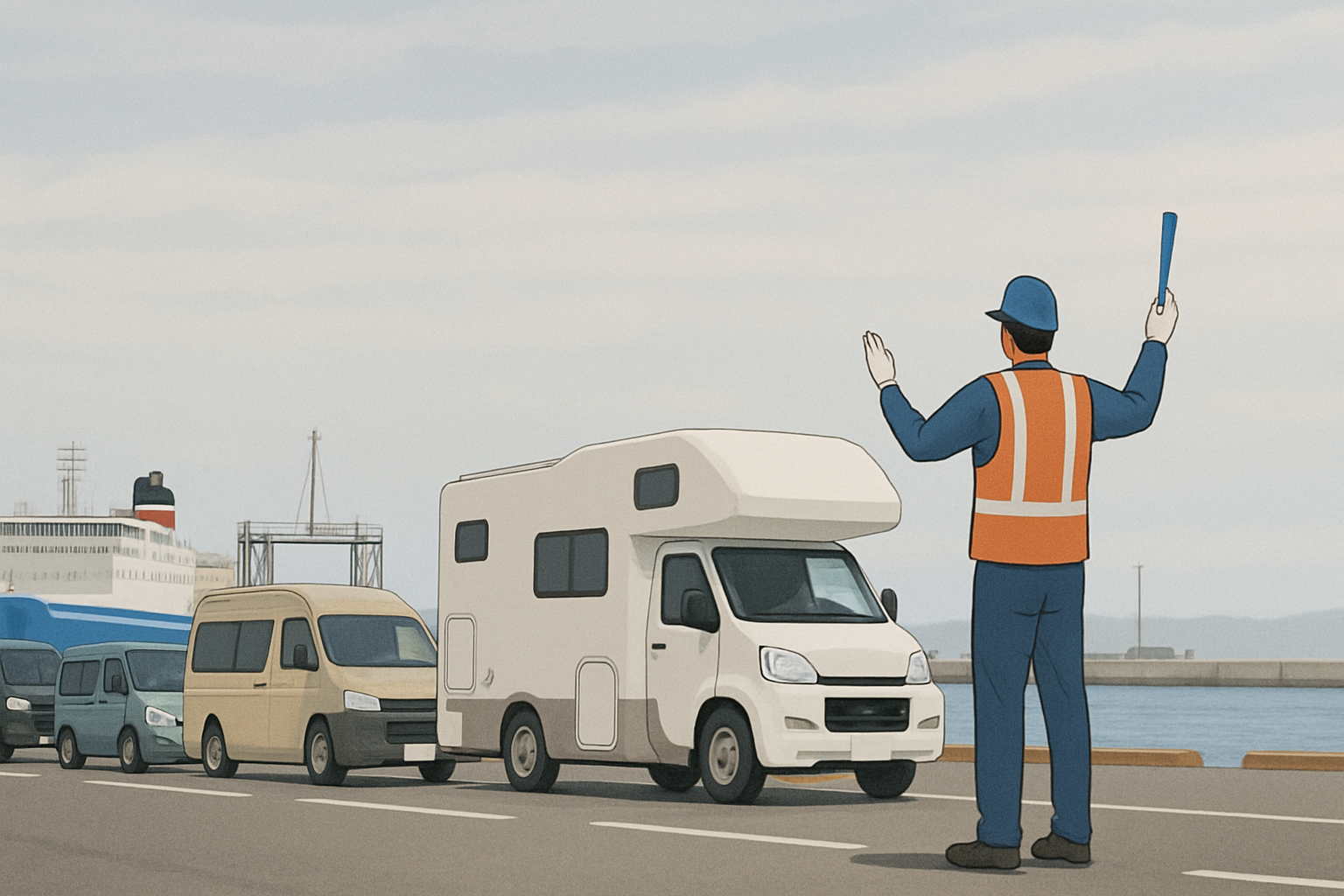
Check in at the ferry terminal roughly 60–90 minutes before departure, then drive onto the vehicle deck under staff direction. You’ll often be asked to show your vehicle registration and driver’s license, so keep them somewhere easy to reach before boarding. On many routes you can’t return to the vehicle deck once under way, so move valuables, motion-sickness medication, and a jacket to where you’ll be sitting before boarding. Disembarking also follows staff instructions, in order.
Seikan Ferry supports unaccompanied vehicle transport for everything except motorcycles: the driver rides in the passenger cabin, and experienced staff handle loading and unloading the vehicle (operator’s official site, confirmed August 1, 2026). If you’re planning to pick up a campervan at Hakodate Airport and head straight for a ferry in southern Hokkaido, it helps to check the pickup-to-boarding logistics in our Hakodate Airport campervan rental guide ahead of time.
Could you be turned away over vehicle height or width?
Every company’s fare table is based on overall length, but there are also limits on height and width. If the dimensions you declared when booking don’t match what’s measured on site, you may be reclassified into a different fare bracket or, in some cases, turned away. Solar panels and roof racks can push a vehicle’s actual height above the catalog figure, so it’s worth double-checking.
- Declare the actual measured length, height, and width when booking
- Factor in the height of any roof rack or solar panel as part of the vehicle’s height
- If you’re unsure, call the terminal ahead of booking to confirm
- Don’t rely on catalog figures alone if you’ve changed or swapped vehicles this year
How early should you book during peak season?
Tsugaru Kaikyo Ferry’s Period C (July 24–August 17, 2026) is both the most expensive stretch of the year and the time when vehicle-deck space fills up fastest. If you know you’ll be using an intra-Hokkaido ferry around the Obon holiday, put in a tentative booking as soon as your dates are set so you still have options. Seikan Ferry’s peak season (June–September) fills up in a similar way, with weekend departures going first.
Some companies offer an online booking discount, so it’s worth comparing that against a phone booking before deciding. On the Esashi–Okushiri route, the extra sailings only run during the summer holidays, so those added slots tend to disappear early too. Since a campervan takes up more vehicle-deck space than an ordinary car, “the boat was full” is a more common problem for larger vehicles than for passenger cars. If your dates have any flexibility, shifting off the absolute peak by even a single day can make booking noticeably easier.
New from New Chitose Airport — Available from June 2026
Rent the Cabcon “Cresson Journey”
Base yourself at New Chitose Airport and travel all across Hokkaido by campervan.
See details at Moving Inn →Can you find overnight parking or RV parks near the ports?
If you’re catching an early-morning or late-night sailing, plan where you’ll stay the night before too. Neither Hakodate Port nor Esashi Port is guaranteed to have nearby overnight parking, so it’s worth picking a Michi-no-Eki or RV park in advance. Overnight parking spots and RV parks around Hakodate and Esashi are covered in our Hokkaido RV Park guide. If you’re touring southern Hokkaido before catching a ferry, our Southern Hokkaido campervan route guide (Japanese) is also worth reading for planning the drive to the port.
The area around Esashi Port doesn’t have a large number of facilities, so it’s more realistic to take care of water refills and bathing in Esashi town or back in Hakodate before heading to the port. Okushiri Island has its own Michi-no-Eki and bathing facilities, but on days with fewer sailings, plan your on-island time backward from the ferry schedule.
What happens if bad weather cancels your sailing?
The Tsugaru Strait and the Okushiri Channel are prone to seasonal winds, especially in winter, and cancellations or delays do happen. How rebooking or refunds are handled varies by company and fare type, so it’s worth confirming when you book. For guidance on judging bad weather and preparing to sleep in your vehicle, see our Hokkaido campervan bad-weather guide (Japanese). Building at least half a day of slack into your itinerary makes it much easier to recover on the next sailing if one gets cancelled.
Frequently Asked Questions
Q: For Hakodate–Aomori, should I choose Tsugaru Kaikyo Ferry or Seikan Ferry?
If frequency matters most, Seikan Ferry’s 8 sailings a day is the stronger option. If you value plan flexibility such as round-trip and online discounts, Tsugaru Kaikyo Ferry is worth considering. If you want unaccompanied vehicle transport, Seikan Ferry supports it (confirmed August 1, 2026).
Q: How much does vehicle transport cost for a campervan?
On Hakodate–Aomori, expect roughly ¥20,000–¥29,000 one way for a vehicle under 6m, and around ¥44,000 for a 6–7m vehicle (it varies by season and company). On Esashi–Okushiri, the under-6m fare runs roughly ¥33,000–¥35,000 one way. For an exact figure, pick your sailing date first and check the fare table on the operator’s official site.
Q: What’s the advantage of the Hakodate–Oma route?
It’s a short 90-minute crossing and several thousand yen cheaper than Hakodate–Aomori. It suits a route that continues on toward the Shimokita Peninsula, but keep in mind there are only two round trips a day.
Q: Does the Esashi–Okushiri Island ferry run year-round?
Yes, it runs year-round, though the number of sailings changes with the season. Winter is typically one sailing a day, rising to two round trips a day during Golden Week and the summer holidays. Those extra sailings fill up quickly, so book early for them.
Q: What’s the process for vehicle transport on the day?
Check in at the terminal 60–90 minutes before departure, then drive onto the vehicle deck under staff direction. Many routes don’t allow you back onto the vehicle deck once under way, so move valuables to where you’ll be sitting before boarding. Disembarking also follows staff instructions.
Q: Will I be turned away if my vehicle is over 6m long?
You won’t be turned away for that alone — you’ll simply move into a higher fare bracket. However, height and width limits do apply, and if what you declared at booking doesn’t match the on-site measurement, you may be reclassified or, in some cases, refused boarding. Double-check the measured height if you’re carrying a roof rack or solar panel.
Q: What happens if the ferry is cancelled?
Rebooking and refund policies vary by company and fare type, so it’s worth confirming the terms when you book. Cancellations are more common in winter due to seasonal winds, so it’s a good idea to build about half a day of slack into your itinerary.
Book a Campervan in Hokkaido
Moving Inn New Chitose Airport supports English booking and offers airport transfers.