Yukimushi (Snow Bugs) in Hokkaido: When They Fly in 2026 and Do They Mean Snow Is Coming?

What Hokkaido locals call “yukimushi” (snow bugs) is an aphid wrapped in white waxy fluff, formally named Prociphilus oriens. In lowland areas such as Sapporo, they become noticeable from mid to late October. The insect pest guide from the Hokkaido Research Organization’s Forestry Research Institute lists the period when the winged adult females appear as “mid to late October” (Hokkaido Research Organization, Forestry Research Institute – Prociphilus oriens).
“When the snow bugs fly, the first snow is near” holds up well as a season-level rule of thumb, but the number of days varies widely. The Hokkaido government’s Rumoi Agricultural Extension Center writes that “once the snow bugs start flying, snow begins falling even in lowland areas within two to four weeks” (Rumoi Agricultural Extension Center – Prociphilus oriens (snow bugs)).
An article from Hokkaido University’s CoSTEP program cites a folk saying that “snow falls one to two weeks after the snow bugs appear” (Ii ne! Hokudai – The season when snow bugs dance). Even among official sources, the range spans one to four weeks. That gap is our starting point.
The Japan Meteorological Agency’s normal (average) first-snow date is October 28 for Sapporo and October 19 for both Asahikawa and Wakkanai (Japan Meteorological Agency, Sapporo Regional Headquarters – Normal dates for first snow, frost, and ice). The mid-to-late-October window when snow bugs fly lines up almost exactly with the normal first-snow dates. The snow bugs aren’t forecasting snow — they’re two different yardsticks measuring the same “threshold of winter.” That’s the closest thing to the real picture.
This article verifies, using official sources, what snow bugs actually are, when they fly, and how they relate to the first snowfall — then connects that to what the sighting signals for anyone touring Hokkaido by campervan in October. If your travel dates are still flexible, you might first read The Best Time for a Hokkaido Campervan Trip, which lines up seasonal climate and crowding; it makes choosing when to go easier.
All sources in this article were checked on September 24, 2026.
Compare Hokkaido Campervan Rentals
Base yourself at New Chitose Airport and compare rates, vehicle types, and pickup locations all in one place.
Compare rental companies and vehicle types →What exactly are snow bugs? An aphid wrapped in white fluff, formally named Prociphilus oriens
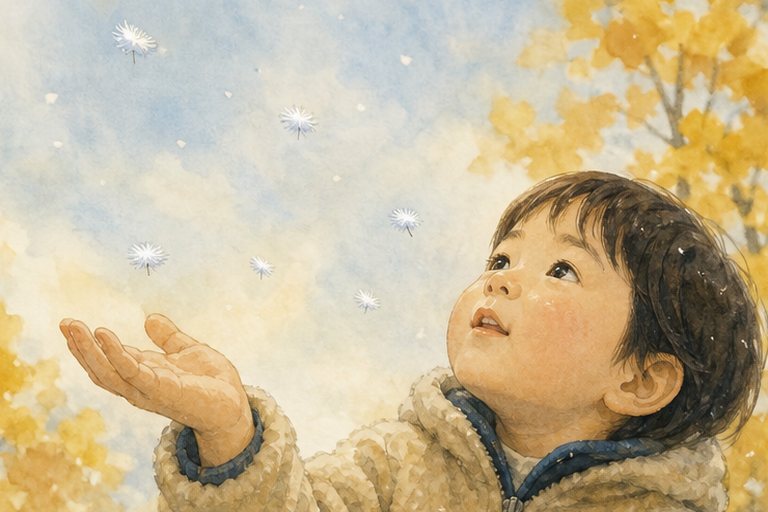
Let’s start with the name. The Sapporo Museum Activity Center explains: “What you’re calling ‘yukimushi’ is actually a kind of insect, an aphid,” and “its formal Japanese name is ‘Todonone-oowatamushi’ (Prociphilus oriens)” (City of Sapporo – Why do so many snow bugs fly around in autumn?). The white fluff covering its body isn’t hair — it’s “waxy cotton-like fibers secreted from inside the body” (same page).
Taxonomically it belongs to the order Hemiptera, family Aphididae. It reaches at most about 4mm in length. In spring it lives on trees in the olive family such as Japanese ash, Manchurian ash, and Japanese tree lilac; from summer into autumn it lives on the roots of Sakhalin fir. Its range covers Hokkaido, Honshu, Sakhalin, the Korean Peninsula, and Siberia (Hokkaido Research Organization, Forestry Research Institute – Prociphilus oriens).
In other words, it isn’t unique to Hokkaido. Even so, few places see streets that look like they’re covered in snow — enough that a Hokkaido University CoSTEP article calls it “an autumn tradition that every Hokkaido resident knows” (Ii ne! Hokudai – The season when snow bugs dance).
When do snow bugs fly? Mid to late October in lowland areas like Sapporo, on days when the cold starts to bite
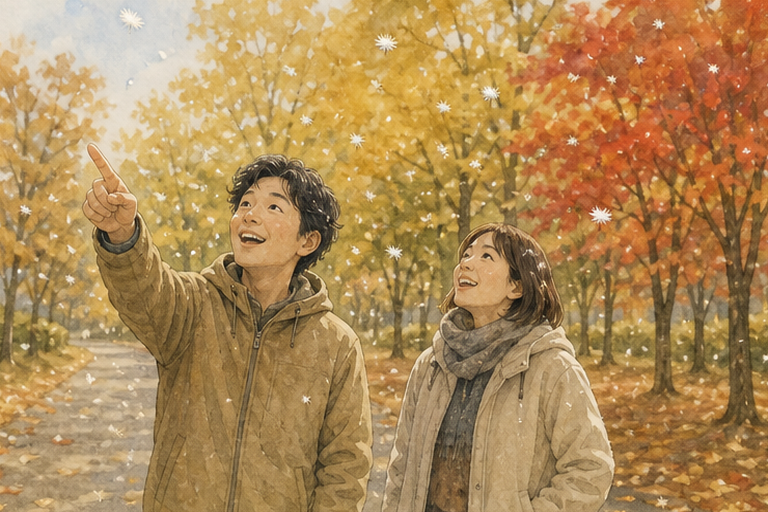
The basis for the timing is the life-cycle table in the Forestry Research Institute’s pest guide. Prociphilus oriens becomes a “winged adult female in mid to late October,” and egg-laying adults can be seen from October through November (Hokkaido Research Organization, Forestry Research Institute – Prociphilus oriens). The City of Sapporo’s page similarly notes they’re seen on “cold autumn days before the snow falls” (City of Sapporo – Why do so many snow bugs fly around in autumn?).
One example from northern Hokkaido: a photo of snow bugs posted by the Hokkaido government’s Rumoi Agricultural Extension Center was taken in Haboro on October 16 and 17, 2009 (Rumoi Agricultural Extension Center – Prociphilus oriens (snow bugs)). A concrete case of snow bugs already flying in a northern Hokkaido town by mid-October.
That said, there’s no official weather-station-style observation of snow bugs. The Japan Meteorological Agency’s seasonal biological observations were cut down to just 6 plant species and 9 phenomena starting in January 2021, removing animals from the list (Japan Meteorological Agency – Changes to seasonal biological observation categories and phenomena (November 10, 2020, PDF)). First snow has a “normal date”; snow bugs don’t. Any “they flew on X date this year” you see online is an individual or media observation, nothing more.
If you want to see snow bugs in 2026, the target window is roughly one to two weeks before Sapporo’s normal first-snow date of October 28 — that is, mid to late October (Japan Meteorological Agency, Sapporo Regional Headquarters – Normal dates for first snow, frost, and ice). Building in time to walk through parks or riverside paths in Sapporo or Asahikawa raises your odds of an encounter. We’ll explain why in the next section.
Why do they swarm so heavily only in autumn?
The answer is: it’s moving season. Prociphilus oriens shuttles between two kinds of trees over the course of a year. According to the Forestry Research Institute’s guide, it overwinters as eggs in the bark crevices of olive-family trees, hatching from mid-April to early May. From late June to early July it moves to Sakhalin fir, giving birth to nymphs at the base of the roots and building up generations there through summer (Hokkaido Research Organization, Forestry Research Institute – Prociphilus oriens).
Then, in mid to late October, winged females leave the Sakhalin fir all at once and head back to olive-family trees such as Japanese ash to lay eggs. The snow bugs you see in autumn are “the Prociphilus oriens migrating from Sakhalin fir to Japanese ash trees” (City of Sapporo – Why do so many snow bugs fly around in autumn?).
The winged insects at this stage “take flight coated in white waxy material,” which is why they look like snow (Rumoi Agricultural Extension Center). Population-heavy years stand out even more; the Forestry Research Institute’s explainer notes that “in outbreak years, enormous numbers of snow bugs fly around Japanese ash trees in late autumn” (Hokkaido Research Organization, Forestry Research Institute – Prociphilus oriens explainer (PDF)).
One useful fact for travelers falls out of this: snow bugs are densest near Japanese ash and Sakhalin fir. Japanese ash “grows in lowland wetlands” (City of Sapporo, same page), so your odds of encountering snow bugs go up near riverside parks or Michi-no-Eki roadside stations close to wetlands. That’s the same map whether you want to see them or avoid them.
Is “snow bugs flying means first snow is near” actually true? Official sources say the range is “one to four weeks”
The short answer: “near” is true, but “how many days” is not fixed. Within the range of research institution and government sources we checked, we found no data presenting the number of days from snow-bug sightings to first snow as a statistic (as of 2026-09-24). What official texts offer is the range from experience.
The Hokkaido government’s Rumoi Agricultural Extension Center: “once the snow bugs start flying, snow begins falling even in lowland areas within two to four weeks” (Rumoi Agricultural Extension Center – Prociphilus oriens (snow bugs)).
A Hokkaido University CoSTEP article cites, as a folk saying that has children exclaiming “Snow’s coming soon!”, that “snow falls one to two weeks after the snow bugs appear” (Ii ne! Hokudai – The season when snow bugs dance). So even between two official Hokkaido institutions, there’s a gap between one week and four weeks.
One private survey, too: Weathernews, drawing on member reports, writes that over the five years from 2007 to 2011 “the average time from a snow-bug outbreak to first snow was 2.24 weeks” (Weathernews – The messenger heralding first snow!? The mystery of snow bugs, published September 29, 2017). That’s slower than the popular “one week” claim, and closer to the lower end of the government’s “two to four weeks.” Since it isn’t a research-institution study, treat it as just one more reference point.
Why does the range vary so much? As explained in the previous section, when the snow bugs fly is determined by their migration from tree to tree. First snow is determined by upper-air cold spells. Both happen at the threshold of winter, so they line up in the same season, but neither causes the other. That’s why in some years only a few days pass between seeing snow bugs and the first snow, while in others it’s three weeks. In the next section we’ll check that gap against Japan Meteorological Agency records.
Lined up against the normal first-snow dates, snow bugs fly “just before” first snow
Here we line up the normal first-snow dates published by the Japan Meteorological Agency’s Sapporo Regional Headquarters (statistical period: August 1990–July 2020) against the actual first-snow dates for the last two seasons, across eight locations in Hokkaido (Normal dates for first snow, frost, and ice · Observation status for the 2025 cold-season year · Observation status for the 2026 cold-season year, all from the Japan Meteorological Agency, Sapporo Regional Headquarters). Normal dates are a typical-year benchmark, not a forecast for any given day.
| Location | Normal first-snow date | First snow, autumn 2024 | First snow, autumn 2025 |
|---|---|---|---|
| Wakkanai | Oct 19 | Oct 19 | Oct 20 |
| Asahikawa | Oct 19 | Oct 19 | Oct 20 |
| Sapporo | Oct 28 | Oct 20 | Oct 23 |
| Abashiri | Oct 30 | Oct 19 | Oct 20 |
| Obihiro | Nov 1 | Oct 20 | Oct 28 |
| Hakodate | Nov 1 | Nov 7 | Oct 28 |
| Muroran | Nov 2 | Nov 7 | Oct 28 |
| Kushiro | Nov 7 | Nov 6 | Nov 11 |
Overlaying the mid-to-late-October window when snow bugs fly onto this table, Sapporo’s normal date of October 28 falls near the tail end of snow-bug season. Looking only at this, “first snow one to two weeks after the snow bugs” is a folk saying that hits often.
But in autumn 2024, Sapporo’s first snow fell on October 20 — eight days earlier than normal — arriving while snow bugs were still flying (Japan Meteorological Agency, Sapporo Regional Headquarters – Observation status for the 2025 cold-season year). In other words, some years, if you wait to start winter prep until after you see snow bugs, you won’t make it in time.
Conversely, eastern Hokkaido runs inherently later — Kushiro’s normal date is November 7, and autumn 2025’s first snow fell on November 11 (same source). Sometimes more than three weeks pass between seeing snow bugs and first snow there. How to translate location-by-location normal dates into trip planning is really the subject of When Does Hokkaido’s First Snow Fall? Impact on Campervan Trips and Last-Minute Prep, so we leave that to that article. What to take away from this piece is one point: snow bugs fly just before the normal first-snow date.
What happened in Sapporo the past two years? First snow on October 20 and October 23, and November 11 in the outbreak year of 2023
Sapporo’s first snow over the last three years: November 11 in 2023, October 20 in 2024, October 23 in 2025 — a three-week spread in the same city. The 2024 and 2025 dates come from the tables in the Sapporo Regional Headquarters’ observation status for the 2025 cold-season year and 2026 cold-season year.
The 2023 date is back-calculated from the note “22 days earlier than last year” attached to Sapporo’s October 20 first-snow entry in the 2025 cold-season-year table, giving November 11; we confirmed this using the Japan Meteorological Agency’s daily data for Sapporo, November 2023, where the weather summary for the 11th reads “snow, then clear,” with no snow recorded in October.
2023 was also the year a snow-bug outbreak made local news. Odori Park’s official site posted on October 27 that “a massive outbreak of the zelkova gall aphid is underway” on the trunks of zelkova trees at Nishi 6-chome, that they were “packed solid from top to bottom,” and called on visitors to “please take care when out and about” (Odori Park – Beware, a massive outbreak is underway, Sapporo Park and Greenspace Foundation).
First snow came 15 days later, on November 11 — a year that fit neatly within the “two to four weeks” range.
On November 11, Sapporo’s daily record shows a minimum temperature of 0.2°C, a weather summary of “snow, then clear,” and a maximum snow depth of 0cm (Japan Meteorological Agency – Daily data for Sapporo, November 2023). That’s also an example showing the first-snow day doesn’t always mean the road surfaces turn white. There’s a sequence — snow bugs, first snow, permanent snow cover — and what your itinerary really needs to guard against is the morning freezing that starts around the time of first snow.
The “snow bugs” that blanketed the city in 2023 were actually a different species
The insect Odori Park named was the zelkova gall aphid, not Prociphilus oriens. There isn’t just one species called “yukimushi” in Hokkaido; a Rumoi Agricultural Extension Center document says “there are said to be about six kinds of snow bugs” and “Prociphilus oriens is the largest of them” (Rumoi Agricultural Extension Center – Prociphilus oriens (snow bugs)).
The species that clings to Odori Park’s zelkova trees stands out downtown, while the species shuttling between Japanese ash and Sakhalin fir flies through parks and riverside areas. Both are called “yukimushi,” but they show up in slightly different places.
On the cause of the outbreak, Odori Park writes, framed strictly as speculation, “we suspect it’s because temperatures were high from summer into autumn” (Odori Park – Beware, a massive outbreak is underway). The same post also notes the insect’s “lifespan is roughly one week.” Whether 2026 will be a heavy year isn’t something we can say as of the writing of this article in September. Checking official posts from the City of Sapporo or the park itself once October arrives is the reliable way to find out.
Sticking to clothes, getting in your eyes, getting into the vehicle: how to avoid the snow-bug nuisances
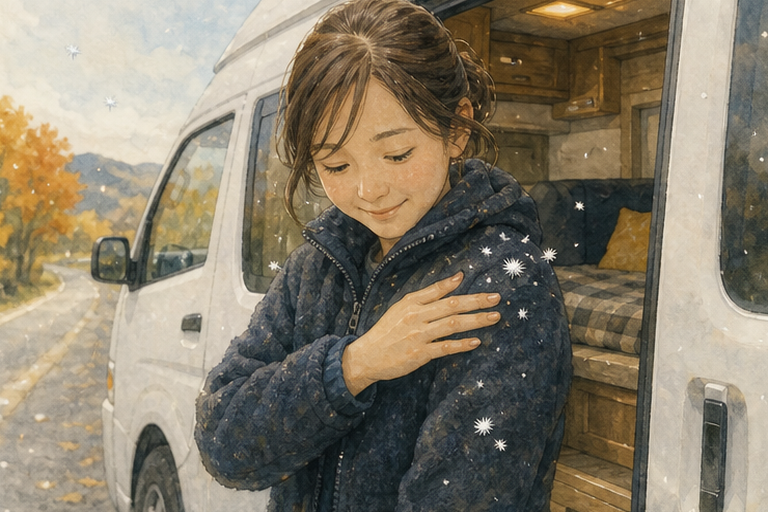
Snow bugs are aphids that feed on tree sap — they don’t sting or bite people. The trouble boils down to two things: they “stick” and they “get in.” A line from Odori Park’s post captures a heavy year in the city well: “an amount so thick you can barely keep your eyes open while walking is rough going” (Odori Park – Beware, a massive outbreak is underway).
Dealing with the “sticking” is simple: brush off your jacket and hair with your hands before getting in the vehicle. The waxy fluff is light and comes off easily with a brush. On dark fleece or down jackets the white specks stand out, so if that bothers you, wearing lighter-colored outerwear while walking makes it less noticeable. If you skip brushing and bring them into the vehicle, you’ll find white specks on the windows or bedding the next morning.
The “getting in” problem covers three places: eyes, mouth, and the vehicle interior. If one gets in your eye, don’t rub — flush with water. Keep your mouth closed while walking, and on heavy days wear a mask and glasses. Inside the vehicle, they tend to slip in during frequent door and window opening at a Michi-no-Eki roadside stop, so when you want fresh air, let it in through a screen instead.
Whether your campervan’s windows or roof vents have screens depends on the vehicle, so checking which vehicle types have screens in advance via Insect Prevention Inside a Campervan: Screens and Repellents is useful both here and when choosing a vehicle for October.
For campervan travelers, snow bugs are the signal to do a final check on your winter gear

Translated into travel terms, snow bugs mean “one to two weeks left until the normal first-snow date — and in some years, it could already be today.” If you’re planning to drive Hokkaido in mid-to-late October, there’s a set list of things to do the day you spot them. Four, in order.
First, tires. From mid-October to early November is a period when, depending on the rental company and vehicle, some are still on summer tires and some have already switched to winter tires. Whether the vehicle you’re borrowing will be on one or the other on your dates varies by company and season, so check When Do Hokkaido Campervans Switch to Studless Winter Tires?, which summarizes how each company handles the switch and how to confirm, before you book — or at the very latest before you set out.
Second, nighttime cold. By the time snow bugs are flying, mornings in Sapporo already call for a jacket just to step outside, and inland areas like Asahikawa and Furano get even colder. Location-by-location, period-by-period normal temperatures — and how to translate them into clothing and gear — are covered in Hokkaido’s October Temperatures and What to Wear. If you’ll be spending overnight-parking nights in a campervan during this period, whether it has an FF heater and how many sets of bedding it comes with become deciding factors in your vehicle choice. You can check how that works in What Is an FF Heater in a Campervan?.
Third, mountain passes and morning road surfaces. Even if the first-snow day doesn’t leave accumulation, freezing on bridges and in shaded spots begins around that time. If your route includes high-elevation stretches like Mikuni Pass or Sekihoku Pass, shift your crossing to daytime hours. How to actually drive on snowy roads is covered in The Complete Guide to Winter Campervan Driving in Hokkaido.
Fourth, treat snow-bug season as a “switch,” not an “ending.” Late October is also when autumn foliage moves down from the mountains to the lowlands — we leave that route planning to The Complete Hokkaido Campervan Autumn Foliage Drive Guide. If you plan to keep driving past the threshold of winter into November and beyond, reading Before You Travel Hokkaido by Campervan in Winter — which addresses worries about snowy roads, freezing, heating, and overnight parking one by one — before choosing a vehicle will sharpen your basis for comparison.
What to do when you see snow bugs: a checklist by stage
Here we condense everything above into one table along your trip timeline — not just numbers to glance at, but a table meant to get you acting the day you see snow bugs.
| Timing | What to check or decide |
|---|---|
| Setting your dates (September–early October) | Overlay your destination’s normal first-snow date (Sapporo Oct 28, Asahikawa/Wakkanai Oct 19, Kushiro Nov 7) with your itinerary. If you’ll be in northern or inland Hokkaido from mid-October onward, confirm with the rental company beforehand whether winter tires will be fitted on your dates |
| When you hear “the snow bugs have flown” before you depart | The general rule of thumb for snow reaching lowlands is one to four weeks — sometimes just days in an early year. Re-check the weekly forecast’s minimum temperatures and your vehicle’s winter equipment for your dates |
| The day you see snow bugs on-site | Switch to ventilating through screens, and brush off your jacket before getting in. Assume that night will be cold, and check how the bedding and FF heater work while it’s still light out |
| When they’re swarming heavily at a park or Michi-no-Eki | Wear glasses and a mask, and keep your mouth closed while walking. Open doors less often, and brush off any that get inside the vehicle the next morning |
| A week or more after seeing snow bugs | Assume morning freezing on mountain passes and avoid early-morning pass crossings. Check that day’s route forecast and road conditions every morning before setting out |
A campervan trip’s strength is that, without a fixed place to stay, you can change your destination and departure time on the morning of. The few weeks of late October when snow bugs fly are exactly when that flexibility pays off most. When you see snow bugs, there is no need to cut the trip short: check your winter gear and keep driving.
New Chitose Airport · Tokachi-Obihiro Airport
See Moving Inn’s Campervans
Check vehicle types, rates, and availability on the official site.
See details on Moving Inn →Frequently Asked Questions
What kind of insect is a “snow bug”?
It’s an aphid wrapped in white waxy fluff, formally named Prociphilus oriens (Japanese: Todonone-oowatamushi). It belongs to the order Hemiptera, family Aphididae, and reaches at most about 4mm in length. It lives on olive-family trees such as Japanese ash in spring, and on the roots of Sakhalin fir from summer into autumn (Hokkaido Research Organization, Forestry Research Institute · Sapporo Museum Activity Center).
When do Hokkaido’s snow bugs fly? Will 2026 be the same?
They become winged adult females in mid to late October, and egg-laying adults can be seen from October into November (Hokkaido Research Organization, Forestry Research Institute). Since there’s no weather-station observation of snow bugs, we can’t say “2026 will be on day X,” but a reasonable target is one to two weeks before Sapporo’s normal first-snow date of October 28 (Japan Meteorological Agency, Sapporo Regional Headquarters).
Does snow bugs flying really mean the first snow is close?
At the season level, yes; the exact number of days isn’t fixed. The Hokkaido government’s material says “snow begins falling even in lowland areas within two to four weeks,” while a Hokkaido University CoSTEP article records the folk saying “one to two weeks” (Rumoi Agricultural Extension Center · Ii ne! Hokudai). In autumn 2024, Sapporo’s first snow arrived on October 20, right in the middle of snow-bug season (Japan Meteorological Agency, Sapporo Regional Headquarters).
Do snow bugs sting? What should I do if they stick to my clothes or vehicle?
They don’t sting or bite people. The trouble is sticking to clothes or hair, and getting into your eyes, mouth, or the vehicle. Three fixes cover it: brush off your jacket before getting in, flush your eyes with water rather than rubbing if one gets in, and let outside air in through a screen.
Why do some years, like 2023, see a massive outbreak?
We haven’t found a source where an official body confirmed a definite cause. Odori Park’s official site, in an October 27, 2023 post about the zelkova gall aphid outbreak, offers as speculation, “we suspect it’s because temperatures were high from summer into autumn” (Odori Park – Beware, a massive outbreak is underway). Whether 2026 will be a heavy year is something to judge from official posts once October arrives.
I’m planning to drive in late October in a campervan. What should I check once I see snow bugs?
Three things: your vehicle’s winter tires on your dates, its FF heater and bedding, and the timing of any mountain pass crossings. Since snow bugs fly just before the normal first-snow date, treat the day you spot them as your final winter-gear check.
Read Next
- When Does Hokkaido’s First Snow Fall? Impact on Campervan Trips and Last-Minute Prep
- When Do Hokkaido Campervans Switch to Studless Winter Tires? A Roundup of How Rental Companies Handle Winter Tires
- Hokkaido’s October Temperatures and What to Wear: Early and Late October Are Two Different Trips for Campervan Travelers
- Before You Travel Hokkaido by Campervan in Winter: Solving Every Worry About Snowy Roads, Freezing, Heating, and Overnight Parking
- The Complete Hokkaido Campervan Autumn Foliage Drive Guide: From Mt. Daisetsu to Hakodate, All of Hokkaido Covered
Book a Campervan in Hokkaido
Moving Inn New Chitose Airport supports English booking and offers airport transfers.

![Monbetsu Drift Ice Festival 2027 [Feb 11–14]: Dates, Ice Sculptures, Garinko-go Icebreaker, Parking and Access by Campervan](https://hokkaido-campingcar.jp/wp-content/uploads/2026/10/monbetsu-hl999-768x576.jpg)
![Hokkaido New Year Weather and What to Wear | Sapporo, Hakodate, Asahikawa, Obihiro Mornings and Evenings, and Heavy-Snow Years [2026-27]](https://hokkaido-campingcar.jp/wp-content/uploads/2026/10/hokkaido-new-year-holiday-weather-eyecatch-768x432.webp)

![Hokkaido Illumination 2026-27 [Dates]: Sapporo Starts Nov 20, Plus Otaru, Asahikawa, Obihiro & Hakodate for Campervan Trips](https://hokkaido-campingcar.jp/wp-content/uploads/2026/10/hokkaido-illumination-2026-eyecatch-768x432.webp)
![What to Do in Tokachi in Winter: Dog Sledding, Snowshoeing, the Shikaribetsu Ice Village, and Staying at Kitanomori [2027]](https://hokkaido-campingcar.jp/wp-content/uploads/2026/10/tokachi-winter-dogsled-1-768x432.jpg)