Stop or Go on Hokkaido’s Winter Roads: Telling Blizzards, Whiteouts and Black Ice Apart, and Where to Check Road Closures [2026-27]
Police, JAF and NEXCO data: blizzard crashes cluster in daytime, Jan-Mar, and black ice is hard to spot. What to do in a whiteout and where to check closures.
Pick a campervan by what matters to you.
Rent in winter (Dec–Mar)
Companies that rent through winter, listed apart from those that close.
Rent at New Chitose Airport
See only the rental bases in Chitose, where the airport is.
Guide price
Moving Inn New Chitose Airport: HIACE van conversion from ¥22,000 per night. 20–30% off when booked 60–90 days ahead (official rate table, checked 15 Oct 2026).
Hokkaido ski resorts by campervan →
Before you book: with an International Driving Permit if your country is in the Geneva Convention (for example the US, Australia, Singapore); Taiwan, Switzerland, Germany, France, Belgium and Monaco need your licence plus a Japanese translation (Tokyo Metropolitan Police). Questions in English: Moving Inn on WhatsApp. Every roadside station (michi-no-eki) must have free 24-hour toilets, and Hokkaido has 128 of them (MLIT).
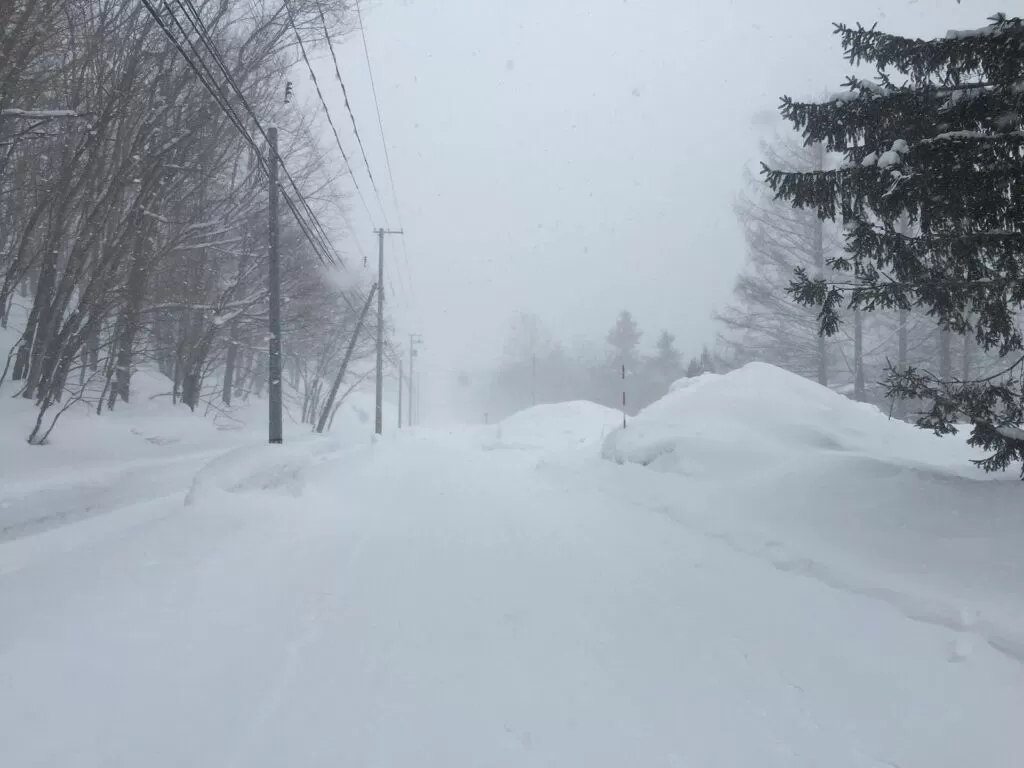
The public-sector rule for deciding to stop driving on a winter road in Hokkaido is this: slow down to a speed at which you can stop within the range you can see, and if driving becomes difficult, stop in the safest place you can and turn on your hazard lights. This is what the Hokkaido Prefectural Police advise for reduced visibility in a blizzard (Hokkaido Prefectural Police and Hokkaido Traffic Safety Association, “The Reality of Traffic Accidents in Poor Visibility Such as Blizzards,” 2022 edition, confirmed October 14, 2026). This article is for people driving a campervan in Hokkaido from December to March. Using only public-agency sources, it sets out what to watch for, and when to stop, in a blizzard, a whiteout and black ice, and where to check road closures on the day.
One point first. If, on a day with bad roads or poor visibility, your reason for driving on is “because I have plans,” your decision is already late. The same Hokkaido Prefectural Police document says that when the weather worsens and driving looks difficult, you should “consider changing your departure time or using public transportation,” and depending on conditions, “it is sometimes necessary to give up going out” (same source, confirmed October 14, 2026). That is why it pays to build a spare day into your itinerary. Seasonal closures such as Shiretoko Pass are covered in our article on Hokkaido roads that close in winter; this article sticks to “while you are driving” and “information for the day.”
Compare Hokkaido Campervan Rentals
Base yourself at New Chitose Airport and compare rates, vehicle types, and pickup locations all in one place.
Compare rental companies and vehicles →When and on what kind of roads do winter blizzard accidents happen?
The Hokkaido Prefectural Police have tallied injury accidents caused by reduced visibility in blizzards and similar conditions (poor-visibility accidents) over the past 10 years (through fiscal 2021). Of 516 cases, 90.1% occurred from January to March, 73.1% fell in the eight hours between 7:00 and 14:59, and 52.1% were on straight roads outside built-up areas. Rear-end collisions made up 53.1% of accident types, and 208 of those (75.9%) were rear-end collisions with stopped vehicles. Compared with other winter accident types, the share of multi-vehicle pileups is high at 18.4% (versus 8.3% for skidding accidents), according to the same summary (Hokkaido Prefectural Police and Hokkaido Traffic Safety Association, “The Reality of Traffic Accidents in Poor Visibility Such as Blizzards,” 2022 edition, confirmed October 14, 2026).
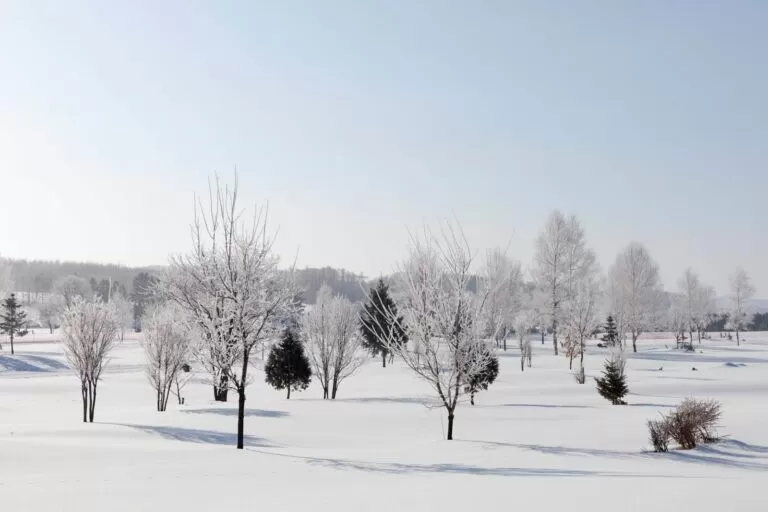
The time of day is the surprise. These accidents happen more in bright daylight than at night. The document explains why: “Sunlight makes the blizzard bright, so cars and other objects are hard to see. The light from a car’s headlights loses effect against the strong brightness of the background” (same source). Even at midday on a clear day, be on guard if a ground blizzard (blowing snow) kicks up on a straight road outside town. That is the first line you can draw from the accident figures.
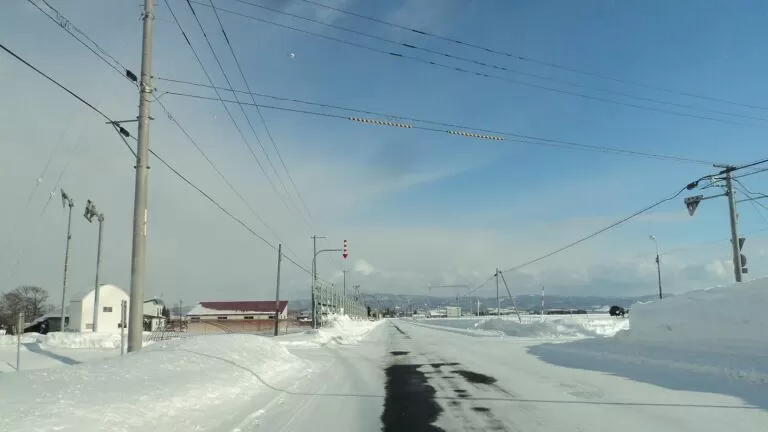
The document also lists where poor visibility is likely to occur: flat, open areas; places where the snowbanks beside the road are high; the boundary between cut and embankment sections; and passes or roads with steep terrain (same source). The Hokkaido Regional Development Bureau’s “Blizzard Poor Visibility MAP” color-codes areas where visibility fell to 200 m or less on average 10 or more days between November and April (Hokkaido Regional Development Bureau, “Winter Driving Mindset” PDF, confirmed October 14, 2026). Checking before you leave whether your route passes through a dark-colored area is the step that takes the least effort and works best.
What should you do first when a whiteout takes away your visibility?
A whiteout is not a phenomenon that happens only on days when snow is falling. The NEXCO East Hokkaido Branch notes that “even in clear weather, a ground blizzard from strong wind, or snow particles reflecting sunlight, can cause one” (NEXCO East Hokkaido Branch, “Notice of Expressway Closures Due to Blizzards in Hokkaido (First Report),” January 13, 2026, confirmed October 14, 2026). Even if the sky is bright, once you can no longer see the car ahead or the edge of the road, assume you have entered a whiteout and act accordingly.
The public sources agree on three actions. First, slow down: “to a speed at which you can stop within the range you can see” (Hokkaido Prefectural Police, PDF above). Second, turn on your headlights and hazard lights to signal that you are here. NEXCO says to “turn on headlights and hazard lights to prevent rear-end collisions with vehicles ahead and behind” (NEXCO document above). Third, if driving becomes difficult, stop in the safest place you can. Remember that more than half of the accidents are rear-end collisions and three quarters of those involve a stopped vehicle. Choosing where to stop is itself a way to help the vehicles behind find you.
In case you have no choice but to stop in the middle of the road or at the edge of a lane, it helps to know the results of a visibility experiment. In a test the Hokkaido Prefectural Police ran in a blizzard, an officer could see a car’s lights from about 100 m away, but from inside the car the officer only became visible when the car had come within about 30 m (same PDF, confirmed October 14, 2026). Cars are easy to see from outside, but it is hard to see out from inside. That is why getting out after stopping to wave following traffic through is not a safe measure.
The document also gives driving tips. When visibility is poor, your sense of distance goes off, and the car ahead looks farther away than it really is. Snow plumes thrown up by large vehicles can reduce visibility further, and snow stuck to headlights and tail lights makes you harder to see, so you are advised to knock it off in a safe place away from the road (same PDF). Leave more distance than usual behind a large vehicle ahead.
Can you tell black ice when you see it? How much longer is the stopping distance?
The official answer is that it is hard to tell by looking. JAF defines black ice as “a surface that looks black like wet asphalt at first glance but is frozen on the surface,” and urges drivers not to judge a road safe by appearance alone. It tends to form on bridges, at tunnel entrances and exits, in shade, and just before intersection stop lines. Take particular care after rain or snowmelt followed by a cold snap, and at night or at dawn (JAF User Test, “Black Ice”, confirmed October 14, 2026).
In January 2013, at the Traffic Science Research Institute in Shibetsu, Hokkaido, JAF measured braking distance from 40 km/h with hard braking that engaged the ABS (average of three runs on each surface). It was 11.0 m on a wet road, 20.2 m on packed snow, 84.1 m on an icy road (ice-covered surface) and 69.5 m on black ice. Compared with a wet road, which looks almost the same, the car needed more than 50 m more to stop (same source). If you meet a road that looks black and wet on a winter morning, slow down and decide in advance that “this may be ice.”
NEXCO East Japan says that even with no snowfall, the road may be frozen because of the temperature swing between morning and evening, and urges drivers to avoid “sudden starts, sudden steering and sudden braking” and to leave more distance between vehicles in winter than in summer. In winter, the maximum speed may be limited to 50–80 km/h because of worsening road conditions or poor visibility, and drivers are asked to observe these speed limits (NEXCO document above, confirmed October 14, 2026). Take the number on the sign as a ceiling worked back from how far you can stop.
Blizzard, whiteout, frozen road: what to do when you see each (summary table)
Here is everything so far, arranged by phenomenon: how to recognize it, what to do, and which source it rests on.
| Phenomenon | How to recognize it | What to do | Source |
|---|---|---|---|
| Blizzard / ground blizzard (blowing snow) | Even when no snow is falling, strong wind lifts snow that has piled up and makes it hard to see ahead. Most likely on open flat land, roads with high snowbanks, passes, and the boundary between cut and embankment sections | Slow to a speed at which you can stop within the range you can see. Turn on lights. Increase following distance | Hokkaido Prefectural Police PDF |
| Whiteout | Everything around you turns white and you cannot tell the road from the scenery. It can happen even in clear weather | Slow down and turn on headlights and hazard lights. If driving is difficult, stop in the safest place you can and keep the hazards on | Hokkaido Prefectural Police PDF, NEXCO East Japan |
| Black ice | Looks black like wet asphalt. Most likely on bridges, at tunnel entrances and exits, in shade, just before stop lines, and at night or dawn | Do not judge it safe by appearance. Avoid any “sudden” action and keep your distance | JAF, NEXCO East Japan |
| Icy road (ice-covered surface) | The road surface is covered in ice. Braking distance from 40 km/h in JAF’s test: 84.1 m | No sudden actions when starting, stopping or cornering. Drive on the assumption that you will slide | JAF |
| Packed snow | Snow packed down hard. Braking distance in the same test: 20.2 m | Allow for about 1.8 times the distance needed on a wet road (11.0 m) and keep your following distance accordingly | JAF |
| Stuck | You cannot move because of drifts or poor visibility | Do not leave the vehicle. Keep the hazard lights on. Clear snow from around the exhaust pipe. For rescue, give your position to the police, fire department or roadside assistance | Hokkaido Regional Development Bureau leaflet, Hokkaido Prefectural Police PDF |
How should you read a blizzard warning and a snow-and-wind advisory?
The Japan Meteorological Agency’s criteria for warnings and advisories differ by area. Both the blizzard warning and the snow-and-wind advisory carry the condition “accompanied by reduced visibility due to snow” in addition to wind speed. For example, in southern Rumoi (Mashike Town), the criterion for a blizzard warning is an average wind speed of 16 m/s over land, and for a snow-and-wind advisory 11 m/s over land (both when accompanied by reduced visibility due to snow) (Asahikawa Local Meteorological Office, “List of Warning and Advisory Criteria,” as of May 28, 2026, confirmed October 14, 2026). This is only one example; check the figures for the area you will drive through in the same list. Wind speed is a 10-minute average, and it is also explained that gusts are often about 1.5 times the average (Japan Meteorological Agency, “Wind Strength and How It Blows”, confirmed October 14, 2026).
How to use this is simple. The day before you leave and on the morning of the day, check the Japan Meteorological Agency’s warnings and advisories page to see whether a snow-and-wind advisory or blizzard warning is out for the area you will drive through. If your time in such an area overlaps the “7:00 to 14:59 on straight roads outside town” window we saw earlier, that is a reason to delay your departure or change your route. I could not read the original text of the Agency’s information on heavy snow and blizzard outlooks while researching this, so it is not covered here.
Where do you click to see road closures and road conditions on the day?
Where to look depends on who manages the road, and falls into three places. For national and prefectural roads, there is Kita no Michi Navi (Northern Road Navi) from the Hokkaido Regional Development Bureau network and the Road Information Provision System (MLIT) from the Ministry of Land, Infrastructure, Transport and Tourism. For expressways, there are DraPla and DriveTraffic from NEXCO East Japan. For conditions on the spot, there are road cameras. Because page layouts get updated, the click order below goes only as far as the main entrance (confirmed October 14, 2026).
- Kita no Michi Navi (Northern Road Navi) (https://northern-road.ceri.go.jp/navi/): The top menu has “Pass (Blizzard) Information,” where you can see blizzard conditions on mountain passes. For traffic restrictions, go in through “National and Prefectural Road Restrictions / Road Images / Road Weather” in the same menu, where you will find entrances to “National and Prefectural Road Closure Information,” “National Road Weather Information” and “National Road Image Information” (road cameras) (Kita no Michi Navi, “Checking Traffic Restrictions”). The old address (northern-road.jp) was changed to the current address on March 29, 2024
- Road Information Provision System (MLIT, https://www.road-info-prvs.mlit.go.jp/): The entrance for checking closures and restrictions on national roads and high-standard roads. The former “Hokkaido Region Road Information” moved to this nationwide version on March 31, 2023
- NEXCO East Japan’s DraPla and DriveTraffic (DraPla road traffic information, DriveTraffic): Check expressway closures and restrictions in real time, and reach the Hokkaido area of the expressway live cameras. NEXCO also announces blizzard closures on its official LINE account and official X account (@e_nexco_kita)
Once you have read the closed sections, check the road surface and visibility with your own eyes on a road camera. If the camera image shows snow swirling, or you can see only the lights of the cars ahead and behind, that is a reason to shift your time through that section even if it is not closed. As an example from last winter, at 19:00 on January 13, 2026, the NEXCO closed sections were both directions of the Sapporo-Minami IC to Shibetsu-Kenbuchi IC stretch of the Do-o Expressway, both directions of Tomakomai-Chuo IC to Onuma-Koen IC, and parts of the Sasson Expressway, the Shiribeshi Expressway and the Fukagawa-Rumoi Expressway, all because of blizzards (NEXCO document above). You cannot assume an expressway will not close.
If avoiding a closed route means a longer detour than planned, also see the “wait or avoid” approach in bad-weather tips for a campervan trip in Hokkaido.
New Chitose Airport and Tokachi-Obihiro Airport
See Moving Inn campervans
Check vehicle types, rates, and availability on the official site.
See details at Moving Inn →If a blizzard leaves you stuck, should you get out of the car? Is it fine to leave the engine running?
The Hokkaido Regional Development Bureau’s leaflet for foreign drivers puts “Do not leave your vehicle” at the very top. If you leave the car in a blizzard, you lose track of where you are and may become lost. Unless you can be sure of a shelter or of someone who will rescue you, you must not leave the vehicle (Hokkaido Regional Development Bureau, “Precautions in Heavy Snow and Blizzards”, confirmed October 14, 2026). The Hokkaido Prefectural Police document also warns that carelessly getting out of the car can get you hit by following traffic.
To call for rescue, stop with the hazard lights flashing and give your exact position. National roads carry the route number and a kilometer post every 1 km, which gives you something to go on when you give your position by phone (Hokkaido Regional Development Bureau leaflet). When you phone the police, the fire department or roadside assistance for rescue, the Hokkaido Prefectural Police likewise ask you to give your position as accurately as possible (Hokkaido Prefectural Police PDF).
On exhaust fumes, the sources word things a little differently, so both are given here. The Hokkaido Regional Development Bureau leaflet says that if the exhaust outlet is buried in snow, carbon monoxide poisoning can kill, and asks you to “clear the snow around the muffler regularly or open a window slightly for ventilation.” The material from the Civil Engineering Research Institute for Cold Region (CERI), quoted by the Hokkaido Prefectural Police, says that as a rule the engine should be turned off; that if it must be run for warmth, you must make sure the muffler is open to the air and take care that it does not get buried again; and that you can never be completely safe even with a window open (Hokkaido Prefectural Police PDF). What both have in common is keeping the muffler from being buried in snow.
The position of the exhaust outlets for a campervan’s FF heater (forced-flue heater) and generator may differ from vehicle to vehicle. Ask at the vehicle briefing when you pick up the car which spots to clear when it is buried in snow. If heavy snow makes you feel unsafe, pulling into a Michi-no-Eki (roadside station), which offers parking, toilets and a telephone available 24 hours, is also listed as an option in the Hokkaido Regional Development Bureau leaflet.
While driving a rental, when should you contact the rental company?
Each company’s own rules are not covered here. A general rule is enough as the guide. The moment you feel you cannot keep going, the vehicle will not move, you are buried in snow, or something is wrong with the vehicle, stop in a safe place first, before thinking about your return time or next stop, and then contact the rental company. If anyone’s safety is at stake or there has been an accident, the police and fire department come first. Note down the contact number and the company’s winter night and holiday support hours at pickup, so you do not have to hunt for them in a blizzard. For snow-road equipment and driving in general, see the complete guide to winter campervan driving in Hokkaido; for an overview of winter worries, see the article on winter concerns.
If you are coming from overseas, or this is your first winter in Hokkaido with a domestic license, you also need to know about tires and drive type in advance. For when rental companies switch to winter tires, see the article on winter tire policies at rental companies; for the difference in drive type, the article on whether you need 4WD; and for licenses and procedures, the article on renting with a foreign license.
Checklist for the day, from before you leave to while you drive
Here are the “things to do before departure” and “things to do while driving” from the Hokkaido Prefectural Police document, together with everything above, ordered as the day before, the morning of, while driving, and after you stop (Hokkaido Prefectural Police PDF, confirmed October 14, 2026). For a rough idea of temperatures, see our article on winter temperatures.
- Day before: Check the weather and road conditions for the area you will drive through on TV, radio or the internet, and tell your family or accommodation your expected arrival time and route
- Day before: Use the Blizzard Poor Visibility MAP to see whether your route passes through dark-colored areas. Check the Japan Meteorological Agency’s warnings and advisories page for snow-and-wind advisories and blizzard warnings
- Morning of: Check closures on Kita no Michi Navi, the Road Information Provision System and DraPla, and check the road surface and visibility with your own eyes on a road camera
- Morning of: Check fuel and battery, phone charge, drinks and emergency food, warm clothing, a shovel, a tow rope, tire chains, a flashlight, a flare and a radio
- While driving: On bad-weather days, rest often at a Michi-no-Eki or parking area and recheck weather and road information
- While driving: On bridges, at tunnel entrances and exits, in shade and just before stop lines, assume it is ice even if it looks black and wet, and slow down
- When visibility worsens: Turn on lights, slow to a speed at which you can stop within the range you can see, and increase following distance
- When driving becomes difficult: Stop in the safest place you can and turn on the hazard lights. Do not leave the vehicle
- After stopping: Keep clearing snow from around the muffler and check ventilation. For rescue, give your exact position to the police, fire department or roadside assistance
Night and dawn are the times JAF warns about freezing. Another danger on winter roads, collisions with Ezo deer, is covered in our article on Ezo deer collisions, which gives the season when they rise and who to contact.
Frequently asked questions (FAQ)
At what times and on what roads do blizzard accidents happen?
In the Hokkaido Prefectural Police tally (past 10 years through fiscal 2021, 516 cases), 90.1% occurred from January to March, 73.1% between 7:00 and 14:59, and 52.1% on straight roads outside built-up areas. They happen more in bright daylight than at night, and rear-end collisions account for 53.1% (Hokkaido Prefectural Police and Hokkaido Traffic Safety Association, confirmed October 14, 2026).
What should I do if I get caught in a whiteout?
Slow to a speed at which you can stop within the range you can see, and turn on your headlights and hazard lights. If driving is difficult, stop in the safest place you can and leave the hazards on (Hokkaido Prefectural Police, NEXCO East Hokkaido Branch, confirmed October 14, 2026).
Can you tell black ice when you see it?
It is hard to tell by looking, and JAF urges drivers not to judge a road safe even if it looks like a wet surface. Bridges, tunnel entrances and exits, shade, spots just before stop lines, and night and dawn are the likeliest places and times. Braking distance from 40 km/h was 69.5 m, against 11.0 m on a wet road (JAF User Test, confirmed October 14, 2026).
How should I read a blizzard warning or a snow-and-wind advisory?
The criteria differ by area, and the wind speed comes with the condition “accompanied by reduced visibility due to snow.” For example, in southern Rumoi, a blizzard warning is 16 m/s over land and a snow-and-wind advisory is 11 m/s over land. Check the figures for the area you will drive through in the Japan Meteorological Agency’s criteria list (Asahikawa Local Meteorological Office, confirmed October 14, 2026).
Where do I check road closures on the day?
For national and prefectural roads, use Kita no Michi Navi and the Ministry of Land, Infrastructure, Transport and Tourism’s Road Information Provision System; for expressways, use NEXCO East Japan’s DraPla and DriveTraffic. Road camera images can also be viewed through Kita no Michi Navi (each site, confirmed October 14, 2026). Seasonal closure periods are covered in a separate article.
If I get stuck in a blizzard, is it okay to get out of the car?
Do not leave the vehicle unless you can be sure of a shelter or of someone who will rescue you. You risk losing your position and being hit by following traffic. Keep clearing snow from around the muffler and give your position to the police, fire department or roadside assistance for rescue (Hokkaido Regional Development Bureau, Hokkaido Prefectural Police, confirmed October 14, 2026).
Who do I contact if something goes wrong while driving a rental?
Stop in a safe place first, then contact the rental company. If anyone’s safety or an accident is involved, the police and fire department come first. Note down each company’s contact number and night-time support at pickup.
Where to look next
- Hokkaido roads that close in winter: Shiretoko Pass and other winter closure periods, spring reopening dates and detour routes
- Complete guide to winter campervan driving in Hokkaido: tips for snow roads, staying warm and overnight parking
- Before a winter campervan trip in Hokkaido: putting every worry about snow roads, ice, heating and overnight parking to rest
- When should you switch a Hokkaido campervan to studless winter tires?
- Bad-weather tips for a campervan trip in Hokkaido: how to safely wait out rain, strong wind, dense fog and heavy snow
Book a Campervan in Hokkaido
Moving Inn New Chitose Airport supports English booking and offers airport transfers.
Pick a campervan by what matters to you.
Rent in winter (Dec–Mar)
Companies that rent through winter, listed apart from those that close.