Hokkaido Campervan Rental Prices by Vehicle Type & Total Cost [2026]
Hokkaido campervan rental prices from 41 real bases: daily rates for Kei camper, Van, and Cab conversion, the 1.3–1.5x summer multiplier, liability coverage and shuttle costs, and day-by-day cost simulations.
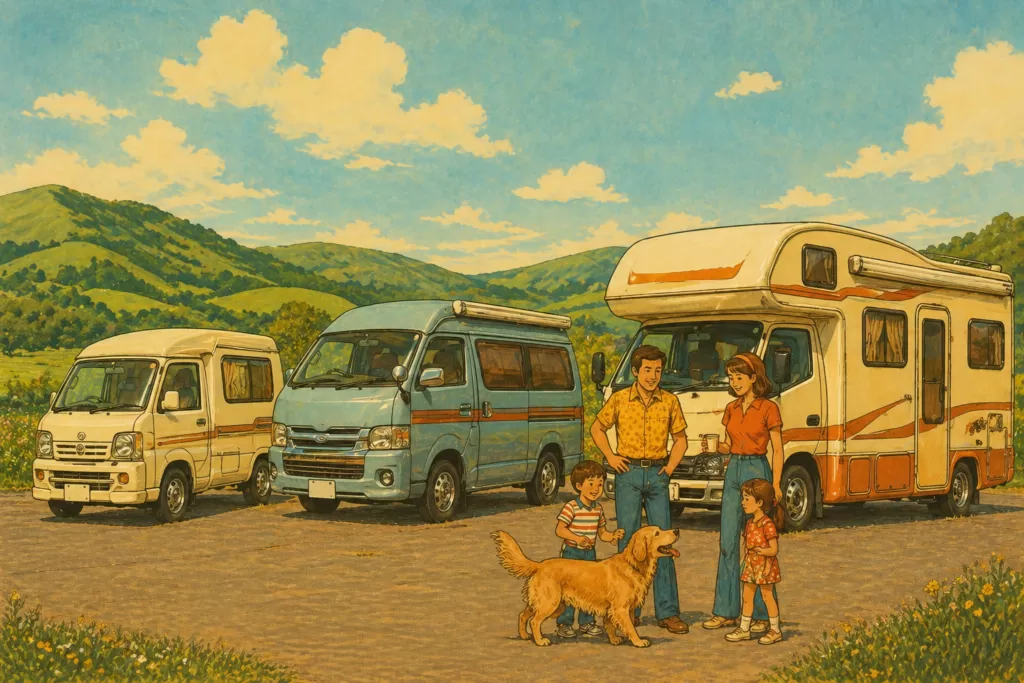
When renting a campervan in Hokkaido, the first question is always the same: how much will it actually cost? Rental prices are set by three factors together — vehicle type, season, and number of days — and the same vehicle can cost over ¥10,000 more per day in July than in November.
This article organizes real published rates from 41 rental bases across Hokkaido listed on this site (verified 2026-09-04), broken down by three vehicle types: Kei camper, Van conversion, and Cab conversion. You’ll find how to read official “from ¥X” pricing, season- and length-based total cost simulations, and the costs that come on top of the rental fee — all with real numbers.
New Chitose Airport / Tokachi-Obihiro Airport
Rent the Cab Conversion “Cresson Journey”
Base yourself at New Chitose Airport and compare rates, vehicle types, and pickup locations all in one place.
See Details at Moving Inn →Tap a dot on the map to see its name here.
Tap a dot to see its name and a link to where it appears in this article. Dot positions are based on each facility’s address or officially published location. Lakes and expressways are from OpenStreetMap data.
Hokkaido Campervan Rental Price at a Glance (By Vehicle Type)
Here's the big picture first. The table below summarizes rates from major rental bases across Hokkaido by vehicle type, for one day (24 hours). These are not the lowest advertised "from" prices — they reflect the actual range paid in the regular season and peak season (verified 2026-09-04).
| Vehicle Type | Regular Season (per day) | Peak Season (per day) |
|---|---|---|
| Kei camper (sleeps 2) | ¥12,000–¥18,000 | ¥15,000–¥25,000 |
| Van conversion (sleeps 2–4) | ¥18,000–¥24,000 | ¥22,000–¥37,000 |
| Cab conversion (sleeps 4–6) | ¥23,000–¥33,000 | ¥32,000–¥45,000 |
Peak season generally means mid-July through late August, plus Golden Week, the year-end/New Year holidays, and other long weekends. The exact cutoffs vary by base, but among bases with season-specific pricing, July–August is the highest band at most of them. In terms of multiplier, peak season runs 1.3–1.5x the regular-season rate at most bases, with some at 1.75x and one base over 2x in August alone (12 bases with season data, verified 2026-09-04). You don't need to assume summer is a flat 2x across the board, but budgeting for 1.5x is a safe bet. As an upper-bound example: the Van conversion at Moving Inn Tokachi Obihiro Airport runs ¥15,400 off-season versus ¥36,850 peak season (per night, base data from this site, verified 2026-09-05) — more than double. Don't assume a Van conversion is automatically cheap; compare the real total with your actual dates plugged in.
Conversely, the off-season from November through March (some bases extend it to April) runs 4–48% cheaper than the regular season, with most bases in the 10–30% discount range (12 bases with both regular- and off-season rates, verified 2026-09-04). Winter driving conditions and which bases pause operations are covered in the FAQ at the end of this article.
How Much Should You Trust the "From ¥X" Price on Official Sites?
Prices like "from ¥15,400" or "from ¥17,600," common on comparison sites and official pages, don't mean you can book at that rate any time. In most cases it's the lowest possible price, under off-season or bare-minimum conditions, and the real amount changes with your booking timing and vehicle grade. Treat "from ¥X" as a way to check where a base's pricing starts — not as your actual travel budget.
The table below shows how much that entry price varies base to base, using data from this site. For the same "Kei camper" category, the lowest advertised price can differ by up to 4x.
| Vehicle Type | "From ¥X" Range | Median | Bases |
|---|---|---|---|
| Kei camper | ¥4,800–¥19,800 | ¥14,300 | 7 bases |
| Van conversion | ¥7,800–¥30,800 | ¥16,500 | 17 bases |
| Cab conversion | ¥14,800–¥39,600 | ¥22,000 | 27 bases |
* Based only on bases that publish a 24-hour rate. Bases using a different pricing system, such as per-night pricing, are excluded (verified 2026-09-04).
Bases near the low end usually have a clear reason for being cheap — bedding or cooking gear as paid extras, or an older vehicle. If budget is your priority, check How to Choose a Budget Campervan Rental in Hokkaido first to see exactly what you give up for the lower price — it cuts down on post-booking surprises.
Prices and Best Fit by Vehicle Type

If you're still unclear on the differences between vehicle types, read How to Choose a Vehicle Type (Kei camper / Van conversion / Cab conversion) first — it makes the price gap easier to understand.
Kei Camper: ¥12,000–¥25,000/day, Best for Couples & Solo Travel
Built on a kei (light) car base, sleeping capacity is 2 as standard. In the regular season, ¥12,000–¥18,000/day is the main price band — the most affordable of the three types. Fuel economy is also strong, around 13–16 km/liter, keeping gas costs down.
The trade-off is interior space and driving performance. Two adults are fine, but on a trip with a lot of luggage, or Hokkaido's long-distance drives, you may feel a lack of power at highway speed. It works well if your main legs are around 120 km one-way, like Sapporo to Furano. How to rent one from Sapporo, New Chitose, or Hakodate is covered in Renting a Kei Camper in Hokkaido.
Van Conversion: ¥18,000–¥37,000/day, Balanced Option for 2–4
Converted from a van such as the Hiace, priced at ¥18,000–¥24,000/day in the regular season. Its strength is driving like a regular car and fitting into city parking lots. Sleeps 2–4, making it a popular choice for a couple with one or two children.
However, many have a lower interior height, and standing up to change clothes inside can be difficult in some. Check the "interior height" before booking to avoid surprises.
Cab Conversion: ¥23,000–¥45,000/day, the Top Pick for Families & Groups
A living space built onto a truck chassis — the type that looks most like a "classic" campervan. Regular season runs ¥23,000–¥33,000/day, rising to ¥32,000–¥45,000 in the summer peak. You can stand and walk inside, and most vehicles come with a fixed bed, kitchen, and FFH heater, sleeping 4–6. For the structure and who it fits, see What Is a Cab Conversion? Features, Pros & Cons, and How It Differs From a Van Conversion.
It's the most expensive of the three, but the math changes once you factor in saving an entire night's lodging. A family of four staying at a hotel would pay ¥30,000–¥40,000 per night, so the Cab conversion's rate is largely offset by the lodging you don't pay for.
Total Cost Simulation by Season & Number of Days
To give you a realistic sense of budget, here's the total cost by vehicle type and number of days, comparing regular season and peak season. Figures are rental fee only (insurance and fuel not included).
| Duration | Kei Camper | Van Conversion | Cab Conversion |
|---|---|---|---|
| 2 nights, 3 days (regular season) | approx. ¥40,000 | approx. ¥60,000 | approx. ¥85,000 |
| 2 nights, 3 days (summer) | approx. ¥52,000 | approx. ¥78,000 | approx. ¥115,000 |
| 4 nights, 5 days (regular season) | approx. ¥65,000 | approx. ¥98,000 | approx. ¥140,000 |
| 4 nights, 5 days (summer) | approx. ¥85,000 | approx. ¥128,000 | approx. ¥190,000 |
| 6 nights, 7 days (summer) | approx. ¥115,000 | approx. ¥175,000 | approx. ¥260,000 |
Many bases offer multi-night discounts (5–15%) for stays of 3+ or 7+ nights, so the longer you rent, the lower your per-day rate. The table above already factors in these discounts as an approximation.
How costs feel also changes with duration. For a 1-night trip, cleaning fees and coverage costs make up a larger share, so it feels pricier per day than the daily rate suggests. For a week-long trip, fuel, campsite fees, and food add up to matter more than the rental fee itself. See 1-Week Total Cost Simulation (from ¥170,000 for 2, from ¥290,000 for 4) for a per-person breakdown — it shows how much of the total is beyond the rental fee.
How Pricing Works: 24-Hour Rate vs. Night Pack
Most Hokkaido campervan rentals use a "24-hour" system — pick up at 10am, and the next 10am marks one full day. Some bases instead use the "calendar-day" system common with regular car rental, where days are counted by the calendar. With the same "2 nights, 3 days," the number of days billed can differ depending on which system a base uses.
Here's a concrete example: picking up Friday at 3pm and returning Sunday at 6pm. Under the 24-hour system, that's "2 days plus 3 hours over," with overage typically charged at ¥2,000–¥3,000/hour. Under the calendar-day system, it's billed as 3 days (Friday, Saturday, Sunday). Which is cheaper depends on your pickup and return times, so confirm how a base counts days before booking.
Some bases also offer a "night pack" (a discounted plan for picking up in the evening and returning the next morning) or "early check-in" (picking up in the morning for an extra few thousand yen). If your flight lands in the evening, getting your first day treated as a night pack can save you close to a full day's fee.
Comparing Total Cost with a Hotel + Rental Car Trip

Whether a campervan feels expensive or affordable depends on what you're comparing it to. Here's a side-by-side of total cost for a family of four on a 4-night, 5-day summer trip, campervan versus hotel + rental car.
| Cost Item | Campervan Trip | Hotel + Rental Car Trip |
|---|---|---|
| Vehicle (4 nights, 5 days, summer) | Cab conversion approx. ¥190,000 | Minivan approx. ¥60,000 |
| Lodging (4 nights, 4 people) | RV parks etc. approx. ¥10,000 | Hotel approx. ¥140,000 |
| Food | Some self-cooking, approx. ¥40,000 | Mostly dining out, approx. ¥70,000 |
| Total | approx. ¥240,000 | approx. ¥270,000 |
Even in the summer peak, the totals come out roughly even, or the campervan comes out cheaper. On top of that, there's value that doesn't show up in the numbers — not being tied to a check-in time, and being able to stay near scenic spots with no lodging nearby. On the other hand, if your trip is centered on city sightseeing and you actually want to enjoy a hotel stay, there's no need to force yourself into a campervan.
Costs Beyond the Rental Fee

Costs beyond the rental fee are the easiest thing to miss when estimating a budget. Here are the typical figures for a 1-week Hokkaido trip.
| Cost Item | Estimate | Notes |
|---|---|---|
| Liability coverage / vehicle insurance | ¥1,100–¥5,500/day | Most common at ¥2,200–¥3,300; most bases treat it as required (verified 2026-09-04) |
| Gas | ¥15,000–¥25,000 for one week | Cab conversion fuel economy: 6–8 km/L |
| Bedding rental | ¥1,100–¥3,300 per set | Some bases include it free |
| RV park / campground | ¥0–¥4,000/night | Free at a Michi-no-Eki (roadside rest stop) |
| Airport/station shuttle | Free–¥10,000 one-way | Some bases offer free shuttle; others charge a few thousand yen one-way (verified 2026-09-04) |
| Cleaning fee / pet fee | ¥0–¥11,000 | Varies widely by base |
| One-way drop-off / optional gear | See base page | Limited bases support one-way drop-off; check pricing with each base |
Liability coverage reduces what you pay out of pocket in an accident, and it's effectively a cost you can't skip. Base data on this site shows a range of ¥1,100 to ¥5,500 per day, and some bases offer multiple plan tiers with different coverage levels (verified 2026-09-04). Some bases also offer "NOC (Non-Operation Charge) coverage" — adding it waives the operator's business-loss compensation (¥20,000–¥50,000) that you'd otherwise owe if the vehicle becomes unusable after an accident. As a concrete example, the Cab conversion at Moving Inn comes to ¥3,300 for the liability coverage option plus ¥2,200 for NOC coverage — ¥5,500 per night (verified on the booking screen 2026-09-05). Over 4 nights that's ¥22,000, a bigger line item than bedding or facility-use fees. Budgeting around ¥5,000 per night for coverage at the estimate stage keeps the total from ballooning later.
A listing that just says "New Chitose available" doesn't necessarily mean the shuttle is free. For the full picture — pickup location, wait times, and after-hours surcharges — see The Complete Guide to Renting a Campervan at New Chitose Airport.
Additional pet conditions (cleaning fees, number of pets, breed restrictions, etc.) vary widely between bases. If you're planning to bring a pet, also check Pet-Friendly Campervan Rental Comparison (Japanese) and Guide to a Hokkaido Trip with Your Dog or Cat for how to plan the itinerary.
Why Prices Differ for the Same Vehicle Type
On comparison sites, even the same Cab conversion category can differ by nearly ¥10,000 per day. This gap comes mainly from four factors.
First is vehicle age and equipment. Newer vehicles tend to have more features — FFH heater, solar panel, a larger sub-battery, a microwave — and cost more. Older vehicles are cheaper, but come with limits, like not being able to run the microwave and air conditioner at the same time due to a smaller electrical capacity.
Second is what's included in the price. Some bases include bedding, cooking gear, and a camp table and chairs; others charge extra for them — so you can't compare on the display price alone. Third is how insurance is handled: whether liability coverage is bundled into the display price or billed separately changes how the number looks. Fourth is location. A base with airport shuttle may show a slightly higher price for the added convenience, but once you add in transfer costs, the total can flip in its favor.
When comparing, line things up by "total cost including bedding + insurance + transfer," not the display price alone. The price tables in this article are built to be close to that total-cost sense. If you want to see rates, shuttle, and pet conditions side by side for each base, the fastest way is Hokkaido Campervan Rental Base Comparison Guide, or filter by area and condition from the base listing on the homepage.
Four Ways to Lower the Price

① Avoid Summer: June and September Offer Near-Summer Comfort at Lower Rates
Just avoiding July–August cuts the total by 20–30%. Early September in Hokkaido runs around 20°C in the daytime and is good for sightseeing, while June sees Furano and Biei quieter, before lavender season. For a balance of price and climate, September is the strongest pick. If you're set on going in July–August anyway, price swings and booking timing are covered in Summer Hokkaido Campervan Trip Guide.
② Use Multi-Night Discounts: 7+ Nights Lowers the Per-Day Rate
It's common for the discount rate to step up at 3, 5, or 7 nights. If you're planning 4 nights, 5 days, extending 2 more days to hit the 7-night discount can actually work out cheaper per day.
③ Think in Terms of Offsetting Lodging and Transport Costs
A campervan trip is really "rental fee = lodging + rental car" combined. For a family of four on a 4-night, 5-day trip, compare 4 hotel nights (¥120,000–¥160,000) plus a rental car (¥30,000–¥40,000) — against that, ¥140,000 for a Cab conversion is not expensive at all.
④ Choose a Base Right by the Airport to Cut Transfer Costs
Choosing a base in central Sapporo means paying for the train from New Chitose Airport (¥1,150 one-way per person) and around an hour of travel time. A base you can pick up from near the airport frees up that time for your itinerary instead.
When Is Hokkaido Campervan Rental Cheapest? Seasonal Demand Data from the Tourism Bureau
"When" matters more than intuition — you can work it out from Hokkaido's tourism demand cycle. According to the Hokkaido District Transport Bureau's "Basic Tourism Data for Hokkaido" (p.21, source: Japan Tourism Agency "Accommodation Travel Statistics Survey"), the total number of overnight stays in Hokkaido each month (including international visitors) peaks in August and dips in April and November. The report states: "To raise service levels year-round, tourism content needs to be expanded for April and November, the months when visitor numbers decline, in order to boost tourism demand in each of those months" (confirmed August 3, 2026).
Campervan rental rates broadly track this tourism demand curve. April and November — when overnight stays drop — along with the surrounding off-peak months of May–June and September–October, are when rental rates tend to fall to their lowest levels. August, the statistical peak, is also the toughest month for both pricing and availability, since operator-side demand runs highest then too. See the table and monthly calendar below for rates by vehicle type and season.
How Rates Move by Season and Day of the Week — and the Best Times to Book
Hokkaido campervan rental prices move in line with tourism demand. Knowing the general monthly trends makes it easier to plan your itinerary.
Golden Week (Late April – Early May): Watch Out for Peak Pricing During the Holiday
During Golden Week, some operators apply peak-season rates. Even in May, bookings concentrate around April 28–May 6, so simply shifting your departure to after Golden Week (May 7 onward) can bring prices down significantly. Mid-to-late May after Golden Week is one of the best value windows in the spring season.
Mid-May to Early June: Spring Off-Peak (Best Value of the Year)
From after Golden Week through mid-June, rates are at their most stable all year. Since it falls before the lavender peak, this period offers the best balance of price, crowd levels, and weather. Unlike the rest of Japan, Hokkaido has no rainy season, and June sees plenty of sunny days, making it very travel-friendly. That said, some mountain areas may still have snow in May, so check your planned route in advance.
The appeal of this period is three things at once: off-peak rates, uncrowded attractions, and stable weather. If you're set on a summer trip, the Hokkaido Campervan Summer Cost Simulator is a useful reference for detailed cost estimates.
July–August: High Season (Most Expensive)
From the lavender season in July through the end of August, tourists concentrate across all of Hokkaido. Campervans start filling up 3–4 months in advance and rates reach their annual peak. In summer 2026, some operators have seen price increases of around 5–10% versus 2025. Obon peak (around August 10–20) is particularly expensive — up to ¥5,000–¥10,000 more per night compared to the surrounding weeks. If summer is your only option, book early (3–4 months ahead) to access early-bird discounts, and narrow your choice to kei campers or compact van conversions to keep costs down.
September – Early October: Autumn Off-Peak (Second-Best Value Window)
By September, tourist numbers ease and rates return to off-peak levels. Early October offers beautiful autumn foliage without overly crowded campsites. As nighttime temperatures drop, consider booking a vehicle with heating (van conversion or larger) or bringing an electric blanket for a comfortable stay.
Late October – April: Off-Season (Cheap but with Limitations)
Rates drop further during this period, but there are three key constraints: fewer vehicles available, many campsites closed, and the risk of snow and ice. If you plan to sleep in the van as your main accommodation, you'll need an itinerary that relies on roadside rest stops (michi-no-eki). Confirm in advance which rental companies operate through winter.
5 Tips to Rent a Hokkaido Campervan Cheaply
Tip 1: Target Off-Peak Months (May, June, September)
The most impactful approach is simply avoiding peak season. May, early June, and September offer the best combination of price, travel ease, and weather. Compared to July–August, the difference can exceed ¥10,000–¥20,000 per night, meaning a 3-night/4-day trip could cost ¥30,000–¥60,000 less.
Even if summer is a must, some operators charge lower rates in the first week of July or from late August through early September. Consider shifting your calendar by two or three weeks first.
Tip 2: Depart and Return on Weekdays
Many operators set higher rates for weekend check-ins (Friday–Saturday). Switching to a Tuesday, Wednesday, or Thursday departure and return can cut costs by 10–20% for the same number of nights.
For example, a Friday-to-Monday 3-night trip often costs more than a Tuesday-to-Friday 3-night trip at the same operator. If you have flexibility with your schedule, check the day of the week before booking.
Tip 3: Choose a Kei Camper or Compact Van Conversion
For two travelers, a kei camper or compact van conversion offers the best value. In the off-peak season, some models start from around ¥10,000 per day, and the gap versus a cab-over motorhome exceeds ¥10,000 per night even in low season.
Kei campers aren't just cheaper — they also offer better fuel economy (around 12–15 km/L), easier handling on narrow forest roads and farm tracks, and more parking options. With basic equipment, you'll rarely feel inconvenienced if you make good use of hot springs and roadside rest stops. See the Hokkaido Kei Camper Rental Guide for more details.
Tip 4: Use Multi-Night and Long-Term Discounts
Many operators offer discounts (5–15% off) for stays of five nights or more, or seven nights or more. If you want to lower your per-night rate, booking one longer trip beats splitting it into multiple shorter rentals.
As a concrete example, booking two separate 3-night/4-day trips (six nights total) will almost always cost more per night than one 6-night/7-day booking. For long-stay cost estimates, the Hokkaido Campervan 1-Month Cost Simulator is a useful reference.
Tip 5: Use Early-Bird and Last-Minute Discounts Strategically
To get a popular vehicle cheaply during peak season (July–August), look for operators offering 10–15% early-bird discounts when you book 3–4 months ahead. Popular cab-over motorhomes departing from Asahikawa or New Chitose can fill up three months out, so if you're going in summer, acting early is essential.
On the other hand, last-minute deals are effective in the off-peak season. Some operators release cancelled slots at a discount one to two weeks before departure — a good fit if your schedule is flexible. Use early-bird booking for peak season and last-minute deals for off-peak, depending on how much flexibility you have. To compare rates across multiple companies at once, visit the rental company comparison page.
Comparing Hokkaido's Main Budget Rental Companies
Once you've narrowed down the timing and vehicle type, the next step is comparing rates company by company. Here are the main budget-friendly bases in Hokkaido.
Focusing on the most affordable kei campervans through vancampervans in the ¥10,000–¥15,000/day range, here's how they stack up:
Budget Tier: ¥4,800–¥9,900
This range includes SALMON RENTALCAR, QUUM, and CAMPINGLABO. All are mainly Sapporo-based, centered around kei campervans and small vancampervans. For couples traveling light and looking to use the vehicle as a moving hotel, this tier offers the best value.
That said, "budget" often means "minimal equipment." Once you add airport transfers, bedding, camping gear, and coverage, the gap from pricier options narrows. Look at the total cost including equipment, not just the nightly rate.
Practical Value Tier: ¥11,000–¥15,000
In the ¥10,000+ range, you'll find more Chitose and Eniwa-area bases: Chiki Chiki, Fuji Cars Japan Chitose, R230 Car Share, GOODLUCK, Moving Inn New Chitose Airport, and FOX Camper. Airport access improves and vehicle options expand to include vancampervans and cab-overs — making family trips more realistic.
For most budget-conscious travelers, this is actually the most practical tier. If you're flying into New Chitose Airport, factor in the cost and time of traveling to a cheaper Sapporo base — and you'll find that ¥11,000–¥15,000 from Chitose is genuinely competitive.
Convenience-Included Tier: ¥17,000+
Bases like Tabisuru Kuruma New Chitose Airport BASE charge more, but the value lies in the smooth airport logistics: pick up immediately on arrival, easy return before your flight. For trips of 3 nights or more covering a wide area of Hokkaido, convenience often matters more than a slightly lower daily rate.
This tier is "higher on paper, but less waste overall." If avoiding an extra night in Sapporo or a train ride saves time and money, the all-in cost can actually come out lower.
If absolute minimum budget is your priority, check SALMON RENTALCAR, QUUM, and CAMPINGLABO in that order. If you want to depart straight from New Chitose Airport, Fuji Cars Chitose, GOODLUCK, Moving Inn New Chitose Airport, FOX Camper, and Tabisuru Kuruma are your candidates. For a balanced ¥10,000–¥15,000 range, R230 Car Share, GOODLUCK, and FOX Camper are worth comparing.
Checklist for Renting Cheap
Here's everything above turned into a checklist you can use right before booking.
- Checked whether the departure date can be moved off peak periods like Golden Week or Obon
- Considered switching to a weekday departure and return
- Matched the vehicle type to group size (kei camper for two, van conversion or larger for a family)
- Checked for multi-night discounts at five nights or more, or seven nights or more
- Checked for early-bird discounts (3–4 months ahead) if traveling in summer
- Checked for last-minute deals as well, if traveling in the off-peak season
- Estimated the total cost including insurance, options, and cancellation fees
To compare rates across multiple companies at once, visit the rental company comparison page.
Sample Estimate: Building the Total for a Family of Four, 4 Nights, 5 Days in Summer
Let's put the numbers above together into one real estimate. The conditions: 2 adults + 2 children, early August, 4 nights 5 days, Cab conversion, starting and ending at New Chitose Airport, 900 km driven.
| Item | Amount |
|---|---|
| Cab conversion, 5 days (summer rate, after multi-night discount) | approx. ¥185,000 |
| Liability coverage + NOC coverage (¥5,500/night × 4 nights) | ¥22,000 |
| Bedding, 4 sets | ¥8,800 |
| Gas (900 km, 7 km/L) | approx. ¥22,000 |
| 2 nights RV park + 2 nights Michi-no-Eki | approx. ¥6,000 |
| Total | approx. ¥244,000 |
That works out to about ¥12,200 per person per day. It comes in at or below what a family of four would pay for 4 hotel nights plus a rental car in summer Hokkaido. Shift the same trip to September, and the rental fee drops from summer rate to regular season, bringing the total down to around ¥200,000. Whether you can shift your dates by a month is the single biggest way to save.
Monthly Price & Travel-Comfort Calendar
Here's a month-by-month breakdown of "when is it cheap and comfortable to go." Price levels are based on the Cab conversion daily rate.
| Period | Price Level | Travel Conditions |
|---|---|---|
| April–May (excl. Golden Week) | Regular season, from ¥23,000 | Cherry blossoms and leftover snow. Cold mornings and evenings |
| June | Regular season, from ¥23,000 | No rainy season; comfortable, and sights are quieter |
| July–August | Peak season, from ¥32,000 | Best season for travel. Book about 2–3 months ahead |
| September–October | Regular season, from ¥23,000 | Autumn foliage and harvest food. Stable climate — a good pick |
| November–March | Winter rate, from ¥20,000 | Assumes winter driving. Cheapest, but for experienced drivers |
For the best balance of cost and comfort, June and September lead the pack — both keep regular-season pricing while offering near-summer weather. If you've already decided on July–August, prioritize securing your booking over price. In some years, popular vehicle types sell out as early as May.
Starting From New Chitose Airport: Moving Inn New Chitose Airport
If you're flying into Hokkaido, a base in the New Chitose Airport area is the most efficient starting point. Moving Inn New Chitose Airport is located near the airport, letting you set off in your campervan right after landing.
Pricing: Van conversion from ¥15,400, Cab conversion (Cresson Journey) from ¥28,000. The liability coverage option runs ¥2,530–¥3,300 per night depending on vehicle type, with NOC coverage a separate ¥2,200; combining both on a Cab conversion comes to ¥5,500 per night (base data from this site and the booking screen, verified 2026-09-05). That "from ¥15,400" is an off-season entry price — for summer, budget for the peak-season band shown in the table above. The Cresson Journey Cab conversion is pet-friendly with no extra charge, as an all-inclusive rate (the Van conversion does not allow pets). For the latest pricing, season breakdown, and pet conditions, check the Moving Inn New Chitose Airport base page.
Availability by vehicle type can be checked on the official site. Summer bookings start filling up 2–3 months out, so once your dates are set, it's worth checking early.
See Pricing & Availability at Moving Inn New Chitose Airport
New Chitose Airport / Tokachi-Obihiro Airport
Rent the Cab Conversion "Cresson Journey"
Base yourself at New Chitose Airport and compare rates, vehicle types, and pickup locations all in one place.
See Details at Moving Inn →Frequently Asked Questions
How much does it cost to rent a campervan in Hokkaido per day?
It depends on vehicle type: Kei camper ¥12,000–¥25,000, Van conversion ¥18,000–¥37,000, Cab conversion ¥23,000–¥45,000 (verified 2026-09-04). During the July–August peak season, prices trend toward the top of each range.
How many times more expensive is peak season than regular season?
Base data on this site shows 1.3–1.5x as the most common range, with some bases at 1.75x and one going over 2x in August alone (verified 2026-09-04). Since the "from ¥X" lowest price is often an off-season figure, it's safer to budget for summer at 1.5x or more of that.
How much does the total cost for a 1-week rental come to?
For summer, 6 nights 7 days, rental fee alone: Kei camper approx. ¥115,000, Van conversion approx. ¥175,000, Cab conversion approx. ¥260,000. For the full total including liability coverage, gas, lodging, and food, broken down by group size (from ¥170,000 for 2, from ¥290,000 for 4), see 1-Week Total Cost Simulation.
Is it cheaper to rent on the mainland and drive to Hokkaido, or rent locally?
In almost every case, renting locally in Hokkaido is cheaper. Driving up from the mainland means paying for the ferry (¥40,000–¥60,000 one-way for a Cab conversion) plus two or more days each way in travel time. Flying in and renting locally wins on both time and cost.
How much should I budget for gas?
A Cab conversion gets about 6–8 km per liter. For a 1-week itinerary covering 1,000 km, budget around ¥20,000 for gas. A Kei camper covering the same distance would run about ¥12,000.
Is it cheaper to rent in winter?
November through March, most bases set off-season rates 10–30% below the regular season, and some drop to close to half price (verified 2026-09-04). That said, this assumes winter driving experience and choosing a vehicle with an FFH heater. Some bases pause rentals entirely during winter, so check in advance.
When do cancellation fees start applying?
It varies by base, but a common structure starts around 30 days before your rental date (e.g., 20% at 30 days out, 50% at 7 days out, 100% the day before/day of). Book early for summer, and check the cancellation policy at the same time for peace of mind.
Is a regular driver's license enough?
Most campervans available for rental have a gross vehicle weight under 3.5 tonnes and can be driven with a regular driver's license. Automatic transmission is the norm, so an AT-only license works. Note that some bases won't rent to drivers who have held their license for less than a year.
Is expressway toll the same as for a regular car?
Kei campers are charged at the kei-car toll rate; most Van and Cab conversions are charged at the regular or mid-size vehicle rate. This is determined by the vehicle's registration category, so check the toll class of your specific vehicle before departure to avoid a mismatch in your cost estimate. You're generally expected to bring your own ETC card.
Is payment by credit card only?
The large majority of bases run on credit card payment as standard — either paid online in advance or by card on the day. Cash-only payment may be declined. Some bases also hold a deposit (¥20,000–¥50,000) on your card at pickup, settled when you return the vehicle.
Can two people take turns driving? Is there an extra charge?
Most bases support registering an additional driver, at free to around ¥1,100 per person. If someone who isn't registered drives and causes an accident, insurance won't cover it, so everyone who might drive should present their license and register at pickup. Given how long the drives tend to be in Hokkaido, registering two drivers is the safer choice.
Book a Campervan in Hokkaido
Moving Inn New Chitose Airport supports English booking and offers airport transfers.

![When and Where Can You See Harbor Seals at Cape Erimo? Kaze no Yakata Official Information, Viewing Season, and Windy-Day Notes [2026-27]](https://hokkaido-campingcar.jp/wp-content/uploads/2026/10/erimo-cape-lighthouse-768x511.jpg.webp)
![Where and Under What Conditions Can You See Diamond Dust in Hokkaido? How Cold a Morning It Takes, and Where It Appears [2026-27]](https://hokkaido-campingcar.jp/wp-content/uploads/2026/10/hokkaido-diamond-dust-nayoro-768x512.jpg.webp)
![Can You Drive to Hokkaido Jingu for Hatsumode? Parking, Crowds, and Where to Park and Walk [2027]](https://hokkaido-campingcar.jp/wp-content/uploads/2026/10/hokkaido-jingu-winter-torii-768x504.jpg.webp)
![Hokkaido Roads Over New Year [2026-27] | Expressway Sections Prone to Blizzard Closures, Forecast Congestion Days, No Holiday Discount, and New Chitose Airport Parking](https://hokkaido-campingcar.jp/wp-content/uploads/2026/10/hokkaido-winter-rural-road-edge-markers-768x432.jpg.webp)
![Where to See Sea Smoke (Kearashi) in Hokkaido: Rumoi’s Ogon-misaki and the Morning Conditions [2026-27]](https://hokkaido-campingcar.jp/wp-content/uploads/2026/10/rumoi-kearashi-sea-smoke-768x511.jpg.webp)
![Geminid Meteor Shower 2026 in Hokkaido: Peak Around 23:00 on December 14, Sapporo Moonset 20:40, and Staying Warm in a Winter Campervan [2026]](https://hokkaido-campingcar.jp/wp-content/uploads/2026/10/geminids-2026-hokkaido-768x575.jpg.webp)