Winter Family Campervan Trip in Hokkaido: Cold-Weather Prep, In-Vehicle Play, and Health Care Tips [2026 Edition]
A winter Hokkaido campervan guide for families with kids: JMA normals for cold-weather prep, indoor play ideas for blizzard days, and health care essentials including the #8000 pediatric phone line.
Pick a campervan by what matters to you.
Rent in winter (Dec–Mar)
Companies that rent through winter, listed apart from those that close.
Rent at New Chitose Airport
See only the rental bases in Chitose, where the airport is.
Guide price
Moving Inn New Chitose Airport: HIACE van conversion from ¥22,000 per night. 20–30% off when booked 60–90 days ahead (official rate table, checked 15 Oct 2026).
Hokkaido ski resorts by campervan →
Before you book: with an International Driving Permit if your country is in the Geneva Convention (for example the US, Australia, Singapore); Taiwan, Switzerland, Germany, France, Belgium and Monaco need your licence plus a Japanese translation (Tokyo Metropolitan Police). Questions in English: Moving Inn on WhatsApp. Every roadside station (michi-no-eki) must have free 24-hour toilets, and Hokkaido has 128 of them (MLIT).
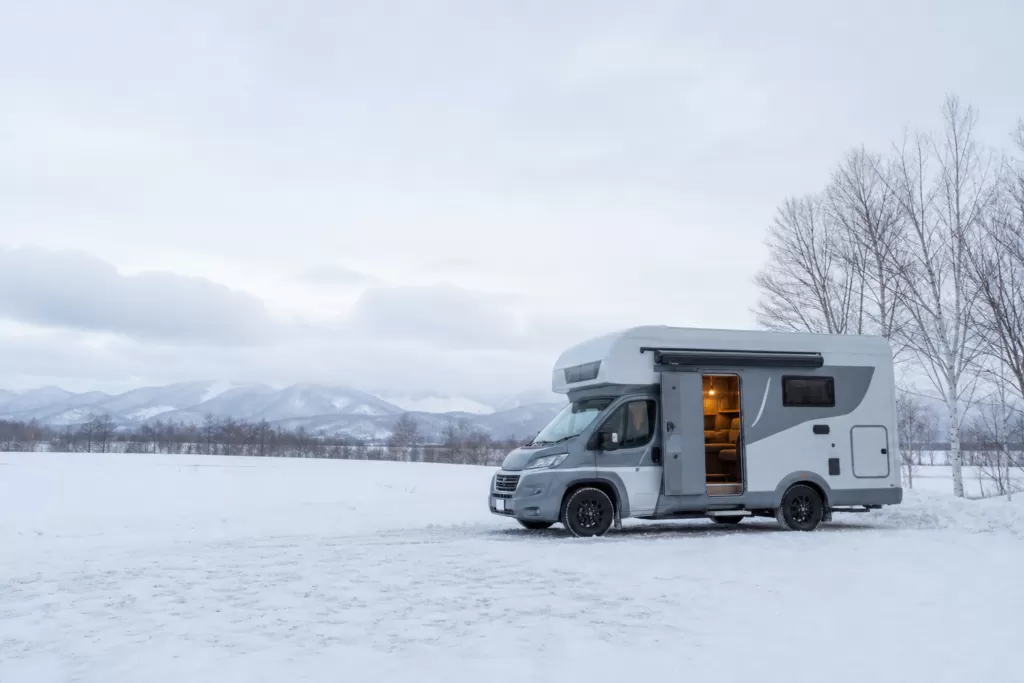
You want to take a winter campervan trip around Hokkaido with your kids. But you’re wondering whether the cold will keep them from sleeping, whether they’ll get restless in a cramped vehicle during a snowstorm, or what to do if they run a fever on the road. The real questions aren’t about which vehicle to pick — they’re about cold-weather prep, keeping kids occupied inside the vehicle, and managing their health. The basics of family campervan trips and vehicle choice are covered in How to Enjoy a Family Campervan Trip in Hokkaido, and preparation for toddlers aged 0–3 is covered in Hokkaido Campervan Guide for Traveling with Toddlers. This article focuses specifically on winter (November–March): how cold it actually gets, how to spend a day stuck indoors during a blizzard, and what to do if your child gets sick inside the vehicle.
How cold does it get on a winter family campervan trip in Hokkaido?
Cold-weather preparation has to start with “how low will it actually go” — otherwise you’ll either over- or under-pack. Here are the monthly normals (1991–2020, 30-year averages) published by the Japan Meteorological Agency for Sapporo and Asahikawa, showing the winter months (December–March).
| Location / Month | Average temperature | Average low temperature |
|---|---|---|
| Sapporo, Dec | -0.9°C | -4.0°C |
| Sapporo, Jan | -3.2°C | -6.4°C |
| Sapporo, Feb | -2.7°C | -6.2°C |
| Sapporo, Mar | 1.1°C | -2.4°C |
| Asahikawa, Dec | -4.2°C | -8.0°C |
| Asahikawa, Jan | -7.0°C | -11.7°C |
| Asahikawa, Feb | -6.0°C | -11.8°C |
| Asahikawa, Mar | -1.4°C | -6.1°C |
Source: Japan Meteorological Agency, “Sapporo (Ishikari region) normals,” https://www.data.jma.go.jp/stats/etrn/view/nml_sfc_ym.php?prec_no=14&block_no=47412, and “Asahikawa (Kamikawa region) normals,” https://www.data.jma.go.jp/stats/etrn/view/nml_sfc_ym.php?prec_no=12&block_no=47407 (both checked 2026-08-25)
Even coastal Sapporo sees normal January and February lows in the -6°C range, and inland Asahikawa drops to around -11°C. These are 30-year averages — a year with a strong cold snap will be even colder. Rather than dressing your kids and setting up your vehicle’s heating for “the normal value,” it’s safer to assume conditions “could be a notch harsher than normal.”
Concern #1: Is an FF heater alone enough to keep the interior warm below freezing?
Most vehicles available for winter rental are equipped with an FF heater (a combustion-type forced-air heater). It runs on kerosene or diesel through a system separate from the driving engine and vents exhaust outside the vehicle, so it can keep heating the cabin even while parked. However, fuel tank capacity and hourly consumption vary by vehicle, so if you’re planning a long overnight stop, confirm with the rental company at booking time how long a full tank will last.
One thing to watch for with kids is their feet. Warm air tends to collect near the ceiling, and children — shorter than adults and closer to the floor — feel the cold more. Beyond the heater’s own output, laying down a floor-insulating mat or thick rug, and applying anti-condensation/insulating film to the windows to block cold air, make a real difference.
At RV parks with electrical hookups, an electric supplementary heater such as a ceramic heater is also an option, but if power draw exceeds what the vehicle’s sub-battery or shore power connection can handle, the breaker can trip — so confirm the wattage with the rental company before bringing one. Details on FF heater refueling and handling are covered in Before Traveling Hokkaido by Campervan in Winter.
Concern #2: Kids’ clothing and bedding — what to add beyond a summer family trip
The basic approach is three layers: a base layer, a mid layer, and an outer shell. Use moisture-wicking base layers that don’t chill when sweaty, a mid layer like fleece that traps air, and an outer shell that blocks wind and snow. The head, neck, hands, and feet lose heat quickly relative to their surface area, so pack hats, neck warmers, gloves, and thick socks for everyone plus spares — you don’t want to be stuck if something gets wet.
Our toddler guide already covers the idea of keeping the room at 18–22°C while sleeping (see Hokkaido Campervan Guide for Traveling with Toddlers), but in areas like the Asahikawa region, where nighttime lows normally drop to around -11°C, it isn’t realistic to maintain that room temperature with the heater off. Plan on running the FF heater through the night, and be sure to check the operating-time and ventilation instructions in the vehicle’s owner’s manual. Bringing a sleeping bag or sleep sack as an extra layer for sleeping also acts as a backup in case the heater stops working.
Compare Hokkaido campervan rentals
Base yourself at New Chitose Airport and compare rates, vehicle types, and pickup locations all in one place.
Compare rental companies and rates →Concern #3: What can kids do inside the vehicle on a blizzard day when you can’t go outside?
This is where a winter Hokkaido trip differs most from a summer one. On days with heavy snow or blizzards, you may need to call off going outside altogether, leaving you with hours to spend entirely inside the vehicle. Packing toys on the assumption that “there will be a day you can’t go outside” changes how manageable that day feels.
Things that work well inside a vehicle include sticker books and magnetic picture books whose pieces don’t scatter, small puzzles, and origami paper. Toys that make noise tend to echo in a confined cabin, so choose ones with adjustable volume, or videos and audio that can be played through headphones — it’s considerate to the rest of the family too. Since phone and tablet signal can drop out along the drive, download videos and apps for offline playback using home or hotel Wi-Fi before you set out.
Keeping some physical activity going also helps both mood and sleep. Work in hand-clap songs or stretches you can do inside the vehicle; at an RV park with power hookups, check whether a common area or the management building is available; at a Michi-no-Eki, let kids walk around a bit in the indoor rest area. Securing even one place outside the cramped cabin where they can move around makes the day lighter than being cooped up for the whole day. Kids’ attention spans tend to run out every 2–3 hours, so preparing toys with the idea of rotating activity types on a schedule helps avoid hitting a wall right when they get bored.
Concern #4: If a fever or stuffy nose shows up inside the vehicle, how much should you handle yourselves?
A fever on the road is something you can ask the front desk about at a hotel, but in a campervan, you’ll find yourselves making more judgment calls on your own. Before you leave, keep a thermometer, any medicine you’ve discussed and prepared with your child’s regular doctor, copies of insurance cards and the maternal and child health handbook, and a nasal aspirator together in one fixed spot in the vehicle — that way you’re not searching for them in the middle of the night.
When you can’t judge the severity of symptoms on your own, you can call the Pediatric Emergency Telephone Consultation Service (“#8000”). It’s a common shortcut number nationwide that automatically routes to the consultation desk for the area you’re calling from, where a pediatrician or nurse can advise on how to handle the symptoms and whether a visit to a doctor is needed. The program has run in every prefecture since fiscal year 2010, operating in the evening on weekdays and from daytime through the next morning on weekends and holidays (Ministry of Health, Labour and Welfare, “About the Pediatric Emergency Telephone Consultation Service (#8000)”, checked 2026-08-25). Operating hours can differ by prefecture, so it helps to check the service details for each prefecture on your itinerary before you leave, so you’re not scrambling if the need arises.
In case you do decide a doctor’s visit is needed, look up in advance how to find the holiday/night emergency clinic or on-duty physician for the areas along your route (each municipality’s official website, local medical association sites, and so on). In Hokkaido, medical facilities become sparser once you leave built-up areas, so it’s less of a burden to research this while planning your itinerary than to search for it once symptoms appear.
Concern #5: What if norovirus-type gastroenteritis or the flu spreads inside a cramped vehicle?
Winter is a season when infectious gastroenteritis and the flu spread easily. A campervan packs the sleeping area, dining space, and living space into one interior, so it’s harder to keep distance than at home — if one family member gets sick, it can spread to the others easily. The core countermeasure is simply not letting the basics slide during the trip: ventilate regularly by opening a window or running the fan even with the FF heater on, and keep hand sanitizer gel near the seats.
Pack a kit of disposable gloves, a solidifying agent, and sealable plastic bags for dealing with vomiting or diaper changes, so a sudden cleanup doesn’t catch you off guard. Many Michi-no-Eki don’t accept this kind of waste in their trash bins, so check for a location that accepts it, such as a convenience store, before disposing of it. If nursing a sick family member in the vehicle’s limited space for several days feels too difficult, it also helps to have the option of switching to an RV park or lodging with a private room rather than pushing on with the itinerary.
Concern #6: Frozen water tanks and toilets — how to handle it with kids along
When temperatures stay below freezing, a vehicle’s water tank or plumbing can freeze and stop delivering water. Freeze-prevention measures (whether a tank heater is fitted, running with minimal water use in winter, etc.) vary by vehicle and rental company, so confirming the winter freeze-prevention setup at booking time is the single best preparation for not getting stuck on-site.
In case of a water outage, it helps to pack more wet wipes and hand sanitizer gel than usual for diaper changes. Some Michi-no-Eki have outdoor taps that freeze over, so if you need to wash hands or rinse diapers, switch to indoor facilities with heated restrooms where available, adjusting your route to the local conditions.
Concern #7: Driving on snow — deciding which days to drive with kids and which to skip
General winter driving technique (following distance, braking, avoiding mountain-pass sections, and so on) is covered in The Complete Guide to Winter Campervan Driving in Hokkaido, and guidance on timing your switch to studless tires is in When Should You Switch to Studless Tires for a Hokkaido Campervan?, so this article focuses only on the judgment calls specific to traveling with kids.
First, children under 6 are legally required to use a child seat even in a campervan (Road Traffic Act, Article 71-3). Even if you resume driving after a night’s sleep, you need to put the child back in the car seat before moving off — and the temptation to skip this step tends to be strongest exactly when you’ve had to stop for a long stretch on a snowy road, so be careful there. Detailed safety rules are covered in Are Child Seats Required in a Campervan? A Safety Guide for Traveling Hokkaido with Kids.
Second, in bad weather, prioritize “not pushing through” over “reaching the next destination today.” A campervan trip’s real strength is not being locked into a fixed lodging, so if a blizzard is forecast, staying an extra night where you are, or pushing your itinerary back a day, are adjustments you can still make on the day itself. Apply the same logic if your child isn’t feeling well — shorten the day’s driving distance, or call off moving that day altogether. If you want to get a handle on first-snow timing and how to structure your itinerary in advance, When Does It First Snow in Hokkaido? Effects on a Campervan Trip and Last-Minute Prep is also useful.
Packing list for a winter family campervan trip
On top of what you’d normally pack for a family trip, check off these additional categories for winter.
| Category | What to add |
|---|---|
| Cold weather / heating | A full three-layer cold-weather outfit (one spare set), hats/gloves/neck warmers, a sleeping bag or sleep sack for bed, a floor-insulating mat, anti-condensation/insulating window film |
| In-vehicle play | Sticker books and magnetic picture books whose pieces don’t scatter, small puzzles, videos/audio that can play offline, toys with adjustable volume, extra picture books beyond the usual amount |
| Health management | Thermometer, medicine pre-discussed with your regular doctor, copies of insurance cards and the maternal/child health handbook, a nasal aspirator, hand sanitizer gel, disposable gloves/solidifying agent/sealable bags (for vomit cleanup) |
| Water-related | Wet wipes (more than usual), waterproof gloves for outdoor use, notes on freeze-prevention measures confirmed for the water/drain tanks |
Indoor spots to enjoy even on a snowy day
Even without a blizzard, there are days you’d rather not keep kids outside for long in below-freezing temperatures. Keeping indoor-centered spots as backup options makes you less at the mercy of the weather.
The “Penguin Walk” at Asahiyama Zoo (Asahikawa City)
During the winter opening season, Asahiyama Zoo typically holds its “Penguin Walk” from mid-December through mid-March. It’s an outdoor event, but there are also times you can watch from inside the penguin house, so you can go back and forth between indoors and out. It can be suddenly cancelled or changed on the day depending on weather and the penguins’ condition, so check the current status on Asahikawa City’s official page before you visit (Asahiyama Zoo, Asahikawa City, checked 2026-08-25).
Chitose Salmon Aquarium (Chitose City)
This freshwater-fish aquarium is mostly indoor exhibits, close to the New Chitose Airport area, so you can stop by without a long detour even on a bad-weather day. Winter hours may be shortened (10:00–16:00), so check the official site for hours and admission before heading over (Chitose Salmon Aquarium — visitor information, checked 2026-08-25).
Sample 1-night, 2-day itinerary (winter, traveling with kids)
In winter, the basic approach is to shorten your daily driving distance and build in time you can spend indoors. Here’s an example based around New Chitose Airport, keeping travel to a minimum.
- Day 1: Pick up your campervan at New Chitose Airport → indoor visit to the Chitose Salmon Aquarium → break and shopping at Michi-no-Eki Salmon Park Chitose (has a nursing room and diaper-changing area) → overnight at RV Park Chitose (has power hookups) (about 20 km of driving)
- Day 2: Room temperature tends to drop overnight, so run the FF heater to warm the cabin thoroughly before setting off → restock diapers and formula in central Chitose → return the vehicle at New Chitose Airport (about 15 km of driving)
At this scale, daily driving stays around 20 km, leaving room to adjust your plans if the weather turns bad. If you extend the trip toward Asahikawa, keep in mind that Dohoku’s normal lows drop to around -11°C, and add an extra travel day to build a more comfortable itinerary.
Frequently asked questions
Q. At what age does a winter family campervan trip in Hokkaido become realistic?
There’s no single lower age limit we can point to. Whether a trip with a 0–3-year-old is workable at all is covered in Hokkaido Campervan Guide for Traveling with Toddlers, but winter assumes you’ll be running the FF heater continuously to hold the nighttime temperature, so check the heating and ventilation setup of the specific vehicle before deciding. If you’re unsure, another option is to try it first in a milder period like November or March.
Q. Is it okay to leave the FF heater running all night?
Recommended usage varies by vehicle and model, so there’s no single answer. Follow the vehicle’s owner’s manual for continuous operating time, fuel consumption, and ventilation needs, and confirm anything unclear with the rental company at booking time.
Q. If my child runs a fever on the road, should I cancel the trip?
It depends on the severity. For a mild fever, staying an extra night where you are and watching how things go, or shortening the next day’s driving distance, can sometimes be enough. If you’re unsure, call the Pediatric Emergency Telephone Consultation Service (“#8000”) and, after getting advice from a pediatrician or nurse, decide whether to see a doctor or continue the trip.
Q. How much in-vehicle play equipment should I pack?
Rather than fixing a target quantity, it’s more practical to think in terms of “enough variety to rotate every 2–3 hours.” Preparing three categories — quiet activities (sticker books, puzzles), video/audio content, and hand-clap or movement games — helps avoid hitting a wall even on a day spent entirely inside due to bad weather.
Q. If I’m not confident driving on snow, should I skip a winter trip with kids?
There’s no need to push through. You can lower the difficulty by shortening driving distances, avoiding mountain-pass routes, and, on bad-weather days, skipping the drive entirely and staying an extra night. Snow driving technique is covered in The Complete Guide to Winter Campervan Driving in Hokkaido — read through it before you go, and if you’re still uneasy, rebuilding your itinerary for a period with less snow is also an option.
Q. RV park or Michi-no-Eki — which is safer with kids?
For an overnight stay in winter, an RV park with power hookups gives you more options for heating and for handling a health issue. A Michi-no-Eki is meant for rest stops, not suited to long stays or working outside the vehicle. Base your overnight lodging around RV parks or campgrounds, and use Michi-no-Eki as daytime rest and shopping stops.
Even by normal values, winter Hokkaido sees nighttime lows drop to around -6°C in Sapporo and around -11°C in Asahikawa. Build these numbers into your pre-trip prep for cold-weather gear, in-vehicle activities, and health management, and stay flexible with your itinerary as you watch the weather and how your kids are doing. That’s the foundation for enjoying a winter family campervan trip without pushing too hard.
New Chitose Airport / Tokachi-Obihiro Airport
Rent the “Cresson Journey” cab-conversion camper
Base yourself at New Chitose Airport and compare rates, vehicle types, and pickup locations all in one place.
See details at Moving Inn →Book a Campervan in Hokkaido
Moving Inn New Chitose Airport supports English booking and offers airport transfers.
Pick a campervan by what matters to you.
Rent in winter (Dec–Mar)
Companies that rent through winter, listed apart from those that close.
![When and Where Can You See Harbor Seals at Cape Erimo? Kaze no Yakata Official Information, Viewing Season, and Windy-Day Notes [2026-27]](https://hokkaido-campingcar.jp/wp-content/uploads/2026/10/erimo-cape-lighthouse-768x511.jpg.webp)
![Where and Under What Conditions Can You See Diamond Dust in Hokkaido? How Cold a Morning It Takes, and Where It Appears [2026-27]](https://hokkaido-campingcar.jp/wp-content/uploads/2026/10/hokkaido-diamond-dust-nayoro-768x512.jpg.webp)
![Can You Drive to Hokkaido Jingu for Hatsumode? Parking, Crowds, and Where to Park and Walk [2027]](https://hokkaido-campingcar.jp/wp-content/uploads/2026/10/hokkaido-jingu-winter-torii-768x504.jpg.webp)
![Hokkaido Roads Over New Year [2026-27] | Expressway Sections Prone to Blizzard Closures, Forecast Congestion Days, No Holiday Discount, and New Chitose Airport Parking](https://hokkaido-campingcar.jp/wp-content/uploads/2026/10/hokkaido-winter-rural-road-edge-markers-768x432.jpg.webp)
![Where to See Sea Smoke (Kearashi) in Hokkaido: Rumoi’s Ogon-misaki and the Morning Conditions [2026-27]](https://hokkaido-campingcar.jp/wp-content/uploads/2026/10/rumoi-kearashi-sea-smoke-768x511.jpg.webp)
![Geminid Meteor Shower 2026 in Hokkaido: Peak Around 23:00 on December 14, Sapporo Moonset 20:40, and Staying Warm in a Winter Campervan [2026]](https://hokkaido-campingcar.jp/wp-content/uploads/2026/10/geminids-2026-hokkaido-768x575.jpg.webp)