Complete Guide to Hokkaido Campervan Travel | Costs, Routes & Packing [2026 Edition]
One article for the full picture of Hokkaido campervan travel: costs for 3 Nights 4 Days to 1 Week, season-by-season routes, and recommended itineraries based at New Chitose Airport, plus Michi-no-Eki overnight parking rules based on guidance from Japan's Ministry of Land, Infrastructure, Transport and Tourism (MLIT), and real named spots such as Hana Road Eniwa and Michi-no-Eki Wakkanai [2026 Edition].
Pick a campervan by what matters to you.
Rent at New Chitose Airport
See only the rental bases in Chitose, where the airport is.
Rent in winter (Dec–Mar)
Companies that rent through winter, listed apart from those that close.
Guide price
Moving Inn New Chitose Airport: HIACE van conversion from ¥22,000 per night. 20–30% off when booked 60–90 days ahead (official rate table, checked 15 Oct 2026).
New Chitose Airport map for campervan travellers →
Before you book: with an International Driving Permit if your country is in the Geneva Convention (for example the US, Australia, Singapore); Taiwan, Switzerland, Germany, France, Belgium and Monaco need your licence plus a Japanese translation (Tokyo Metropolitan Police). Questions in English: Moving Inn on WhatsApp. Every roadside station (michi-no-eki) must have free 24-hour toilets, and Hokkaido has 128 of them (MLIT).
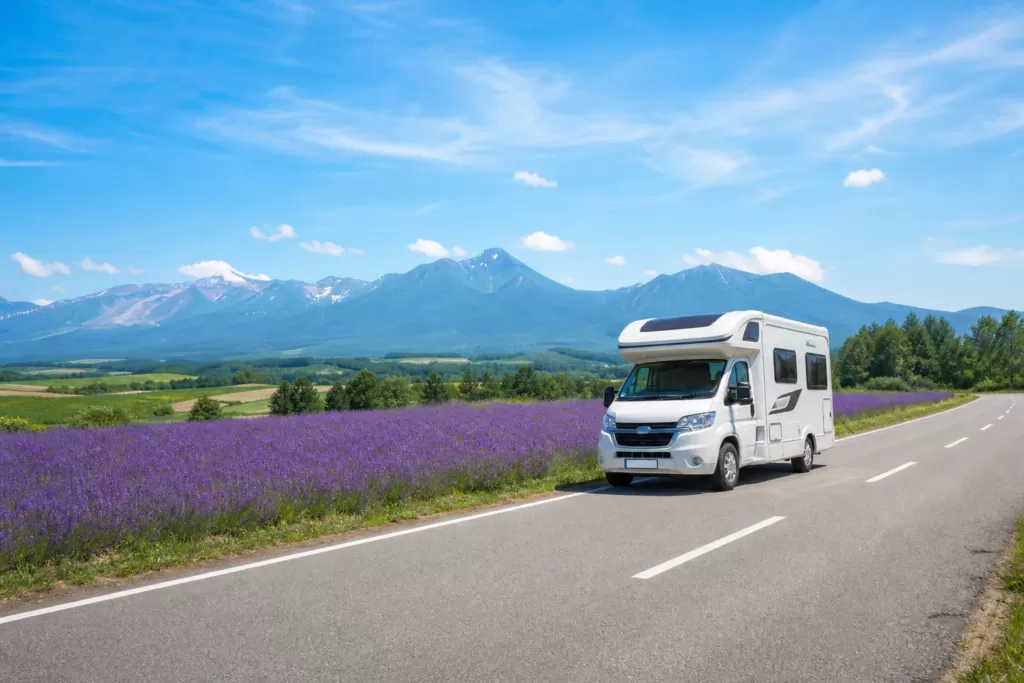
Traveling Hokkaido in a campervan. It’s the experience of driving across a vast landscape at your own pace, freed from hotel check-in schedules. Watch the sunrise through your window over eastern Hokkaido’s grasslands, buy freshly landed fish in a harbor town and cook it in the van — rental campervans make this style of travel immediately accessible. This guide covers the full picture of costs, routes, and preparation for first-time campervan travelers.
Winter (December–March) at a glance
- FF heater: a fuel-fed cabin heater that works with the engine off. Not every rental vehicle has one, so ask at booking. How an FF heater works and how to check
- Studless (winter) tires: the switch date differs by company. Confirm that your vehicle will be on studless tires for your dates. When companies switch to winter tires
- Who rents December–March: official sites confirm winter operation for Moving Inn (New Chitose Airport and Tokachi Obihiro Airport), Camping Lines Hokkaido, Shin-Chitose Campervan Rental Center and BicUp. Tajima Rental Station Shin-Hakodate-Hokuto, Iris Rental Campingcar and Chikichiki Camping Car Rental close in winter (official sites, checked 2026-10-05). Winter rental guide: closures and what to check
Hokkaido campervan travel sounds complicated to many who haven’t tried it, but once you get started, it’s surprisingly simple. Book a rental, sketch a rough route, know where the roadside stations are and what groceries you need — then drive wherever the day takes you. By the end of this guide, we hope you’ll feel: “I can do this.”
Tap a dot on the map to see its name here.
Tap a dot to see its name and a link to where it appears in this article. Dot positions are based on each facility’s address or officially published location. Lakes and expressways are from OpenStreetMap data.
The Appeal of Hokkaido Campervan Travel: The Basics
Hokkaido is Japan's top campervan destination — simply because it's vast yet lightly trafficked, with well-maintained roads that reward driving at a scale impossible on Honshu. There are 128 roadside stations (Michi-no-Eki) across the island (as of August 2026), many of which function as overnight bases for campervans.
Vehicle Types and How to Choose
Rental campervans fall into three broad types: kei campervans (based on a light vehicle), van-conversions (a van with a converted interior), and cab-overs (a truck with a habitation box fitted to the rear).
- Kei campervan: For 1–2 people. Good fuel economy, easy to maneuver, comfortable in tight roads and small parking lots. Cheaper to rent.
- Van-conversion: For 2–3 people. HiAce or similar base with a converted interior. Balances drive performance and living comfort.
- Cab-over: For 2–5 people. Spacious living area; some models have a toilet and shower. Suited to families and extended trips.
First-timers are most often surprised by vehicle size and height. Cab-overs can be 2.5–3 m tall — multi-story car parks and low underpasses are impassable. When planning your route, confirm in advance that roadside stations and campsites you plan to stay at have no height restrictions. For driving tips, see our campervan driving guide: 7 things beginners should know.
Types of Overnight Accommodation
Three main options for overnight stays during a campervan trip:
- Campsites (vehicle access permitted): Electric hookup sites allow you to run the air conditioner and other appliances from shore power. Typically ¥1,000–3,000/night. Some, such as Hokkaido Okhotsk Park Tentorando (Abashiri), have an attached auto campsite.
- Roadside stations (Michi-no-Eki): Free parking at many facilities. But roadside stations are rest areas, not campsites — sleeping in your vehicle is generally tolerated, but extended stays and campsite-style use violate the rules at most facilities. Good manners are mandatory (details in the next section).
- RV parks: Campervan-specific sites with electric hookup, water, and toilets. Typically ¥1,500–3,500/night. Options include Tabisuru Kuruma New Chitose Airport BASE (Chitose), Hana Road Eniwa (Eniwa), Hakodate Ryokuen-dori (Hakodate), and Akan Tancho-no-Sato (Kushiro) — near the airport, in city centers, and next to hot springs.
For a starting point in choosing where to stop, see our 20 recommended Michi-no-Eki for overnight parking in Hokkaido (checked station by station against official sites) and our Hokkaido RV park directory, comparing price, power hookups, and hot springs.
Rules for Overnight Parking at Michi-no-Eki: MLIT's Position and the Legal Points to Know
"Is it okay to sleep at a Michi-no-Eki?" is the single most common question in Hokkaido campervan travel. Japan's Ministry of Land, Infrastructure, Transport and Tourism (MLIT) addressed this directly through its Road Consultation Office: "Michi-no-Eki are rest facilities available 24 hours a day for drivers and others to help prevent traffic accidents, so taking a nap in your vehicle mid-drive to recover from fatigue is not a problem. However, we generally ask that you refrain from using public spaces such as parking lots for overnight lodging purposes" (source: MLIT Road Consultation Office, confirmed 2026-08-13). A nap is fine; using the space as lodging is something they ask you to avoid — that is the official position.
We checked the official websites of 96 of Hokkaido's 128 Michi-no-Eki, and none explicitly banned overnight parking in their lots (confirmed August 2026; the remaining 32 have not been checked). The one exception is Michi-no-Eki Sarufutsu Park (Sarufutsu Village), which asks visitors to refrain: "Please refrain from using the Michi-no-Eki for overnight lodging purposes" (source: Sarufutsu Park official site, confirmed 2026-08-03). The absence of an explicit ban does not mean overnight stays are welcomed. Keep it to a nap and follow each facility's posted rules.
Beyond manners, some actions carry legal penalties. Littering and open burning of trash violate Japan's Waste Management Act. The law states that "no person shall dispose of waste in an improper manner" (Article 16), and violations are punishable by "imprisonment with work for not more than five years or a fine of not more than ¥10,000,000, or both" (Article 25, Paragraph 1, Item 14; open-air burning of trash falls under Item 15 of the same paragraph; source: e-Gov Japanese Law Search, Waste Management and Public Cleansing Act, confirmed 2026-08-13). Take your trash home — that's the rule while traveling.
- OK to do: Taking a nap mid-drive to recover from fatigue (explicitly stated by MLIT above)
- Please refrain: Using the facility for overnight lodging (MLIT states it generally asks visitors to refrain)
- Manners violation: Camping-style behavior such as setting up tables and chairs or a BBQ, running a generator, extended idling, washing dishes or drawing water at the restroom, and multi-night stays
- Legal violation: Dumping trash or open burning (Waste Management Act; penalties as above)
For the full detail on the 8 manners to follow, and the typical chain of events that leads a Michi-no-Eki to ban overnight parking altogether, see our Michi-no-Eki overnight parking etiquette guide. First-timers should read it before setting out. On nights when you want solid sleep or access to power, it's more realistic to use an RV park or campsite where overnight stays are officially permitted.
Cost Simulation: 3 Nights 4 Days to 1 Week
Campervan travel costs = rental fee + fuel + accommodation (campsite/RV park) + food and sightseeing. Here are typical budget ranges.
3 Nights 4 Days Budget
- Rental fee: Kei campervan ¥30,000–50,000; van-conversion ¥60,000–90,000; cab-over ¥100,000–180,000 (varies by season and company)
- Fuel: Assuming 1,000 km, approximately ¥8,000–15,000
- Accommodation: 3 nights at campsite/RV park, approximately ¥3,000–9,000
- Food & sightseeing: ¥3,000–8,000/day × 4 days = ¥12,000–32,000
Total for 2 people in a cab-over: roughly ¥150,000–300,000 for 3 nights 4 days; ¥80,000–150,000 in a kei campervan. Compared to hotel travel, accommodation costs are significantly lower for groups of 2+, but the rental fee means solo travelers may find it more expensive per person.
1 Week Budget
For 6 nights 7 days, per-night rental rates often drop — many companies offer discounts for 7+ nights or consecutive bookings.
- Rental fee (van-conversion, 1 week): ¥120,000–200,000
- Fuel (2,000 km assumed): ¥15,000–25,000
- Accommodation (6 nights): ¥6,000–20,000
- Food & sightseeing (7 days): ¥20,000–55,000
For 2 people in a van-conversion for a week, a realistic total is ¥200,000–350,000. For a detailed breakdown by group size, see our 1-week Hokkaido campervan trip cost simulation; for tips on cutting the total through timing and plan choice, see our cost-saving guide.
Note: whether insurance, damage waiver fees, and one-way return charges are included in the rental price varies by company. Confirm at the time of your quote.
Compare Hokkaido Campervan Rentals
Base yourself at New Chitose Airport and compare rates, vehicle types, and pickup locations all in one place.
Compare rental companies & prices →How to Choose a Route by Season
What you can see and where you can drive in Hokkaido changes dramatically with the seasons. Matching your route to the time of year is key to a satisfying trip. Hokkaido’s weather can also change abruptly — preparation for rain, strong wind, dense fog, and heavy snow matters year-round. Our bad-weather guide covers when to keep driving, when to stop, and when to wait it out.
Spring (late April – June): Flowers and Fresh Green
Central and southern Hokkaido spring to life around Golden Week. Furano/Biei lavender is yet to bloom, but moss phlox (Takino) and tulips (Kamiyubetsu) are at their peak. By June, eastern Hokkaido wetlands return to green, and Kushiro Wetlands and Shiretoko offer spring landscapes. Fewer tourists mean quieter roadside stations and more flexibility. Snow may still block mountain passes (Daisetsuzan, Shiretoko) — check road information before setting out. For spot selection in this season, see our spring travel guide.
Summer (July – August): Peak Season Golden Route
July and August are the Hokkaido campervan peak. Furano/Biei lavender, Soya Cape, Sounkyo's Daisetsuzan, and Shiretoko World Heritage site are all accessible in their best form. Rental prices are highest, and popular roadside stations and campsites get crowded. Book 2–3 months in advance. For crowd-avoidance tips and a sense of July–August costs, see our summer travel guide.
Autumn (September – October): Foliage and Food
Daisetsuzan foliage starts in mid-September; by October the colors reach eastern and southern Hokkaido. Temperatures drop — choose a campervan with an FFheater for night comfort. Autumn Hokkaido offers saury, autumn salmon, and pumpkin to cook in the van. Popular foliage areas (Mt. Asahidake, Mikuni Pass) get crowded — arrive early. For foliage spot details, see our autumn travel guide. On cold nights, pairing your stop with a day-use hot spring bath makes a real difference in comfort — our hot spring guide covers how to find one.
Winter (November – March): Advanced-Level Snow Routes
Winter campervan travel in Hokkaido is for experienced drivers. Icy roads, whiteout conditions, and temperatures below -20°C require active risk management. But drift ice at Abashiri and Mombetsu, snowy Biei, and the frozen world of Notsuke Peninsula are only possible in winter. Choose a winter-equipped campervan (studded snow tires, FF heater, insulated body) and keep your itinerary compact. For equipment and winter route planning, see our winter travel guide.
What to Prepare Before Your Trip
Comfort in a campervan depends largely on pre-trip preparation. Here are the things first-timers most often wish they'd confirmed or packed.
Confirm Before Renting
- Driver's license class: Cab-overs with gross vehicle weight over 5 t require a medium-duty license. Confirm beforehand.
- Insurance and damage waiver: Check third-party, property damage, and vehicle coverage, plus the deductible (self-pay) amount.
- One-way rental: Can you pick up at New Chitose and return at Asahikawa? What is the surcharge?
- Equipment: Confirm whether toilet, shower, microwave, FF heater, and shore power connector are fitted — these vary widely by vehicle.
- Pets: Pet-friendly vehicles and companies are limited. For pet travel, see our pet-friendly campervan travel guide.
Packing List (Essentials)
Rental campervans usually come with bedding, cookware, and basic tableware, but some items are worth bringing yourself.
- Clothing: Thin fleece and windbreaker for layering (mornings and evenings are cold even in summer)
- Food & condiments: Stock up at a supermarket at the start of the trip. Mini bottles of soy sauce, salt, and olive oil are convenient.
- Insect repellent: At campsites, insect spray and mosquito netting are essential. Horseflies are heavy in eastern and northern Hokkaido in summer.
- Power bank & charging cables: Large-capacity bank for periods when charging in the van isn't possible.
- Garbage bags: Roadside stations generally require you to take your trash home. Some areas require designated bags.
- Towels & toiletries: Bring extras for campsite showers.
- Portable speaker / entertainment: For pleasant evenings in the van.
For a full detailed checklist and "must-not-forget" items, see our campervan trip packing checklist. Read it before you go. For BBQ and in-van cooking gear and how to source ingredients at campsites, see our camp cooking and BBQ guide (BBQ is not permitted in Michi-no-Eki parking lots).
How to Use Shore Power (EHU)
Plugging into a campsite electric hookup allows you to run the air conditioner, microwave, and electric blanket. You need a dedicated cable (EHU cord), which most rental companies supply. For details on how to use it, see our shore power guide.
Recommended Itineraries Based at New Chitose Airport
Most Hokkaido visitors arrive via New Chitose Airport. Being able to step into a campervan on arrival and drive away immediately is a major advantage of Hokkaido rental campervan travel. Multiple companies have offices near the airport with shuttle pickup. For details on rental companies near New Chitose Airport, see our Sapporo / New Chitose Airport campervan rental comparison. If you’re bringing your own campervan from Honshu by ferry, our Honshu round-trip ferry guide covers routes and vehicle transport fares.
Plan A: Central & Eastern Hokkaido Loop (4–5 days)
From New Chitose Airport: Tomakomai → Hidaka → Obihiro → Kushiro → Lake Akan → Abashiri → Shiretoko, then return. Total distance 700–900 km. Adding Furano/Biei works as a return detour. Eastern Hokkaido has few traffic lights but also fewer gas stations — refuel whenever you see one. Candidate overnight stops include Michi-no-Eki Utoro Shiretoko (Shari — the gateway to Shiretoko; in summer, parking can fill up after 19:00), Michi-no-Eki Mashu Onsen (Teshikaga; its official site states 24-hour restrooms, confirmed August 2026), and RV park Akan Tancho-no-Sato (Kushiro), which has a hot spring.
Plan B: Central Hokkaido — Furano & Biei (3–4 days)
New Chitose Airport → Sapporo → Otaru → Biei → Furano → Tomamu → New Chitose Airport. Total distance around 500 km — relatively short and well suited to a first campervan trip. In lavender season (July), Farm Tomita in Furano is unmissable. Time for wine and seafood in Otaru and Yoichi is built in. In Biei, Michi-no-Eki Biei "Shirogane Birke" has a paid campervan-only site (spring–autumn only, confirm in advance) where you can plug into shore power for a proper rest. For your first or last night, Michi-no-Eki Hana Road Eniwa (Eniwa) — about 15 minutes by car from New Chitose Airport and home to an attached RV park — is well positioned.
Plan C: Hokkaido Top-to-Bottom in the Cresson Journey (5–7 days)
From June 2026, Moving Inn based at New Chitose Airport started renting the cab-over "Cresson Journey." It's a full-spec campervan with toilet, shower, and large refrigerator — enabling a fully self-sufficient trip with no hotels. New Chitose Airport → Furano & Biei → Asahikawa → Wakkanai → Rishiri Island ferry → Rumoi → New Chitose Airport. The spacious, comfortable interior makes a 5–7 day top-to-bottom Hokkaido traverse well within reach. Candidate overnight stops along the way include Michi-no-Eki Wakkanai (Wakkanai; its official site states 24-hour restrooms, confirmed August 2026) and RV park Nayoro Onsen Sun Pillar (Nayoro), which has a hot spring.
New Chitose Airport / Tokachi-Obihiro Airport
Rent the Cab-Over Campervan "Cresson Journey"
Base yourself at New Chitose Airport and travel all across Hokkaido by campervan.
See details at Moving Inn →Plan D: Southern Hokkaido — Hakodate & Onuma (2–3 days)
From New Chitose Airport south along the expressway: Lake Toya → Noboribetsu → Hakodate → Onuma Park. Hakodate packs night views, the morning market, and historic Western-style buildings into one city — an accessible first Hokkaido destination. Total distance 400–500 km — manageable for drivers who are nervous about the size of the vehicle. In central Hakodate, RV park Hakodate Ryokuen-dori is a candidate stop; toward Onuma, Michi-no-Eki "YOU, Yu, Mori" (Mori), which looks out on Mt. Komagatake, is another option. For campervan rental options in Hakodate, see our complete Hakodate campervan rental comparison.
Frequently Asked Questions (FAQ)
Q: Can I drive a campervan with a regular driver's license?
Most van-conversions and kei campervans can be driven on a standard license (including automatic-only). However, large cab-overs with gross vehicle weight over 5 t may require a medium-duty license. Confirm "regular license OK" when booking. Licenses obtained before 2007 under the old system may permit vehicles up to 8 t — check your license class.
Q: How many days do I need to travel all of Hokkaido in a campervan?
A full circuit (central → northern → eastern → southern) requires a minimum of 7–10 days. 10–14 days gives comfortable time at each stop. Hokkaido's scale is nothing like Honshu — it's 500+ km from one end to the other. For shorter trips, it's better to focus on one region deeply than to rush through all the famous spots.
Q: What is the best time to travel Hokkaido in a campervan?
For first-timers, late June to September is ideal. Weather is stable, and most campsites and RV parks are open. July–August has the most iconic Hokkaido summer scenery but also peak crowds and peak prices. June and September offer lower prices and fewer crowds — excellent value.
Q: Is sleeping in my campervan at a roadside station OK?
MLIT states: "Taking a nap in your vehicle mid-drive to recover from fatigue is not a problem. However, we generally ask that you refrain from using public spaces such as parking lots for overnight lodging purposes" (MLIT Road Consultation Office, confirmed 2026-08-13). Keep it to a nap, and don’t cook, set up tables, or BBQ. For the full rules, read the "Rules for Overnight Parking at Michi-no-Eki" section above and our Michi-no-Eki overnight parking etiquette guide before you go.
Q: What should families with children especially watch out for?
First confirm whether a child seat can be fitted in the vehicle — some models don't have compatible rear seat anchor points. For young children, a toilet-equipped cab-over eliminates roadside bathroom urgency. For family-specific tips and route recommendations, see our family Hokkaido campervan travel guide.
Q: What happens if I'm in an accident in a rental campervan?
Third-party and property damage insurance is generally included. However, a vehicle damage deductible of ¥50,000–100,000 is common; many companies offer a damage waiver (optional daily fee) to reduce the deductible to zero. Confirm coverage and deductible before signing, and consider adding the damage waiver if uncertain. Note that tire punctures and damage to interior fittings are typically not covered by standard vehicle insurance.
Q: How is the toilet in a campervan handled?
Toilet-equipped campervans have cassette toilets or flush toilets. A cassette toilet's removable tank is emptied at the waste disposal facilities at RV parks and campsites. A flush toilet's black water tank is drained at dump stations. Hokkaido's RV parks and campsites have disposal facilities widely distributed — empty regularly along your route and you won't run short. If the vehicle has no toilet, convenience stores, roadside stations, and gas stations provide facilities along the way.
Book a Campervan in Hokkaido
Moving Inn New Chitose Airport supports English booking and offers airport transfers.
Pick a campervan by what matters to you.
Rent at New Chitose Airport
See only the rental bases in Chitose, where the airport is.

![When and Where Can You See Harbor Seals at Cape Erimo? Kaze no Yakata Official Information, Viewing Season, and Windy-Day Notes [2026-27]](https://hokkaido-campingcar.jp/wp-content/uploads/2026/10/erimo-cape-lighthouse-768x511.jpg.webp)
![Where and Under What Conditions Can You See Diamond Dust in Hokkaido? How Cold a Morning It Takes, and Where It Appears [2026-27]](https://hokkaido-campingcar.jp/wp-content/uploads/2026/10/hokkaido-diamond-dust-nayoro-768x512.jpg.webp)
![Can You Drive to Hokkaido Jingu for Hatsumode? Parking, Crowds, and Where to Park and Walk [2027]](https://hokkaido-campingcar.jp/wp-content/uploads/2026/10/hokkaido-jingu-winter-torii-768x504.jpg.webp)
![Hokkaido Roads Over New Year [2026-27] | Expressway Sections Prone to Blizzard Closures, Forecast Congestion Days, No Holiday Discount, and New Chitose Airport Parking](https://hokkaido-campingcar.jp/wp-content/uploads/2026/10/hokkaido-winter-rural-road-edge-markers-768x432.jpg.webp)
![Where to See Sea Smoke (Kearashi) in Hokkaido: Rumoi’s Ogon-misaki and the Morning Conditions [2026-27]](https://hokkaido-campingcar.jp/wp-content/uploads/2026/10/rumoi-kearashi-sea-smoke-768x511.jpg.webp)
![Geminid Meteor Shower 2026 in Hokkaido: Peak Around 23:00 on December 14, Sapporo Moonset 20:40, and Staying Warm in a Winter Campervan [2026]](https://hokkaido-campingcar.jp/wp-content/uploads/2026/10/geminids-2026-hokkaido-768x575.jpg.webp)