Large or Small Campervan? How to Choose for Your Hokkaido Trip [2026 Edition]
Using the vehicle classification under Japan's Road Transport Vehicle Act (MLIT) as a baseline, this guide sorts out the gap between the industry terms "large" and "small," then covers how to decide between them for a Hokkaido trip across 5 axes: group size, driving experience, itinerary, cost, and road conditions.
Pick a campervan by what matters to you.
Rent at New Chitose Airport
See only the rental bases in Chitose, where the airport is.
Rent in winter (Dec–Mar)
Companies that rent through winter, listed apart from those that close.
Guide price
Moving Inn New Chitose Airport: HIACE van conversion from ¥22,000 per night. 20–30% off when booked 60–90 days ahead (official rate table, checked 15 Oct 2026).
Before you book: with an International Driving Permit if your country is in the Geneva Convention (for example the US, Australia, Singapore); Taiwan, Switzerland, Germany, France, Belgium and Monaco need your licence plus a Japanese translation (Tokyo Metropolitan Police). Questions in English: Moving Inn on WhatsApp. Every roadside station (michi-no-eki) must have free 24-hour toilets, and Hokkaido has 128 of them (MLIT).
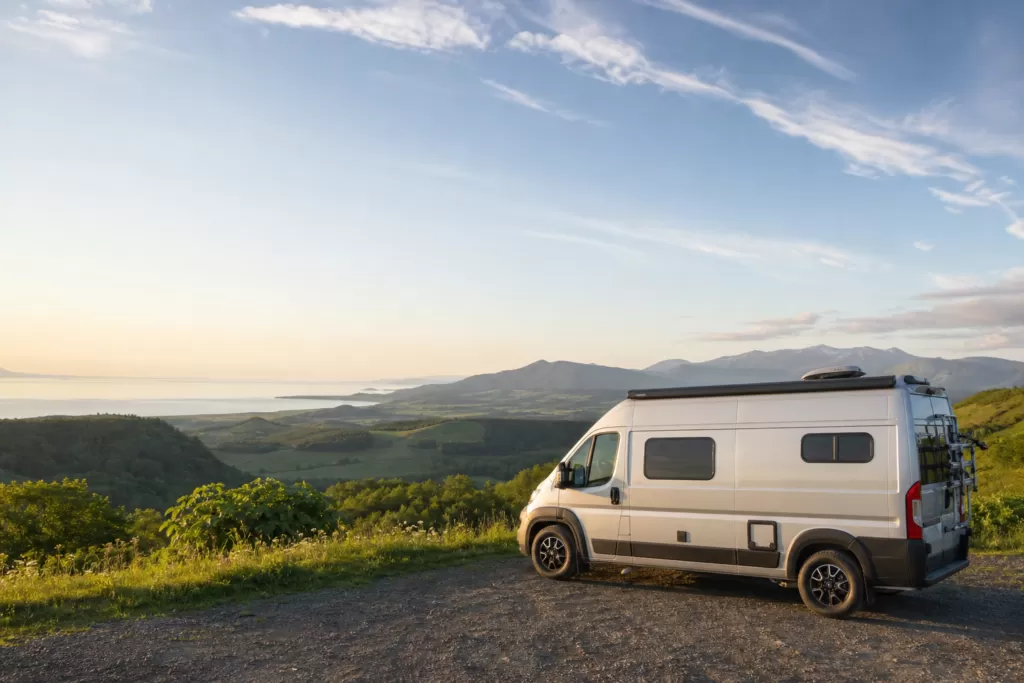
The terms “large” and “small” used for campervans are not, in fact, an official legal classification. Under Japan’s Road Transport Vehicle Act, as administered by the Ministry of Land, Infrastructure, Transport and Tourism (MLIT), four-wheeled vehicles fall into three categories: kei (light) vehicles, small vehicles, and standard vehicles. The standard for a small vehicle is a total length of 4.7m or less, width of 1.7m or less, height of 2.0m or less, and engine displacement over 660cc up to 2,000cc (diesel vehicles are not subject to the displacement standard); anything beyond that is a standard vehicle (MLIT, “Types of Automobiles,” confirmed August 25, 2026). Measured against this standard, many vancons — often thought of as “small” — actually run 4.8–5.4m in length and 2.1–2.3m in height, already putting them in the standard-vehicle category. In other words, the industry’s “large” (cabcons, etc.) and “small” (vancons, etc.) are just a customary way of speaking, separate from the actual large/small distinction in vehicle classification.
This article first sorts out the gap between the legal classification and the industry’s terminology, then lays out how to decide whether to book “large” or “small” for a Hokkaido trip using practical criteria: group size, driving experience, itinerary, cost, and road conditions. For detailed vehicle-type features, see Comparing Campervan Types: Features and How to Choose Among 7 Types; for a detailed cabcon-vs-vancon comparison, see Cabcon vs. Vancon: Differences and How to Choose. This article focuses narrowly on the decision axis of “am I more of a large-vehicle type or a small-vehicle type.”
New Chitose Airport / Tokachi-Obihiro Airport
Rent the Cabcon “Cresson Journey”
Moving Inn New Chitose Airport now takes bookings for full cab conversions. Both large and small vehicles can be picked up at New Chitose Airport.
See details at Moving Inn →Where is “large” vs. “small” legally defined?
Under the vehicle classification based on MLIT’s Road Transport Vehicle Act, four-wheeled vehicles are divided by size into three categories: kei (light) vehicles, small vehicles, and standard vehicles. A kei vehicle is 3.4m or less in length, 1.48m or less in width, 2.0m or less in height, and 660cc or less in displacement. A small vehicle is 4.7m or less in length, 1.7m or less in width, 2.0m or less in height, and over 660cc up to 2,000cc in displacement (diesel vehicles are not subject to the displacement standard). A standard vehicle is defined as anything larger than a small vehicle (MLIT, “Types of Automobiles,” confirmed August 25, 2026). This classification is used for vehicle inspection and registration — it isn’t a special standard unique to campervans.
| Category | Length | Width | Height | Engine displacement |
|---|---|---|---|---|
| Kei (light) vehicle | 3.4m or less | 1.48m or less | 2.0m or less | 660cc or less |
| Small vehicle | 4.7m or less | 1.7m or less | 2.0m or less | Over 660cc up to 2,000cc |
| Standard vehicle | Larger than a small vehicle | Same | Same | Same (no displacement standard for diesel) |
This standard applies just as much to the regular car or kei car you already drive. Many minivans and SUVs exceed 4.7m in length and so count as standard vehicles, while kei cars stay literally within the kei classification. Campervans are measured against the very same yardstick.
Even a vancon isn’t necessarily “small” — the gap between vehicle classification and everyday terms
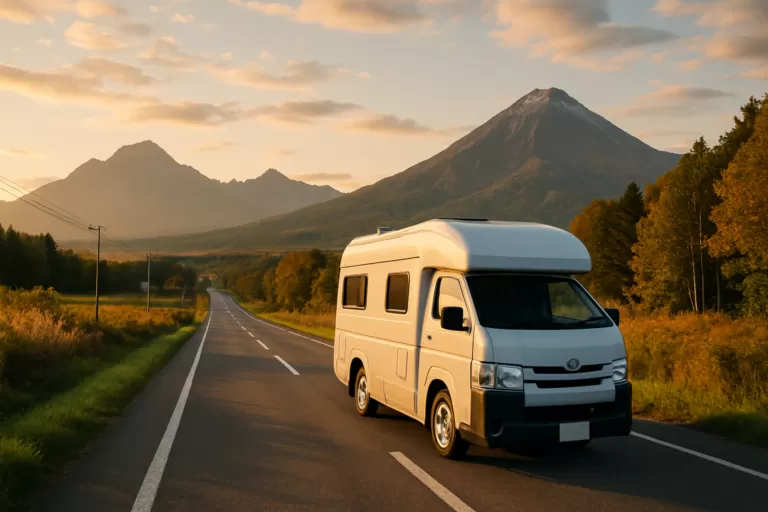
What’s worth watching here is that the campervan industry’s “large” and “small” labels often don’t line up with the classification above. Cross-checking against the dimension data in Comparing Campervan Types: Features and How to Choose Among 7 Types, only the kei-camper, at roughly 3.4m in length, fits within the kei-vehicle category. Vancons (roughly 4.8–5.4m long, 2.1–2.3m high) already exceed the small-vehicle standard (4.7m or less in length, 2.0m or less in height) and mostly fall into the standard-vehicle category. Cabcons (roughly 5.0–5.5m long), buscons (roughly 6.0–7.0m long), and full conversions (roughly 10–12m long) are naturally standard vehicles too. In other words, the vancon that’s called “small” sits in the very same standard-vehicle bracket, legally, as the cabcon that’s called “large.”
From here on, when this article uses “large” and “small,” it means the industry’s customary image — cabcons, buscons, full conversions, and truck campers leaning “large”; vancons and kei-campers leaning “small” — not the actual vehicle classification. For judging how easy a vehicle is to drive and park, the license classification (based on gross vehicle weight), covered next, and each vehicle’s actual length and height are more useful than the vehicle classification.
How far can you drive with your license?
Separate from vehicle classification (size), driver’s licenses are classified under the Road Traffic Act based on gross vehicle weight. A standard license obtained on or after March 12, 2017 covers vehicles under 3.5t gross weight with capacity for 10 or fewer passengers, and most kei-campers, vancons, and small cabcons (Camroad-based, roughly 3.0–3.4t) fall within that range. Large cabcons and buscons over 3.5t require at least a semi-medium-duty license. Since the class of vehicle you can drive depends on when you obtained your license, check the reference table for which vehicle types match your license in Can You Drive a Campervan on a Standard License? A Reference Table by License Class. The key point to keep in mind here is simply that a vehicle that looks “large” can sometimes be driven on a standard license, and a vehicle that looks “small” can sometimes require a higher license depending on its weight — appearance and license class don’t always match.
Split by group size: is small enough, or do you need large?
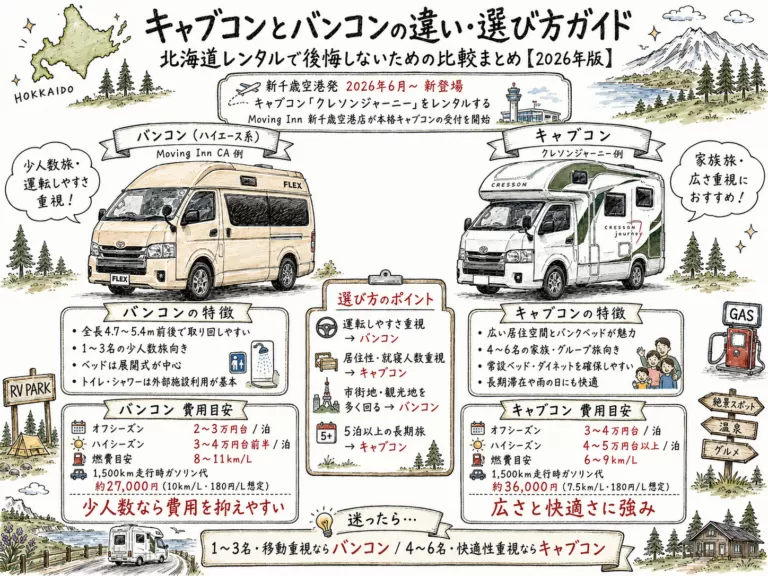
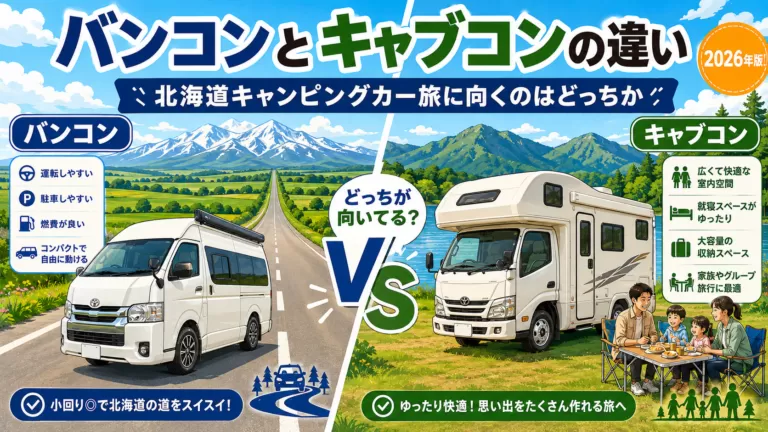
In practice, the clearest line between “large” and “small” is seating and sleeping capacity. For 1–2 people, a small-leaning vehicle such as a kei-camper or vancon is often plenty; for 3–4 people, both vancons and cabcons become viable options. For 5 or more, a vancon’s sleeping space tends to fall short, making a large-leaning vehicle like a cabcon a more realistic choice. Guidelines on sleeping capacity by vehicle type are in Features and How to Choose Among 7 Types, and how cabcons and vancons each suit different situations is covered in Cabcon vs. Vancon: Differences and How to Choose — if your group size is already fixed, use those to narrow down a vehicle.
Split by driving experience: is it okay to jump straight into a large vehicle?
If you regularly drive a minivan or SUV, a vancon at roughly 4.8–5.4m in length tends to feel relatively familiar. On the other hand, large-leaning cabcons and buscons — over 5m long and 2.7m or more in height — demand more attention while you get used to them: rear visibility, the wider turning radius at the rear wheels, and watching for height limits in parking structures. If you’re unsure about your driving experience, it’s worth asking the rental company whether you can practice reversing and parking in their lot before you set off. Driving tips themselves are covered in Campervan Driving Tips: 7 Points Beginners Should Know. If you’re especially nervous about your first campervan trip, it’s also realistic to start with a small-leaning vancon or kei-camper to get comfortable, then move up to a large-leaning vehicle on your next trip.
Split by travel style: touring or based at one spot?
For a touring-style itinerary that moves to a different place every day and visits many roadside stations and sightseeing spots, a small-leaning vehicle that’s nimble and doesn’t demand much thought about where to park is easier to move around in. Conversely, for a base-style itinerary where you stay multiple nights in one or two spots and take day trips around them, you’ll spend more time inside the vehicle, so the extra comfort of a large-leaning vehicle’s roomier living space starts to pay off. Deciding, while planning your itinerary, how many places you’ll visit per day and how many nights you’ll stay at the same spot gives you material for judging whether large or small suits you better.
Split by cost: the total difference in rental fees and fuel
Large-leaning vehicles tend to cost more in both rental fees and fuel than small-leaning ones, in exchange for more living space. Specific rate ranges, fuel-efficiency guidelines, and total-cost comparisons split per person are covered in the cost section of Cabcon vs. Vancon: Differences and How to Choose — check there for a sense of the numbers. The point worth keeping in mind here is just this: the larger your group, the more the per-person cost of choosing a large-leaning vehicle tends to shrink, while choosing large-leaning for just 1–2 people tends to weigh more heavily per person. Overall rental rate ranges are in Rental Rate Guide: Prices and How to Rent Smart, and fuel-efficiency comparisons by vehicle type are in Campervan Fuel Efficiency Comparison Guide.
How large and small each handle Hokkaido’s road conditions
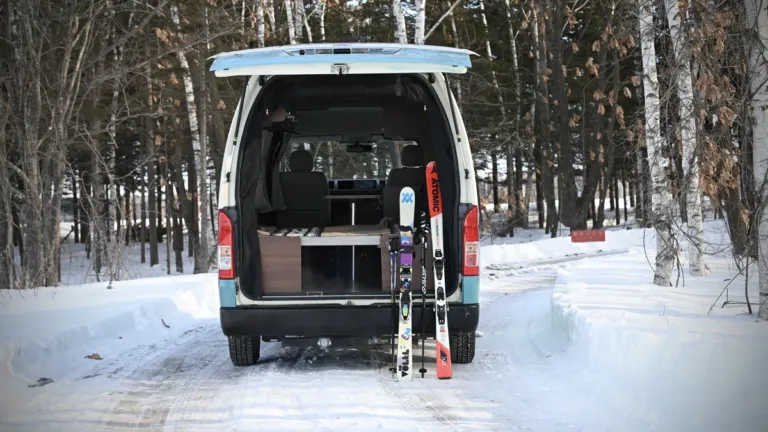
Hokkaido has long, flat, single-lane-each-way stretches on its national and prefectural roads, so large-leaning vehicles feel less unwieldy here than they might in a mainland Japanese city. That said, in the city centers of Sapporo, Asahikawa, and Hakodate, and in sightseeing-area parking lots (including multi-story and underground lots with height limits), a large-leaning vehicle calls for more caution. Differences in road conditions — covering national-highway driving, sightseeing parking lots, ferry transport, and how to spend time inside the vehicle during bad weather — are covered in detail in Cabcon vs. Vancon: Differences and How to Choose; check there if your route is already set. If you’re planning to drive in winter (November through March), sections where snow-clearing narrows the road, and passing oncoming traffic on packed-snow roads, can call for extra width margin — if you’re not used to winter driving, choosing a small-leaning vehicle, or confirming with the rental company in advance whether studded/winter tires are fitted, is the safer approach.
Downsides of large-leaning vehicles: more constraints in exchange for living space
Large-leaning vehicles trade extra living space for a set of concrete constraints. Knowing exactly where and how the inconvenience shows up — rather than a vague sense that “it’s harder to maneuver” — helps prevent a mismatch after booking.
- Fewer places to park: MLIT’s “Parking Lot Design and Construction Guidelines” set standard parking-bay dimensions by vehicle type: 6.0m long by 2.5m wide for standard passenger cars, and 13.0m long by 3.3m wide for large trucks and buses (this notice was also issued to the Hokkaido Regional Development Bureau’s Construction Department. MLIT, “About the Parking Lot Design and Construction Guidelines,” confirmed August 26, 2026). Buscons and full conversions over roughly 6m long may not fit at parking lots or roadside stations without a large-vehicle bay, and even a cabcon in the 5m range can run out of room where the actual bay is smaller than the standard.
- May not fit multi-story or underground lots: Large-leaning vehicles often run roughly 2.8–3.2m in height, which won’t clear multi-story or underground lots with height limits around 2.1–2.5m. Check your vehicle’s actual height in advance and plan a route that avoids height-restricted lots.
- Wider turning offset and rear overhang: A longer body means a bigger gap between front and rear wheel paths when turning (the inside wheels cut a tighter line than the front), and more rear overhang swinging outward. At tight intersections this makes curbs and guardrails easier to clip on a left turn, and calls for a wider turning arc than you’d use in a regular car.
- Worse fuel economy, higher fuel costs: As a guideline, a vancon (Hiace-based) runs roughly 8–11 km/L, while a large-leaning cabcon runs roughly 6–9 km/L (varies by vehicle, load, and driving conditions). Over a roughly 1,500km trip, the fuel-cost gap can run close to ¥10,000.
- Less road-width margin in winter (November–March): After snowfall, snow banks along the roadside can narrow the effective width of the carriageway, and some stretches require “widening snow removal” to restore the needed width (City of Sapporo, “Widening Snow Removal,” confirmed August 26, 2026). The wider the vehicle, the less margin you have for passing oncoming traffic or pulling aside in these stretches.
Downsides of small-leaning vehicles: less margin in exchange for nimbleness
Small-leaning vehicles trade easier handling for a set of concrete limits on comfort. Worth confirming before booking, weighing them against your group size, trip length, and how likely bad weather is.
- A cap on sleeping capacity: Most vancons use a fold-out bed made by flattening the rear seats, and sleeping space tends to fall short once you’re 5 or more people. For a group with a fixed headcount, always check the sleeping capacity on the vehicle’s spec sheet.
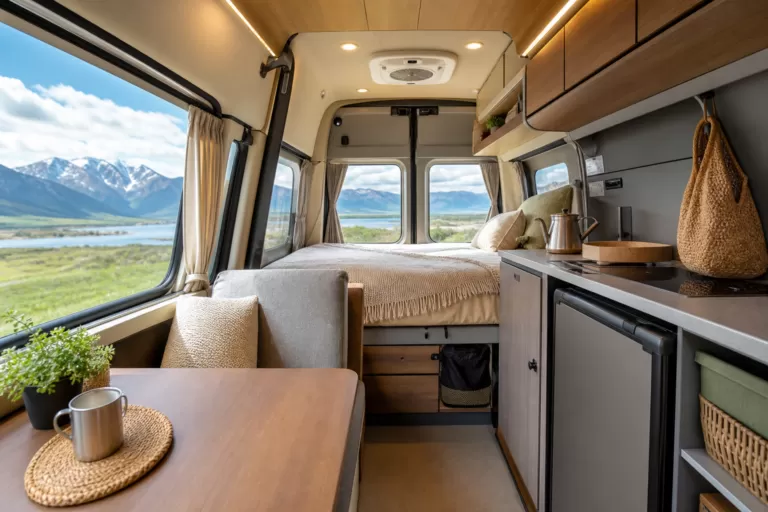
- Cramped inside during bad weather: A vancon’s living, kitchen, and sleeping areas are one combined space, so spending long stretches inside with 4 or more people during rain or wind can feel tight. Since living and sleeping aren’t separated the way they are in a cabcon, this matters more on an itinerary with extended bad weather.
- Smaller storage and fridge capacity: A vancon’s fridge runs roughly 25–40L, versus roughly 50–100L for a large-leaning cabcon — a gap that directly affects how much food you can keep and how often you need to restock on a longer trip.
- Many models have no onboard toilet or shower: Most vancons don’t have a toilet or shower installed, so you’ll rely on outside facilities — roadside stations, convenience stores, hot springs. Late at night or early morning in mountainous stretches, those facilities can be far apart, so it’s worth building in the habit of using the toilet before bed.
Self-check: are you more the large type or the small type?
Here’s a checklist you can run through on the spot before booking, based on the criteria above. The more items that apply, the closer that direction likely fits your trip.
You’re probably more suited to a large-leaning vehicle if
- You have 5 or more people traveling together
- You’re planning a base-style itinerary with 3 or more nights in the same spot
- You want to stay comfortable inside the vehicle even on rainy or bad-weather days
- You have minivan- or SUV-level driving experience and aren’t put off by driving a bigger vehicle
- You want a shower and toilet on board
You’re probably more suited to a small-leaning vehicle if
- You have roughly 1–3 people traveling together
- You’re planning a touring-style itinerary that changes location every day
- This is your first time driving a campervan, or you’re unsure about it
- You want to keep fuel and rental costs as low as possible
- You’ll be doing a lot of sightseeing and parking in tight spots in urban areas
If many items apply on both sides, deciding based on which matters more — group size or how light and flexible your itinerary needs to be — keeps your choice from wavering. As a basic rule of thumb: a larger group points toward large-leaning, and prioritizing a nimble itinerary points toward small-leaning.
What to confirm with the rental company if you’re still unsure
If the checklist doesn’t settle it, confirming the following with the rental company before booking can prevent a mismatch after the fact.
- Whether the candidate vehicle’s gross vehicle weight is drivable on your license, based on when you obtained it
- The candidate vehicle’s length, width, and height (to check against height limits in multi-story parking or ferry transport)
- Whether you can practice reversing and parking in their lot before setting off
- Whether sleeping capacity and seating capacity are the same, or different
- For winter use, whether studded/winter tires and cold-weather equipment (such as an FF heater) are fitted
If it’s hard to picture which vehicle suits you on a first booking, it’s also realistic to rent a small-leaning vehicle first to get a feel for driving it, then move up to a large-leaning vehicle on your next trip. The full flow from booking to return in Hokkaido is covered in The Complete Guide to Your First Hokkaido Campervan Rental.
New Chitose Airport / Tokachi-Obihiro Airport
Rent the Cabcon “Cresson Journey”
From large cabcons to small vancons, pick up at New Chitose Airport and head out on your Hokkaido trip.
See details at Moving Inn →Want to know more about representative large and small models?
This article focuses narrowly on how to decide between large and small, and doesn’t cover detailed vehicle features, base chassis, or equipment differences model by model. If you want to compare all 7 types, see Comparing Campervan Types: Features and How to Choose Among 7 Types. For a deeper comparison between the cabcon — the large-leaning archetype — and the vancon — the small-leaning archetype — see Cabcon vs. Vancon: Differences and How to Choose. The cabcon alone is covered in What Is a Cabcon? Features, Pros and Cons, and How It Differs from a Vancon; the vancon alone in What Is a Vancon? Features, Pros, and Cons; the large-leaning buscon in What Is a Buscon? Features of a Large Campervan; and the small-leaning kei-camper, a representative small model, in The Complete Kei-Camper Guide.
Frequently asked questions
Is there a legal definition of “large” and “small” for campervans?
There is a vehicle classification (kei, small, and standard vehicles) under the Road Transport Vehicle Act, but the industry’s “large” (cabcons, etc.) and “small” (vancons, etc.) are a separate, customary way of speaking, distinct from that classification. Many vancons already exceed the small-vehicle standard of 4.7m in length and 2.0m in height, putting them in the standard-vehicle category under the law (MLIT, “Types of Automobiles,” confirmed August 25, 2026).
For a first campervan trip, should I choose large or small?
If you’re unsure about your driving experience, or your group is small — roughly 1–3 people — starting with a small-leaning vancon or kei-camper is less likely to go wrong. If your group is 5 or more, or you’re planning multiple nights in the same spot, the living space of a large-leaning cabcon starts to pay off.
Could choosing large mean my license isn’t enough?
Large-leaning cabcons and buscons over 3.5t gross vehicle weight may not be drivable on a standard license obtained on or after March 12, 2017. Check the required license by vehicle type and by when you obtained your license in the reference table by license class before booking.
Is large or small safer for Hokkaido winters (November–March)?
If you’re not used to winter driving, a small-leaning vehicle is easier to handle when passing oncoming traffic on sections narrowed by snow clearing. Regardless of vehicle size, you need to confirm with the rental company in advance whether studded/winter tires and cold-weather equipment such as an FF heater are fitted.
If I want to save money, will choosing small make it cheaper?
Per person, a small-leaning vehicle tends to be cheaper for a small group. But for a larger group, choosing large-leaning can lower the per-person cost relatively, so it’s better to compare group size and total vehicle cost together. Specific rate ranges are in Cabcon vs. Vancon: Differences and How to Choose.
Can I try both large and small on the same trip?
Since one booking is for one vehicle, you can’t try both at the same time. A realistic approach is to get a feel for driving with a small-leaning vehicle first, then move up to a large-leaning vehicle on your next trip.
Book a Campervan in Hokkaido
Moving Inn New Chitose Airport supports English booking and offers airport transfers.
Pick a campervan by what matters to you.
Rent at New Chitose Airport
See only the rental bases in Chitose, where the airport is.