What Is a Van Conversion? Features, Pros and Cons Explained [Why the HiAce and Caravan Are So Popular]
A clear guide to van conversion (vancon) features, pros, and cons. Covers why the HiAce and Caravan are top choices, plus fuel economy, sleeping capacity, and how they perform on a Hokkaido road trip.
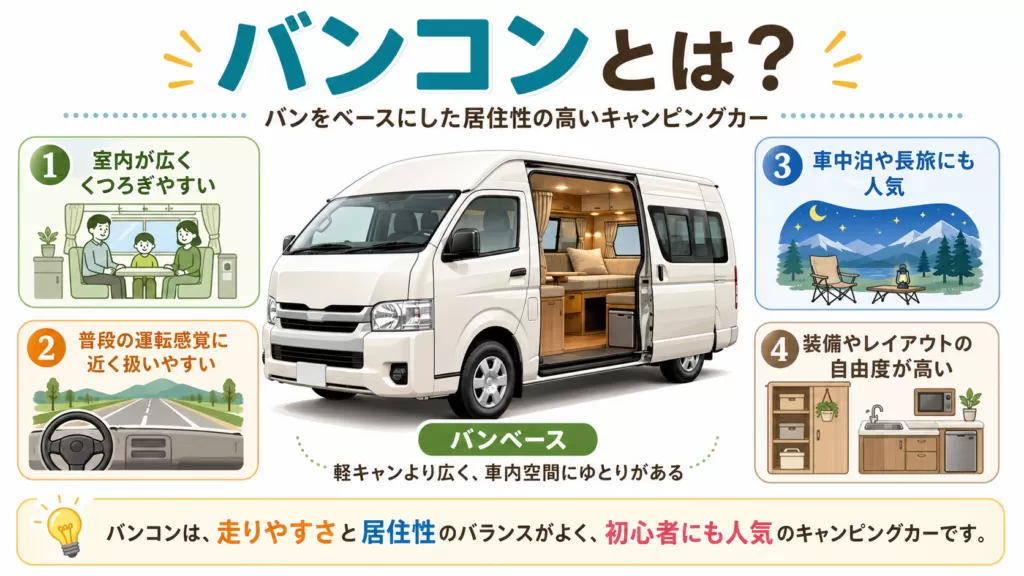
You’ve probably heard the term “van conversion,” but if you’re not quite sure how it differs from a cab-over or a kei campervan, you’re not alone.
A van conversion is a type of campervan built by converting the cargo area of a production commercial van — such as the HiAce or Caravan — into living and sleeping space. This article brings together everything in one place: the basics of van conversions, their pros and cons, representative models, and how they hold up on a Hokkaido road trip.
What Is a Van Conversion?
A van conversion is a campervan created by fitting out the rear cargo area of a one-box van — such as a HiAce or NV350 Caravan — as a space for living and sleeping.
Externally it looks close to an ordinary van, and would hardly stand out in traffic. The interior has been built out with a bed, storage, and space for sleeping, eating, and relaxing. Unlike the large silhouette or distinctive bodywork of a cab-over, a van conversion is also one of the most approachable options for first-time campervan users.
Basic Van Conversion Specifications
| Item | Typical Van Conversion Figures |
|---|---|
| Overall Length | 4.7–5.4m |
| Overall Height | 2.0–2.3m (up to 2.8m with pop-up roof raised) |
| Interior Height | 130–160cm (190cm+ with pop-up roof open) |
| Sleeping Capacity | 2–5 (with pop-up roof) |
| Licence Required | Standard licence (automatic permitted) |
| Fuel Economy | 8–10km/L |
| New Price | ¥3–8 million |
| Rental Rate (estimate) | ¥15,000–28,000/day |
HiAce or Caravan: Which Is More Common?
Two models dominate Japan’s van conversion market.
Toyota HiAce
The Toyota HiAce (200-series) is the most widely used base vehicle for van conversions. The long and super-long body variants — 4.7–5.4m overall, 135–140cm interior height — are used for campervan conversions. With many conversion specialists competing, equipment options are varied. Well-known converted models include the “Amity” (Toy Factory) and “Hermit” (Vantech). Many Hokkaido rental companies offer HiAce-based van conversions as their main product line.
Nissan NV350 Caravan
The Nissan NV350 Caravan is the other main base vehicle for van conversions. Its 5.2m long body has a slightly higher ceiling than the HiAce, giving a slightly more open feel inside. Fewer conversion models exist compared to the HiAce, but distinctive designs such as the “Vamos” and “Heartland Grand Home” are available.
HiAce Body Types: Super Long vs. Wide Middle
Super Long is the classic van conversion. Many models are built on the HiAce Super Long High Roof (5.38 m long × 2.28 m tall) with the rear fitted out as permanent bunk beds or a dinette. Most sleep 2–4 people and come standard with an FF heater (a combustion heater that runs with the engine off), so they handle the cold snaps of Hokkaido’s spring and autumn.
Wide Middle is 4.84 m long — 50 cm shorter than the Super Long — and handles like a minivan. Realistically it sleeps two adults plus one child. It’s often chosen by couples or less confident drivers as their first campervan, and pairs well with itineraries that include a lot of city sightseeing.
Why Are Van Conversions So Popular?
① Standard Licence, Including Automatic-Only
Both the HiAce and Caravan can be driven on a standard licence, including automatic-only. Most models have a gross vehicle weight under 3.5t, so no medium or heavy vehicle licence is required. For anyone who has been put off campervan travel by licence concerns, van conversions are the most accessible starting point.
② Fits in Ordinary Car Parks
With the pop-up roof retracted, a van conversion at 2.0–2.3m tall can often fit in multi-storey car parks and underground shopping centre car parks with a 2.1m+ height limit. Cab-overs at 2.8–3.1m tall can’t get into many of these spaces — van conversions generally don’t have that problem. Greater freedom in tourist car parks is a significant benefit.
③ Better Fuel Economy Keeps Running Costs Down
Van conversions get around 8–10km/L in real-world driving, better than cab-overs (6–9km/L). On a long Hokkaido road trip, this gap adds up.
Estimated fuel cost for 200km/day:
- 9km/L at ¥170/L → approx. ¥3,800/day
- Over 7 days → approx. ¥26,000
Under the same conditions, a cab-over at 8km/L would cost around ¥30,000 — a difference of roughly ¥4,000 over a week.
④ Affordable Rental Rates
Looking at Hokkaido rental companies, van conversions are mostly in the ¥15,000–28,000/day range, lower than cab-overs (¥25,000–45,000). The gap over a week can be ¥20,000–120,000 — a meaningful saving for budget-conscious travellers.
⑤ Widest Availability at Rental Companies Nationwide
For people renting a campervan for the first time, the ability to book easily is a surprisingly important reassurance.
Things to Know Before You Get In
① Most Models Require Daily Setup
Most van conversions create sleeping space by converting the dinette (living area) flat. You’ll need to move seats and luggage each night. Unlike a cab-over where you can just arrive and sleep, the setup task can catch up with you in the later stages of a multi-night trip.
Models with a pop-up roof have a fixed upper bunk, which reduces the daily setup effort.
② Lower Interior Height
Interior height on van conversions is typically 130–160cm, so most adults cannot stand upright. Working in a bent-over posture can cause back strain over extended trips. With the pop-up roof raised, 190cm+ of headroom is available, but opening and closing takes a few minutes.
③ Many Models Don’t Have an FF Heater for Cold Weather
Whereas cab-overs usually come standard with a diesel-forced-circulation heater (FF heater), many van conversions don’t include one. Hokkaido nights can drop below 5°C in spring and autumn, so it’s worth checking the heating setup before renting.
④ Not Ideal for Larger Groups
Most van conversions sleep 2–4 people. For a family campervan trip with 5 or more, it’s worth considering a cab-over instead.
Van Conversion vs. Other Types
| Van Conversion | Cab-Over | Kei Campervan | |
|---|---|---|---|
| Sleeping Capacity | 2–4 | 4–8 | 1–2 |
| Interior Height | 130–160cm | 180–195cm (can stand) | 100–130cm |
| Fuel Economy | 8–10km/L | 6–9km/L | 10–13km/L |
| Parking Flexibility | High | Low (height restrictions) | Highest |
| Rental Rate | ¥15,000–28,000/day | ¥25,000–45,000/day | ¥10,000–22,000/day |
| FF Heater | Optional (standard on some) | Almost always standard | None to optional |
| Beginner-Friendly | ◎ | ○ | ◎ |
New Chitose Airport / Tokachi-Obihiro Airport
Rent the Cabcon “Cresson Journey”
Base yourself at New Chitose Airport and compare rates, vehicle types, and pickup locations all in one place.
See details at Moving Inn →Using a Van Conversion in Hokkaido
A van conversion is the most balanced option for groups of 2–4 on trips of 3–7 days.
It suits a free-ranging Hokkaido style: driving across the island and overnighting at RV parks and roadside stations. Easy access to tourist car parks and good manoeuvrability make it a great fit for those who like to change their route often.
For trips over a week or families of 4+, the living comfort of a cab-over starts to pull ahead. Choose based on your travel style and group size.
Hokkaido trips tend to involve long daily distances. It’s about 110 km from Shin-Chitose Airport to Furano, and about 260 km from Furano to Shiretoko — roughly 1.5 times the distances you’d cover on Honshu. An easy-to-drive van conversion suits these long drives well.
Tips for Driving in Hokkaido
Even in a van conversion, Hokkaido’s road conditions require some adjustment. First, animals darting onto the road: deer-related traffic accidents in Hokkaido reached 6,705 in 2025, a record for the ninth year in a row (Hokkaido Police), and rural roads around dawn and dusk are the most dangerous. Campervan repairs are expensive, so avoid driving after dark and aim to reach your overnight spot while it’s still light. Second, distances: Hokkaido’s general roads move fast, and rest breaks will push arrival times beyond what the sat-nav estimates. Keeping daily driving under 300 km keeps it comfortable. Third, refueling: late-night petrol stations are scarce in eastern and northern Hokkaido, and some towns have none open on Sundays. Refuel whenever the tank drops to half.
See our page summarising Hokkaido van conversion rental companies, rates, and reviews.
Is a Van Conversion Right for You?
| Suits You If… | May Not Suit You If… |
|---|---|
| Couple or small family of 2–4 | Large family or group of 5+ |
| 3–7 day Hokkaido trip | 10+ day extended trip (cab-over living comfort wins) |
| Trip that relies on tourist car parks | Winter, early spring, or autumn travel (cold without an FF heater) |
| First-time campervan user | Those who don’t want to set up the bed every night (cab-over with fixed bank bed is better) |
| Want to save on fuel and rental costs | Those who need full standing headroom |
New Chitose Airport / Tokachi-Obihiro Airport
Rent the Cabcon “Cresson Journey”
Base yourself at New Chitose Airport and compare rates, vehicle types, and pickup locations all in one place.
See details at Moving Inn →Frequently Asked Questions
Can I drive a van conversion on an automatic-only licence?
Yes, you can. HiAce and Caravan-based van conversions are predominantly automatic vehicles and present no problem for automatic-only licence holders. However, insurance and compensation terms may vary by age and driving history at some rental companies, so check when booking.
Do van conversions have a toilet?
Some rental companies offer a portable toilet as an option, but built-in flush toilets are rare in van conversions. Roadside stations and RV parks in Hokkaido often have 24-hour toilets, so inconvenience is limited within Hokkaido.
What is a pop-up roof on a van conversion?
A mechanism that raises the roof panel — hydraulically or manually — to create additional sleeping space and headroom. With the roof retracted, the van looks like a standard panel van. When raised, it provides an upper sleeping bunk and around 190cm of interior height. Popular among couples and families who need extra sleeping capacity.
Should I choose a van conversion or a cab-over?
It depends on group size and trip length. For 2–3 people on a trip of a week or less, a van conversion is easier to use. For 4 or more people, or trips over a week, the living space and equipment of a cab-over comes into its own. If you’re unsure, Hokkaido rental companies can advise based on your itinerary.
How much does a week-long Hokkaido van conversion trip cost?
Combined rental, fuel, and accommodation costs (RV parks and roadside stations) for two people typically run ¥150,000–250,000. For a detailed cost breakdown, see below.
Estimate the cost of a one-week Hokkaido campervan rental
Summary
Key points about van conversions:
- Built on the HiAce or NV350 Caravan — the most widely distributed campervan type in Japan
- Standard licence (automatic permitted), fits standard car parks, fuel economy 8–10km/L — practical and versatile
- Rental rates ¥15,000–28,000/day — more affordable than cab-overs
- Most balanced for groups of 2–4 on 3–7 day Hokkaido trips
- FF heater and fixed bed availability vary by model — check before renting
If you’d like to compare all campervan types, this overview may help.
For a summary of Hokkaido rental companies, rates, and reviews:
Book a Campervan in Hokkaido
Moving Inn New Chitose Airport supports English booking and offers airport transfers.

![When and Where Can You See Harbor Seals at Cape Erimo? Kaze no Yakata Official Information, Viewing Season, and Windy-Day Notes [2026-27]](https://hokkaido-campingcar.jp/wp-content/uploads/2026/10/erimo-cape-lighthouse-768x511.jpg.webp)
![Where and Under What Conditions Can You See Diamond Dust in Hokkaido? How Cold a Morning It Takes, and Where It Appears [2026-27]](https://hokkaido-campingcar.jp/wp-content/uploads/2026/10/hokkaido-diamond-dust-nayoro-768x512.jpg.webp)
![Can You Drive to Hokkaido Jingu for Hatsumode? Parking, Crowds, and Where to Park and Walk [2027]](https://hokkaido-campingcar.jp/wp-content/uploads/2026/10/hokkaido-jingu-winter-torii-768x504.jpg.webp)
![Hokkaido Roads Over New Year [2026-27] | Expressway Sections Prone to Blizzard Closures, Forecast Congestion Days, No Holiday Discount, and New Chitose Airport Parking](https://hokkaido-campingcar.jp/wp-content/uploads/2026/10/hokkaido-winter-rural-road-edge-markers-768x432.jpg.webp)
![Where to See Sea Smoke (Kearashi) in Hokkaido: Rumoi’s Ogon-misaki and the Morning Conditions [2026-27]](https://hokkaido-campingcar.jp/wp-content/uploads/2026/10/rumoi-kearashi-sea-smoke-768x511.jpg.webp)
![Geminid Meteor Shower 2026 in Hokkaido: Peak Around 23:00 on December 14, Sapporo Moonset 20:40, and Staying Warm in a Winter Campervan [2026]](https://hokkaido-campingcar.jp/wp-content/uploads/2026/10/geminids-2026-hokkaido-768x575.jpg.webp)