Car Camping Guide
Updated: 2026-10-09
11
This page brings together what you need to know before sleeping in a campervan or car in Hokkaido: where you can stay overnight, the rules at Michi-no-Eki roadside stations, where to find water, toilets, baths and power, and what to watch for by season and for safety. Each section keeps to the essentials and links to our full guides, which are based on official sources. The list of articles in this category is at the bottom of the page.
Four things to know first
- RV parks and auto campsites are places to stay overnight. Michi-no-Eki and expressway service and parking areas (SA/PA) are places to rest.
- We have not found a free RV park in Hokkaido. The cheapest charge around ¥1,000 a night for a pitch without power.
- In winter, never sleep with the engine running. Leave heating to something that works with the engine off, such as an FF heater.
- Plan no more than 200 km and 9 hours of driving a day. If the next place to stay is farther, split the day.
On this page: Types of places / Michi-no-Eki rules and manners / Water, toilets, baths and power / Seasons / Safety / By area / Before you leave / FAQ / Articles
Where can I sleep tonight? Types of places and how to choose
Start by separating places built for staying overnight from places meant for resting. Prices, facilities and rules all depend on which one you are at.
| Place | Can you stay overnight? | Typical price | Power, toilets, trash |
|---|---|---|---|
| RV park | Built for overnight stays | From around ¥1,000 a night; ¥2,500 is the most common price | Power available (some offer cheaper pitches without power). 24-hour toilets and trash disposal are certification requirements |
| Auto campsite | Built for overnight stays | Varies by site | Power depends on the pitch. Sort trash by the site’s rules |
| Michi-no-Eki (roadside station) | A nap while driving is fine; staying the night is something the government asks you to refrain from | Parking is free | Generally no power (a few stations have paid power hookups). Take your trash with you |
| Expressway SA/PA | Use them as rest stops only | Parking is free | Hokkaido has only 4 SAs. Bins are for facility users |
| Convenience store parking | Private property. Even a nap is up to the store | — | Only trash from items bought at that store |
If you want power, a place for your trash, or several nights in one spot, choose an RV park. If you want to cook outside or pitch a tent, choose an auto campsite. Think of Michi-no-Eki and PAs as places to rest when you get sleepy.
The quickest way to find a place is to start from a list.
- Hokkaido RV park list: 77 places, including RV parks and Yu-YOU Parks, filterable by power, 24-hour toilets and winter opening (checked 2026-09-18)
- The 10 cheapest RV parks in Hokkaido (in Japanese): none of the 45–46 certified parks we could check were free (checked 2026-09-15)
- 72 campgrounds and auto campsites in Hokkaido: sort by power, campervan access and distance from the airport (checked 2026-09-02)
- 20 Michi-no-Eki for a night’s rest: stations compared by 24-hour toilets and nearby hot springs
- What is an RV park?: the 8 certification requirements and how a stay works from booking to departure
Can I sleep at a Michi-no-Eki? Rules and manners
Japan’s Ministry of Land, Infrastructure, Transport and Tourism says a nap at a Michi-no-Eki while you are driving is fine, but it “basically asks people to refrain from” staying overnight in the parking lot (Road Consultation page, in Japanese, checked 2026-08-19). It is a request, not a ban.
We checked the official websites of 96 of Hokkaido’s 128 Michi-no-Eki. None of them says car camping is banned. One asks visitors to refrain from staying overnight, and four point to paid facilities for overnight stays (checked August 2026). Station-by-station results are in our Hokkaido Michi-no-Eki car-camping ban list.
Some stations put up signs on site even when their website says nothing. When you arrive, read the signs first.
Wherever you sleep, these five things cause the most trouble:
- Keeping the engine running (the noise and exhaust bother others, and in winter it can kill)
- Running a generator
- Putting tables or chairs outside, or cooking in the parking lot
- Dumping your travel trash in the bins of facilities or shops
- Parking across two spaces, or staying in the same spot for days
For the reasons behind each, see Michi-no-Eki manners. For how to store and get rid of trash, see Trash on a campervan trip.
No law in Japan punishes sleeping in a car. What matters is where you park and for how long. Spending the night on a public road can break the Garage Act, which bans parking in the same spot on a road for 8 hours or more at night (Is it legal to sleep in your car in Japan?).
Convenience store parking lots are private property, so even for a short nap, move on right away if staff ask you to (Convenience store parking manners). Rest stops on Hokkaido’s expressways are far apart, so decide where you will stop with our Hokkaido expressway SA/PA guide before you set off.
Where do I get water, toilets, baths and power?
A dump station is where you empty your campervan’s waste water and refill fresh water. In our list of 53 RV parks, Michi-no-Eki and campsites in Hokkaido, we confirmed a dump station at 16 and fresh water at 41 (Hokkaido dump stations and water points, checked 2026-07-31).
For how the tanks work, see our campervan water system guide; for emptying the toilet, see Campervan toilets.
For a bath, stopping at a day-use hot spring (onsen) is the usual way. Hot springs that suit car campers are in our Hokkaido hot spring guide, and a regional list with opening hours and prices is in 25 day-use hot springs by region.
For power, use the external hookup (AC 100V) at RV parks and auto campsites. Read How to use external power before you go so you know the plug type and the order to connect.
What changes with the seasons? Winter, summer and rain
In winter, sleep with the engine off
The most important rule in winter is never to sleep with the engine running. In a JAF test in Asahikawa, Hokkaido, a car buried in snow with its engine running reached 400 ppm of carbon monoxide inside in 16 minutes (JAF user test, in Japanese, conducted 2015-02-16).
Carbon monoxide has no color or smell, so you will not notice it in your sleep. Leave heating to an FF heater, which runs with the engine off.
More places close in winter, too. Of 61 RV parks and similar sites, 38 officially say they are open year-round and 18 close for the winter (Hokkaido RV park list). Only 5 of 72 campgrounds stay open in winter (Campgrounds open in winter, in Japanese, checked 2026-09-15).
Before you set off, also read Where to park and sleep in winter and Hokkaido roads closed in winter, which covers the mountain passes.
In summer, insects and heat
Hokkaido summers bring biting blackflies (buyo) as well as mosquitoes. If you sleep with the windows open, having screens makes a big difference to your night (Keeping insects out of your campervan). If you want air conditioning while you sleep, choose a vehicle with an air conditioner in the living area and stay where there is external power (Campervan air conditioning).
On rainy days, condensation and ventilation
On rainy nights the windows fog up easily, and if you leave it, your bedding can get damp. How to ventilate and how to spend the time inside are covered in Car camping in the rain.
Decide these before you go: bears, driving time and weather
Be especially careful about brown bears in autumn. The Hokkaido Government sets an autumn brown bear alert period every year; in fiscal 2026 it runs from September 1 to October 31 (Hokkaido Government, in Japanese, checked 2026-10-07). Keep food and trash inside the vehicle and never leave them outside overnight (Autumn bear safety).
Plan no more than 200 km and 9 hours of driving a day. This is the limit this site uses when planning routes, and even 200 km makes a long day once you add sightseeing and breaks. If the next place to stay is too far, split the day (How long does a Hokkaido loop take?).
Check the weather and roads the day before and on the morning you leave. Forecasts and warnings are on the Japan Meteorological Agency site, and road closures are on the ministry’s Road Information System and Kita-no-Michi Navi (both in Japanese). How to get through rain, strong wind, dense fog and heavy snow is in our bad-weather guide.
Where can I stay near my destination? Articles by area
These articles check, town by town, where you can stay overnight, using official information. If you already know where you are going, start here.
| Area | Article and what you will find |
|---|---|
| Sapporo | RV parks in Sapporo: only 3 RV parks in the city; prices, hot springs and booking |
| Otaru | RV parks near Otaru: no certified RV park in the city; the nearest is a single pitch in Akaigawa |
| Lake Toya | Where to sleep at Lake Toya: 3 lakeside campsites, 3 nearby RV parks and a year-round Yu-YOU Park |
| Noboribetsu | Noboribetsu Onsen by campervan: Jigokudani, day-use hot springs and where to stay |
| Tomakomai | Tomakomai’s only RV park: Itoi no Mori, plus 4 nearby options when it is full |
| Hakodate and southern Hokkaido | Hakodate and southern Hokkaido: RV parks and Michi-no-Eki in the south / Michi-no-Eki in Kikonai, Matsumae and Esashi: what 6 stations say officially, and 24-hour toilets |
| Obihiro and Tokachi | RV parks around Obihiro: none in the city, 4 certified parks in Tokachi / Obihiro and Tokachi in winter: how many minutes from Tokachi-Obihiro Airport |
| Kushiro and Nemuro | RV parks in Kushiro and Nemuro: 4 certified parks, and whether you can stay at the Michi-no-Eki |
| Shiretoko and Shari | Michi-no-Eki Shari and Utoro Shirietoku: what official sources say, and where to stay in Shiretoko and Shari |
| Northern Hokkaido | RV parks in northern Hokkaido: only 2, in Nayoro and Wassamu; 1 usable in winter |
| Wakkanai | RV parks near Wakkanai: no certified park in the Soya region; places open in winter |
| Ski areas (winter) | Sleeping near 6 major ski resorts (in Japanese): winter opening at 9 RV parks and similar sites |
What should I prepare before I leave?
Our campervan packing list covers what to bring. For a list split into essentials and useful extras, use the Hokkaido packing checklist. Before you go, make sure of these:
- Decide where you will stay first, and book RV parks and campsites
- Check your licence: licences from places such as South Korea, Hong Kong, Australia and the US are used with a 1949 Geneva Convention international driving permit, licences from Taiwan need the original plus a Japanese translation instead, and licences from mainland China cannot be used in Japan (Driving on a foreign licence, by country)
- In winter, ask before booking whether the vehicle has an FF heater and whether it works with the engine off (Sleeping warm in a winter campervan)
- In summer, bring window screens and insect repellent
- Pack plenty of odor-proof trash bags
- Fill up before you get on the expressway (Hokkaido’s expressways have few places to refuel)
- Check the weather and road closures the day before and on the morning you leave
If you have not chosen a vehicle yet, see Choosing a vehicle for overnight stays. If you are renting in winter, check Rental companies open in winter first.
Frequently asked questions (FAQ)
Can I sleep overnight at a Michi-no-Eki in Hokkaido?
A nap while driving is fine, but Japan’s transport ministry “basically asks people to refrain from” staying overnight. None of the 96 station websites we checked says it is banned. To stay the night properly, choose an RV park or an auto campsite.
Are there free RV parks in Hokkaido?
None of the 45–46 certified RV parks in Hokkaido we could check were free. The cheapest offer pitches without power from around ¥1,000 a night.
Can I car camp in winter?
Yes, but there are fewer places. 38 RV parks and similar sites officially say they are open year-round, and 5 of 72 campgrounds stay open in winter. Sleeping with the engine running risks carbon monoxide poisoning, so choose a vehicle with an FF heater.
Where are the dump stations?
Most are inside RV parks. Our list of 53 places in Hokkaido confirmed a dump station at 16. What you can empty differs by place, so check with the facility before using it.
How far should I plan to drive each day?
This site uses 200 km and 9 hours a day as the upper limit. With sightseeing and breaks, even 200 km makes a long day. If the next place to stay is far, do not push on; split the day.
Can I drive in Japan with my own licence?
It depends on where your licence is from. Licences from places such as South Korea, Hong Kong, Australia and the US are used with a 1949 Geneva Convention international driving permit. Licences from Taiwan need the original plus a Japanese translation, and licences from mainland China cannot be used. Check your country in our guide before you book.
Compare Hokkaido Campervan Rentals
Base yourself at New Chitose Airport and compare rates, vehicle types, and pickup locations all in one place.
Compare Rental Companies and Rates →Renting a campervan in Hokkaido?
Moving Inn
Check vehicle types, rates, and availability on the official site.
See details at Moving Inn →Articles in this category
Newest first. Most of them cover RV parks town by town and places you can stay in winter.
-
2026.09.14
Which Hokkaido Ski Resorts Have Campervan Parking Nearby in Winter? Checking Winter Operation of 9 RV Parks and More at 6 Major Resorts [2026]
-
2026.09.14
Which RV Parks Near Obihiro-Tokachi Are Open in Winter, and How Far From the Airport?
-
2026.09.14
Where You Can Legally Park and Sleep in a Campervan in Hokkaido in Winter
-
2026.09.13
Northern Hokkaido Has Only 2 RV Parks, in Nayoro and Wassamu | Just 1 Usable in Winter, Plus 11 Michi-no-Eki and 11 Campgrounds Checked [2026 Edition]
-
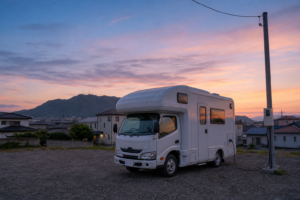
2026.09.12
RV Park HAKODATE SHOWA BASE Rates, Booking, and Facilities | ¥3,000 with Power, Phone Booking Only, No Running Water [2026 Edition]
-
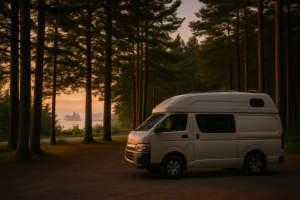
2026.08.13
Tomakomai’s Only RV Park: Itoi no Mori — Rates, Booking, and 4 Nearby Backups When It’s Full [2026]
-
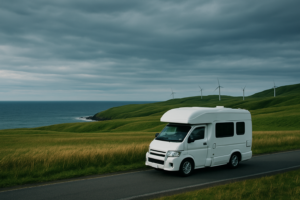
2026.08.13
Wakkanai RV Parks: Zero Certified in the Soya Region — Where You Can Actually Stay, Confirmed Officially [2026 Edition]
-
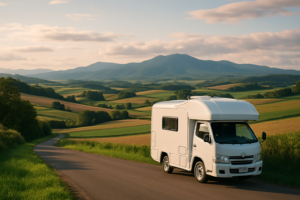
2026.08.12
Where Are Otaru’s RV Parks? Zero Certified Sites in the City — the Nearest Is a Single Space in Akaigawa Village [2026 Edition]
-
2026.08.12
Where Can You Sleep in Your Campervan at Lake Toya? 7 Places: 3 Lakeside Campgrounds, 3 RV Parks Nearby, 1 Open Year-Round [2026]
-
2026.08.11
Sapporo RV Parks: Only 3 in the City — Prices, Onsen & Booking Confirmed [2026]
-
2026.07.06
Hokkaido RV Parks: All 77 Overnight Sites, Including 47 JRVA-Certified RV Parks (2026)